You know about Tiffany and his lamps, and how the lamps are put together with copper foil? Well, before Tiffany came along and foiled everything, there was came. Here’s a little description of came. Came 101, if you will.
Came
(noun)
1. a slender, grooved bar of lead for holding together the pieces of glass in windows of latticework or stained glass.
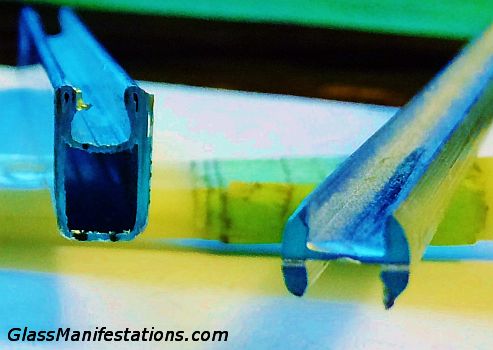
Close, Dictionary.com, but not quite. Came now comes not only in lead, but also in zinc, brass and copper. Maybe other metals, too. I’m not sure. But yes, came has grooves – or channels – that hold pieces of glass together. Or, as in the case of U-came, it can be used as a border to frame stained glass panels.

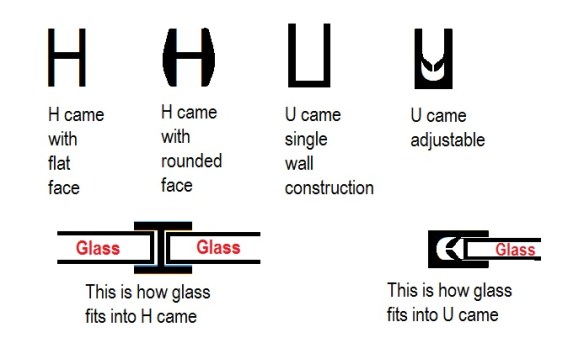
Came comes in an assortment of styles. There is H came that has two channels and thus looks like an H when viewed from the end. The exterior (face) surfaces can be either be flat or rounded.
U came has one groove and thus looks like a U when viewed from the end. Both H and U came come in varying sizes to allow for different thicknesses of glass, and for different face widths, depending on how you want your seams to appear, and on how much support your glass needs in the case of larger, heavier panels or windows.
Lead came can be cut with nippers, but more rigid material, like zinc, needs something stronger to cut it. I use a hack saw. The panel is soldered together at the joints where one length of came meets another.
Okay, that’s all I came here to explain. I hope U got what U came for.
 U is for U came.
 What Rhymes with Stanza?