Sometimes you’re the artist,
and sometimes you’re the canvas.

Tattoo by artist Jessica Helmke.
Participatory art? I think so.
 T is for Tattoo.
Sometimes you’re the artist,
and sometimes you’re the canvas.
Tattoo by artist Jessica Helmke.
Participatory art? I think so.
T is for Tattoo.

I’m going to make a hole in a window
You’re going to break a window?
Not break a window. Just put a hole in one.
So smash it, you mean.
Yes, it might look smashed.
What will you smash it with?
Does it matter what smashed it?
If you want to smash a hole in a window, you have to hit it with something.
What would you use, if you were to smash a window?
Me? I’d use a baseball. Maybe smack it hard with a bat. You could hit it from clear across a field and no one would know it was you.
People will know I smashed this window.
See, that’s why you use a baseball or something. Make it look like an accident.
So, an unfortunate baseball incident?
Exactly.
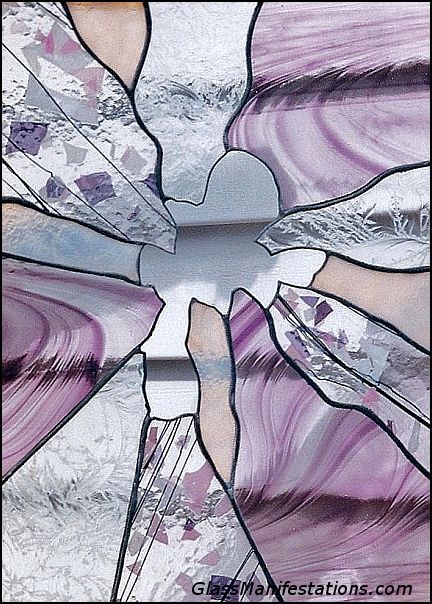
“The Unfortunate Baseball Incident”
 S is for Smashing.

I didn’t hedge my bet
that the hedge would stay,
but the leaves left
and I was left with
a whole new view
on my view.

Sometimes privacy can be a real pane.
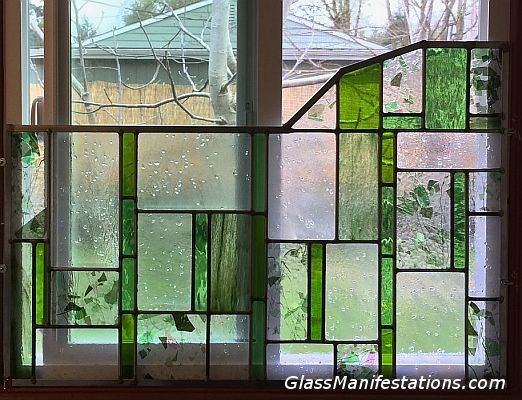
Stained glass privacy screen I recently made for my bathroom.
I raise my glass to glass.

 P is for Privacy.
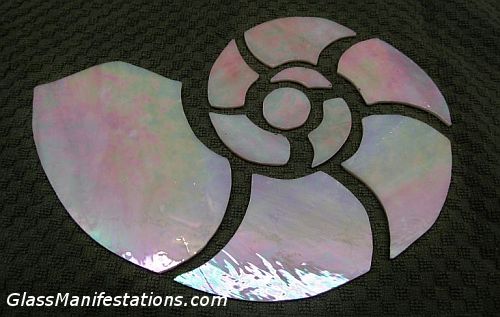
I mentioned last week that I featured a nautilus design in a stained glass panel I made for my granddaughter because of the shell’s meaning to me.
A [chambered] nautilus is a cephalopod of the genus Nautilus that has a spiral, chambered shell with pearly septa. Now doesn’t that sound totally inspiring? I mean… pearly septa! It just doesn’t get any better than that.
Okay… at my level of understanding: it’s a mollusk with a spiral shaped shell that consists of individually partitioned chambers. As the nautilus grows, it continues to enlarge its shell and create more partitions as it goes. Each chamber contains a gas that helps give the animal buoyancy.
When the nautilus inhales the gas from its chambers, its voice sounds really high, like Mickey Mouse’s. Nautiluses love to do this at parties, as it usually gets a pretty good laugh.
Okay, I made that last part up. Just the Mickey Mouse part. They really do have gas. And they don’t even eat beans.
But they are whizzes at math. See, the nautilus shell, with it’s spiral shape, is an example of the “golden ratio,” a mathematical ratio based on the number Phi. Phi (with upper case “p,” Greek letter Φ) represents the number 1.618… It’s reciprocal, phi (with lower case “p”, Greek letter φ), equals 0.618…

Approximation of the golden spiral (drawing in public domain).
Since math is all Greek to me anyway, I can’t really grasp the concept of Phi, but the ratio it represents can be seen in relationships all throughout the universe, in:
proportions of the human body, proportions of some animals, DNA, plants, music, art, geometry, the solar system, movements in the stock market, the designs of the Egyptian pyramids, raindrops on roses and whiskers on kittens (just testing to see if you’re paying attention)… and as noted, in the shape of the spiral of the nautilus shell.
Some may argue that the application of the golden ratio, in many instances, is based on arbitrary points of proportion that happen to match the equation. Kind of the idea that when all you have is a hammer, everything looks like a nail. If you set about looking for a particular pattern or ratio, you can find ways to fabricate – er, I mean discover – its appearance in almost anything.
So that’s the “golden spiral.” But, not to be outdone by the Greeks, the French (specifically French mathematician Rene Descartes) came up with the “marvelous spiral.” Something about logarithms and more math stuff.
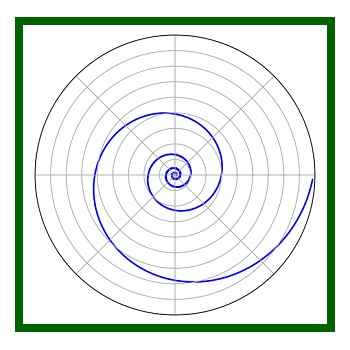
Logarithmic “marvelous” spiral (drawing in public domain).
As with the Golden ratio, the logarithmic (“marvelous”) spiral occurs in many forms in nature. Examples:
the shells of mollusks (i.e. the chambered nautilus shell); the approach of a hawk to its prey; the approach of an insect to a light source; the arms of spiral galaxies; the bands of tropical cyclones; patterns in sunflower heads; the nerves of the cornea…
I guess you could say it’s everywhere you look! (See what I did there? Cornea… everywhere you look… pretty funny, huh?)
So what is the significance of all of this?
To me it indicates that there is a strong interrelationship between virtually everything in nature (and the aesthetics of some things manmade); that there are forces bigger than we can imagine at work in the universe; and that on some level there is a grand design to everything.
A golden, marvelous design.
Note: This is a revision of a post I published on another blog I had going in a previous lifetime. Any plagiarism of myself has been done with my full knowledge and permission (to myself). I think.
 N is for Nautilus.
 Inertia: I want to make a stained glass panel for my soon-to-be-born grandbaby. But:
Inquisitiveness: What could I make that would be fairly simple, using materials I already have on hand, while challenging my perfectionism?

Idea: I have a sample box of multi-colored rectangles of glass. I have lead came. Straight lines are simple.

Inspiration: When I lay out the sample pieces, they remind me of a patchwork quilt. I could make my new grandbaby a “quilt.” That’s a grandmotherly gift, right?

Imagination: What if I added a symbol of some sort? Something meaningful to me that would make the “quilt” more personal… like… a nautilus! [You’ll have to wait for the “N” day to find out what makes the nautilus meaningful to me.]
Implementation: Get the lead out (literally), and go for it!

Insight:

Incredible!!!! ⇒ The way that I feel for having overcome the inertia, impediments and insecurity I felt before taking on this project!

Isla: The name of my first grandbaby.
 I is for Incredible.
 You look at these beautiful buttons of glass; a confectioner’s delight of colorful “candy.” And you ask, “What are these gorgeous pieces called?”
And I say, “Oh, those? Those are globs.”
Globs? Brings up visions of a lump of ice cream fallen to the sidewalk where the warm pavement turns it into a sticky – well… a sticky glob.
Or maybe a coagulation of gunked up motor oil stuck to the floor of a mechanic’s garage, dripped from an engine that was so filled with grime that the dark sludge came out in – you guessed it – globs.
But these beauties of glass? These irregular shapes and sizes were formed when molten glass was dropped in small amounts onto a flat surface and left to solidify. Flat on the bottom, rounded on top, and delightfully ready for incorporation into stained glass projects.
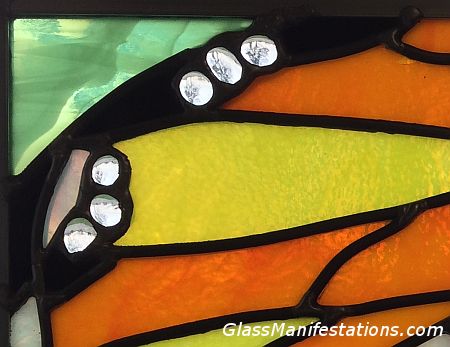
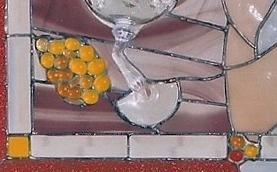
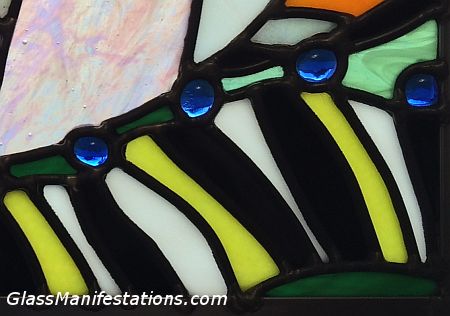
And, yes, they’re called globs.
Oh, by the way, if you don’t think that name quite suits them, I guess you could call them by their other name. They are also known as nuggets.

Feel better now? I know I do.
 G is for Glob.

In yesterday’s post, the definition of bevels included the mention of “geometric configurations (called ‘clusters’) for incorporation into leaded glass work.”
Ah, clusters…
The fun thing about clusters is that you have ready-made pieces that you simply fit together (with copper foil or some type of came, i.e. lead), and then fill in the rest of your pattern with pieces to accomplish the desired panel shape (rectangle, square, circle…).
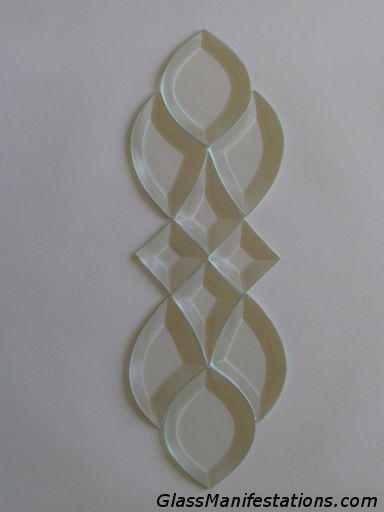
For example, I purchased a bevel cluster with ten bevels that – when pieced together – would look like this ornate design:
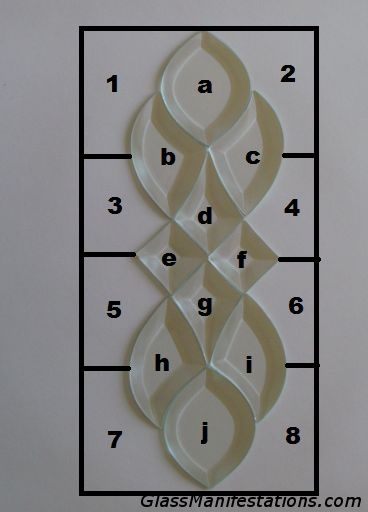
By cutting glass in the shapes of “1” through “8,” as pictured below, one could turn the design into a rectangular panel with the bevel cluster pieces (“a” through “j” in the diagram) centered within the rectangle. A simple example:
Something I like to do for fun is use the bevel pieces in a more unconventional way and incorporate them into panels to create entirely different patterns. In the example below I kind of “exploded” the bevel cluster and came up with this design:
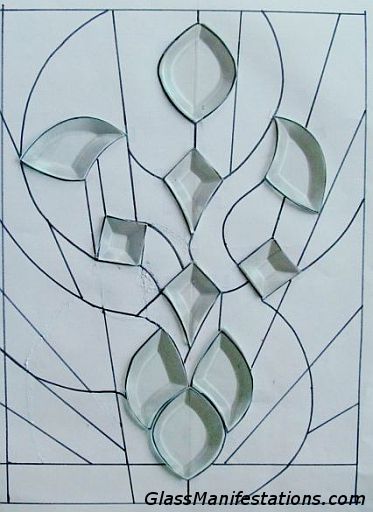
And here is the completed panel:

I need to work on my window photography.
I titled the panel “Ascending.”
The bevels used in the “Manifest” design that appears on the header of this blog is another example of using a cluster in an unconventional way. Can you guess what the design was originally intended to be?
 C is for Cluster.

One way to easily dress up a stained glass panel is to incorporate bevels into the design. While frequently used as borders, individual bevels can also be employed as standalone elements in the overall design of a window or panel.
A bevel, as defined at Glass Patterns Quarterly, is:
“cold glass (usually clear, thick plate) with edges that have been ground and polished to an angle other than 90 degrees. Transmitted light is refracted and a prism-like effect results. Bevels are available in a variety of sizes, shapes and geometric configurations (called ‘clusters’) for incorporation into leaded glass work.”
There was a time when I was downsizing from my three-bedroom home (with garage studio), and moving into a one-bedroom apartment (no garage). I couldn’t see any way that I could find room for a stained glass work area. So I started selling/giving away/using up many of my supplies.
I had a box of triangle-shaped clear bevels that I had purchased with no particular project in mind. I probably got them in some kind of deal, like the “spend just $100 more and get free shipping on your order” offers. Who can pass those up, right?
I decided to make a window based simply around triangle bevels. This is what I came up with:

I’m back in a three-bedroom home (two bedrooms and one studio, actually), and glass supplies seem to be slowly accumulating again. I now have a box of ¾ inch by 4 inch rectangular bevels that I bought for no particular purpose (going-out-of-business sale… Hello!). They will no doubt start trickling into future designs.
In the meantime, I can always hang them in my windows and, just like Pollyanna, use them as prisms to create rainbows.
“Just as if anybody’d care when they were living all the time in a rainbow!”
~ Pollyanna, by Eleanor H. Porter
 B is for Bevel.
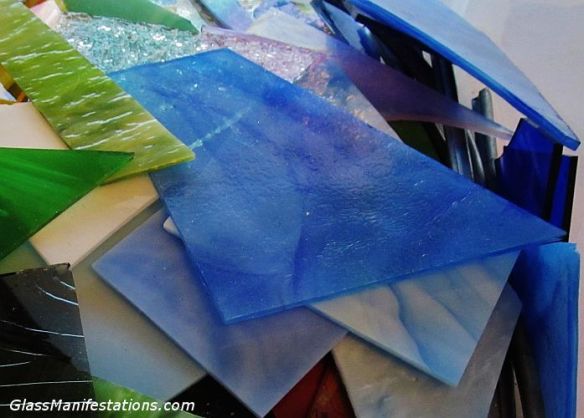
We’re up to Day 16 of the Blogging U’s Photo 101 course. The subject today is “treasure.” The instructions given in this lesson tell us that “any object or experience that is deeply meaningful can be a treasure. Items, places, people — we all cherish something, or someone.”
No surprise here: one of the things I greatly treasure in my life is having the space, time, and capability to follow my love of working with stained glass.
The photo I took for this lesson shows the partial contents of a drawer containing scraps of glass left over from previous projects; scraps that are just waiting to become part of some new project sometime down the road.
My family used to put together jigsaw puzzles occasionally, and it was considered “cheating” to look at the picture on the box cover to figure out placement of the different components of the image. It was more of a challenge to figure it all out without knowing exactly what the finished puzzle would look like.
With my glass scraps, the “picture on the box” may not even exist yet, and yet the puzzle pieces do. Sometimes a small glass scrap may be just what I need to fit into a particular design I’ve drawn up, but sometimes my design evolves from the particular scraps on hand.
So maybe what I treasure most is the creative process and the potential of the raw materials. I wonder… is it cheating to make the puzzle fit your pieces instead of having the pieces fit the puzzle?
Photo 101, Day Sixteen: Treasure + Close-up
The theme for this week’s Daily Post photo challenge is “Life Imitates Art.”
When I created the “Canid” panel (pictured below), I had a fox in mind. Some folks commented that it looked like my American Eskimo dog, except for the coloring of course.
I’ve been thinking about tweaking the design to make a similar panel to represent my Eskie. Might have to add that to the queue of projects.
In the meantime, enjoy my entry for the “life imitates art” challenge:
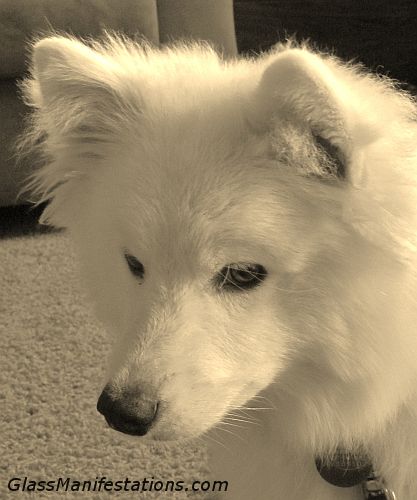
Chules, my America Eskimo dog

“Canid” stained glass panel by Maggie C.
 What Rhymes with Stanza?