A Glob by Any Other Name. Please.

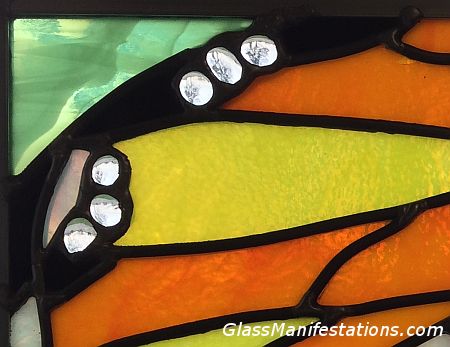
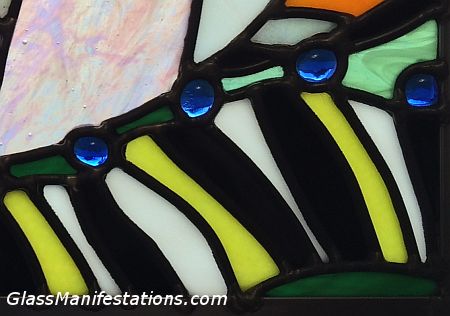
g4You look at these beautiful buttons of glass; a confectioner’s delight of colorful “candy.” And you ask, “What are these gorgeous pieces called?”

And I say, “Oh, those? Those are globs.”

Globs? Brings up visions of a lump of ice cream fallen to the sidewalk where the warm pavement turns it into a sticky – well… a sticky glob.

Or maybe a coagulation of gunked up motor oil stuck to the floor of a mechanic’s garage, dripped from an engine that was so filled with grime that the dark sludge came out in – you guessed it – globs.

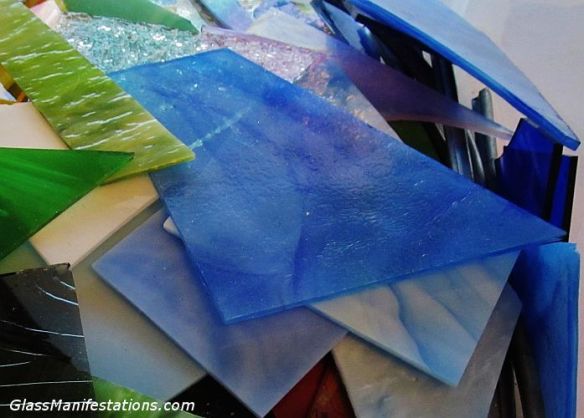
But these beauties of glass? These irregular shapes and sizes were formed when molten glass was dropped in small amounts onto a flat surface and left to solidify. Flat on the bottom, rounded on top, and delightfully ready for incorporation into stained glass projects.

g2

g1

g3

And, yes, they’re called globs.

Oh, by the way, if you don’t think that name quite suits them, I guess you could call them by their other name. They are also known as nuggets.

g5

Feel better now? I know I do.


G  G is for Glob.

Experimenting in the 90s

experiment g

NOTE: Stained glass photos in this post are from scans of  3×5 inch prints taken a loooong time ago by a not very apt photographer (me). I apologize for the quality (or lack thereof) and small size of the detail photos.

You all remember 1998, don’t you? You could buy a dozen eggs in the USA for 88 cents. President Bill Clinton was impeached for lying about… well, everything. Quebec sought independence from Canada. The Wedding Singer was playing at movie theaters, and Spice Girls were playing everywhere else.

Okay, I don’t remember 1998 either, but I think that was around about the time that I bought my glass kiln. It was a manual model, as opposed to a programmable model. The difference being that mine had one dial that went from “1” to “10” to denote how hot you wanted the interior of your kiln to be, and a gauge that showed how hot the interior actually was. Kind of. Ballpark. Your guess was as good as the gauge’s.

Programmable kilns require a degree in computer technology (or a savvy teenager) to operate. They can be set to heat up when you want them to, stay at that temperature for however long you want, ramp up or down to whatever temp you want next… and continue doing so for however many changes your kiln allows you to preset (which is determined by how much money you shelled out for said kiln).

Needless to say, a manual kiln required a lot of experimentation, copious note-taking and additional experimentation to get the results one wants when fusing or slumping glass. Since I’m too impatient to do all of that – and since that seemed boring as all get out – I opted to just experiment to see what the kiln would produce after my wild guesses about how and when to adjust (remember that little 1 to 10 dial I mentioned?) the temperature.

Here are some of my early experiments:

In the 90s, it was really cool to melt a bottle to flatten it, drill a small, angled hole in one end, and turn it into a stick incense holder. I just stopped at the flattened bottle stage.

experiment b

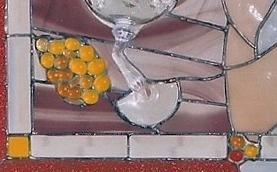
Then, I had a chipped wine glass that was headed for the garbage. I “repurposed” it, chucking it into the kiln to see what would happen. I was thrilled with this result.

experiment c

This next one was quite brilliant! Unfortunately the photo doesn’t show the results well at all (we took photos with cameras back then, not our phones; my phone cord wouldn’t have extended all the way to the kiln, anyway).

I cut a circular piece of textured glass (hence the grid pattern). Then I placed little rocks in the kiln and laid the glass on top of the rocks. The notion was that the glass would melt around the rocks and form a really cool, totally random, bumpy shape.

How was I to know that the rocks I had gathered from the beach still contained moisture inside and would explode once they were heated to umpteen degrees? That session was cut short once the rock shrapnel began pummeling the inside lining of my kiln.

experiment a

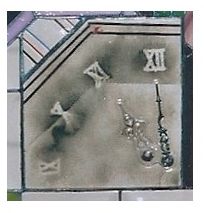
Next, I experimented with sandwiching various things between two pieces of clear glass and fusing them together. Here, I used a couple of metal clock hands. I made the Roman numeral shapes by placing the plastic pieces that came with the clock kit on the glass and sprinkling black fine frit over them. (Fine frit is colored glass that has been ground into powder.) I was smart enough to remove the plastic numbers before preparing the piece for  the kiln (rack one up for the experimenter!).

As I was moving this clock “sandwich” to the kiln, the layers slipped, thus making the shadow line in the frit that mirrors the shape of the glass corner. That “accident” just made it more interesting, so into the kiln it went! I thought this one turned out rather well. Much better than the exploding rock episode.
experiment d

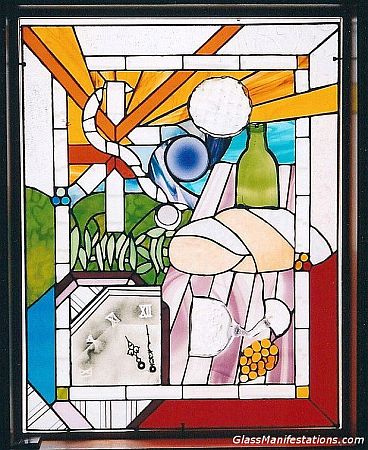
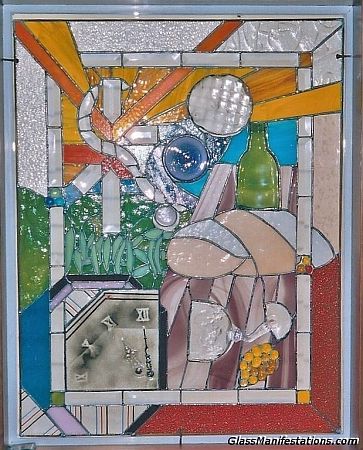
I ultimately soldered my experiment “results” into this panel:
experiment e

Window with no back lighting.

experiment f

Window backlit by sunlight.

I sold my kiln when I downsized my living space. Probably just as well; who knows what I might have tried next? Will I ever buy another? I doubt it. The programming seems too daunting.

Besides, I’m still learning how to take photos with my cell phone.


E E is for Experiment

Clusters: All Together, Now

cluster example 5
In yesterday’s post, the definition of bevels included the mention of “geometric configurations (called ‘clusters’) for incorporation into leaded glass work.”

Ah, clusters…

The fun thing about clusters is that you have ready-made pieces that you simply fit together (with copper foil or some type of came, i.e. lead), and then fill in the rest of your pattern with pieces to accomplish the desired panel shape (rectangle, square, circle…).

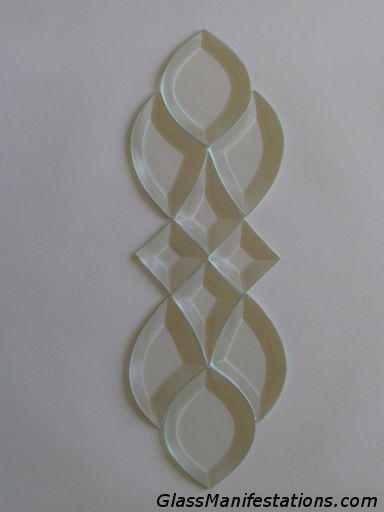
For example, I purchased a bevel cluster with ten bevels that – when pieced together – would look like this ornate design:

cluster example 1

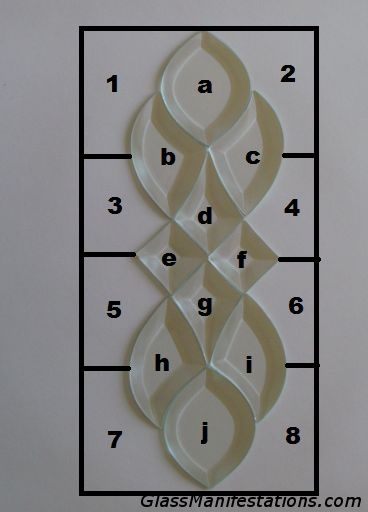
By cutting glass in the shapes of “1” through “8,” as pictured below, one could turn the design into a rectangular panel with the bevel cluster pieces (“a” through “j” in the diagram) centered within the rectangle. A simple example:

cluster example 2

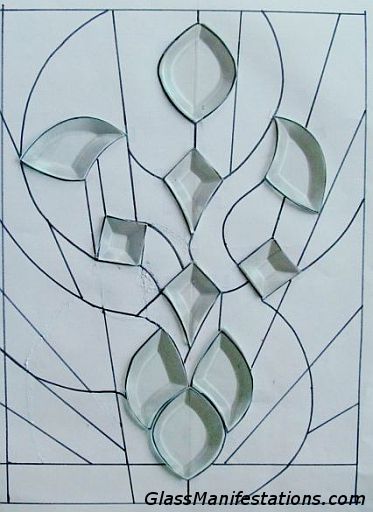
Something I like to do for fun is use the bevel pieces in a more unconventional way and incorporate them into panels to create entirely different patterns. In the example below I kind of “exploded” the bevel cluster and came up with this design:

cluster example 3

And here is the completed panel:

cluster example 4

I need to work on my window photography.

I titled the panel “Ascending.”

The bevels used in the “Manifest” design that appears on the header of this blog is another example of using a cluster in an unconventional way. Can you guess what the design was originally intended to be?


C  C is for Cluster.

The Bevel You Say!

Bevel
One way to easily dress up a stained glass panel is to incorporate bevels into the design. While frequently used as borders, individual bevels can also be employed as standalone elements in the overall design of a window or panel.

A bevel, as defined at Glass Patterns Quarterly, is:

“cold glass (usually clear, thick plate) with edges that have been ground and polished to an angle other than 90 degrees. Transmitted light is refracted and a prism-like effect results. Bevels are available in a variety of sizes, shapes and geometric configurations (called ‘clusters’) for incorporation into leaded glass work.”

There was a time when I was downsizing from my three-bedroom home (with garage studio), and moving into a one-bedroom apartment (no garage). I couldn’t see any way that I could find room for a stained glass work area. So I started selling/giving away/using up many of my supplies.

I had a box of triangle-shaped clear bevels that I had purchased with no particular project in mind. I probably got them in some kind of deal, like the “spend just $100 more and get free shipping on your order” offers. Who can pass those up, right?

I decided to make a window based simply around triangle bevels. This is what I came up with:

bevel2

I’m back in a three-bedroom home (two bedrooms and one studio, actually), and glass supplies seem to be slowly accumulating again. I now have a box of ¾ inch by 4 inch rectangular bevels that I bought for no particular purpose (going-out-of-business sale… Hello!). They will no doubt start trickling into future designs.

In the meantime, I can always hang them in my windows and, just like Pollyanna, use them as prisms to create rainbows.

“Just as if anybody’d care when they were living all the time in a rainbow!”
~ Pollyanna, by Eleanor H. Porter


B  B is for Bevel.

Behind the Scene(ry)

scene

I was talking with a friend about finding good scenes to photograph, and she shared something she had learned while on her photo hikes. She learned to always look behind her.

Not that she’s paranoid; although I suppose it is a good safety tip. But her point was that, while focusing on what we thought to be the best subject matter, the best angle, the best lighting for our intended photo, we might be missing out on something even more wonderful or intriguing right behind us.

This advice helps me to be more aware when I’m out and about with my camera. Sometimes I’ve gotten great shots that way. And sometimes, like with the photo above, well… not so much. Perhaps there’s a reason the bench in the photo is pointed in the opposite direction.

The lesson for me – which extends to life well beyond my artistic endeavors:

Try not to be so intent on what you’re looking for that you don’t notice what you see.

♦♦♦♦♦

Those stacks of lumber, though… they do have a certain je ne sais quoi about them, no?


The Daily Post weekly photo challenge: Landscape

Treasure Trove

IMG_0095

We’re up to Day 16 of the Blogging U’s Photo 101 course. The subject today is “treasure.” The instructions given in this lesson tell us that “any object or experience that is deeply meaningful can be a treasure. Items, places, people — we all cherish something, or someone.”

No surprise here: one of the things I greatly treasure in my life is having the space, time, and capability to follow my love of working with stained glass.

The photo I took for this lesson shows the partial contents of a drawer containing scraps of glass left over from previous projects; scraps that are just waiting to become part of some new project sometime down the road.

My family used to put together jigsaw puzzles occasionally, and it was considered “cheating” to look at the picture on the box cover to figure out placement of the different components of the image. It was more of a challenge to figure it all out without knowing exactly what the finished puzzle would look like.

With my glass scraps, the “picture on the box” may not even exist yet, and yet the puzzle pieces do. Sometimes a small glass scrap may be just what I need to fit into a particular design I’ve drawn up, but sometimes my design evolves from the particular scraps on hand.

So maybe what I treasure most is the creative process and the potential of the raw materials. I wonder… is it cheating to make the puzzle fit your pieces instead of having the pieces fit the puzzle?


Photo 101, Day Sixteen: Treasure + Close-up

Play Time

home

This is Day One of the WordPress Blogging U’s course Photography 101. Okay, I’ve taken the class twice before, but what can I say? It’s fun!

Today’s assignment is to share an image showing, “What does ‘home’ mean to you?” And of course, my first thought for a meaningful photo was: My bathroom! Well, more specifically, the new backsplash I made for the sink.

I happen to have a bit of opaque stained glass laying around (okay, maybe a lot of it), which I rarely use these days as I am mostly working with translucent or transparent glass for panels meant to be displayed in windows. I decided to try making opaque glass tiles to add a “splash” of color to the bathroom. The photo above shows the results.

My home is nothing fancy, was built over 60 years ago, and for me it is a perfect place to try out new skills on whatever “improvements” I want to attempt. It’s my life-sized “arts and crafts” project, you might say. My personal playground for pretending to be a plumber or a carpenter, or sometimes a purple unicorn. Don’t judge.

So what’s in the works for my next home project? I don’t know yet. I’ll have to see what’s in my toy box. Uh, I mean my tool box.

Dog Imitates Art

The theme for this week’s Daily Post photo challenge is “Life Imitates Art.”

When I created the “Canid” panel (pictured below), I had a fox in mind. Some folks commented that it looked like my American Eskimo dog, except for the coloring of course.

I’ve been thinking about tweaking the design to make a similar panel to represent my Eskie. Might have to add that to the queue of projects.

In the meantime, enjoy my entry for the “life imitates art” challenge:

art1

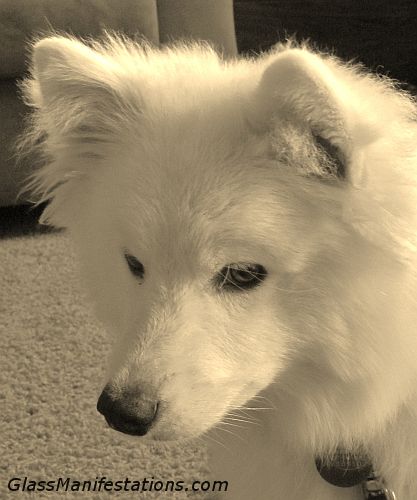
Chules, my America Eskimo dog

art2

“Canid” stained glass panel by Maggie C.