
Alternative Facts
Image
3
Unity ~~
harmonic voices
sing as one to the beat of
hearts aligned in love
The Daily Post Discover Challenge: The Greatest _______ in the World

George Washington, 1st US president
@realGeorgeWashington
“If the freedom of speech is taken away then dumb and silent we may be led, like sheep to the slaughter.” #FreedomTrumpsSheep
Abraham Lincoln, 16th US president
@HonestAbe
“Don’t interfere with anything in the Constitution. That must be maintained, for it is the only safeguard of our liberties.” #UGottaReadIt
Theodore Roosevelt, 26th US president
@TeddyR
“To announce that there must be no criticism of the president… is morally treasonable to the American public.” #SNL #MerylStreep
Franklin Delano Roosevelt, 32nd US president
@FDR
“Great minds discuss ideas; average minds discuss events; small minds discuss people.” #EleanorActuallySaidThat #FLOTUS_Rocks
Calvin Coolidge, 30th US president
@SilentCal
“The government of the United States is a device for maintaining in perpetuity the rights of the people, with the ultimate extinction of…”Calvin Coolidge, 30th US president
@SilentCal
“all privileged classes.” #HashtagsAreSilly
Dwight D Eisenhower, 34th US president
@Ike
“In most communities it is illegal to cry ‘fire’ in a crowded assembly. Should it not be considered serious international misconduct to…”Dwight D Eisenhower, 34th US president
@Ike
“manufacture a general war scare in an effort to achieve local political aims?”
#thebuckstopshere #bargainingchips
Harry S Truman, 33rd US president
@GiveEmHellHarry
“It is amazing what you can accomplish if you do not care who gets the credit.” #YouCanQuoteMe #ButGiveMetheCredit
James Madison, 4th US president
@DollysHusband
“Liberty may be endangered by the abuse of liberty, but also by the abuse of power.” #WhatsAHashtagAnyway
Warren G. Harding, 29th US president
@WobblyWarren
“America’s present need is not heroics but healing; not nostrums but normalcy; not revolution but restoration.” #IHateMyNickname
William Howard Taft, 27th US president
@OldBIll
“We live in a stage of politics, where legislators seem to regard the passage of laws as much more important than the results of their…”William Howard Taft, 27th US president
@OldBIll
“enforcement.” #LegislateFirstAskQuestionsLater #SAD
Woodrow Wilson, 28th US president
@TheSchoolmaster
“America was established not to create wealth but to realize a vision, to realize an ideal – to discover and maintain liberty among men.”
“There is much to do and no time to lose because the soul of our country is on the line. We must be brave and stand up.”
~~ Congressman Jerry Nadler

Artwork commissioned for the sole use by Maggie C.
The soul of our country… I’ve been giving a lot of thought lately to the soul of our country; to the soul of our society; to the soul of our generation. And – for that matter – to my own soul.
I am not in any position to preach. I’m not immune to biases; to the divisive mindset of “us” versus “them;” to the smugness of believing that my soul is in the right place; to the complacency of assuming that it’s those “other souls” that need adjustment, and so I have the right – nay, the duty – to sit here at my laptop spewing rhetoric about the lost soul of our country.
And yet, just yesterday I wrote about the gutting of our societies’ values and mores. Life is so complicated these days.
I respect Congressman Nadler’s statement as quoted above from his essay on “How We Resist Trump and his Extreme Agenda.” And standing alone, it does not convey his full meaning in those words. But I find the part about “no time to lose” rather thought-provoking. And that other part: “the soul of our country is on the line.” What does that even mean? And exactly when did our country’s soul become “on the line?”
Was it the day Donald Trump declared candidacy? Was it the day Hillary Clinton began using a private email server for official government communications? Was it the day Vladimir Putin took a liking to one presidential candidate over another?
Will it become paramount on Friday of this week when a new president takes the helm of our soul-conflicted country?
And when did this country’s questionable soul status reach the tipping point to where there is suddenly “no time to lose?”
As I said before… Life is complicated.
I would also say, metaphorically, that life is not a 50-yard dash. Life is a marathon. We begin the moral leg of the marathon on the day we make our first ethical choice, and to beat my metaphor to a bloody pulp, I can say that the marathon is run one step at a time; one ethical choice at a time.

Artwork commissioned for the sole use by Maggie C.
No time to lose? Perhaps. Time to assess whether we are on the right track (there’s that pesky metaphor again)? I would say yes. And today I’m doing that as best I can. And I will do so tomorrow. I will do so on Friday, the day of the presidential inauguration.
I will do so — and continue to do so – because that’s how a marathoner stays in the race. And – ultimately — because my soul is on the line.
The Daily Post one-word prompt: Marathon

#WeekendCoffeeShare is graciously hosted by Diana at ParttimeMonsterBlog.com.
If we were having coffee, I’d tell you that the snow from last week is lingering on. There’s been no new snowfall, but temperatures have remained too cold for much of it to melt. With only my dog Chules and me accessing my fenced yard, it is still relatively pristine and white. I like the way it reflects light – both by day and night – and makes everything seem brighter and more cheerful.
The US will have a new president as of the end of this week, and I am not alone in dreading what that might mean for the future of human rights and ecological preservation. Or, for that matter, ecological rights and human preservation. There’s not enough snow anywhere that can make the current political scene appear cheerful and bright.
I’ve been dealing with a general sense of anxiety and malaise for the past couple of weeks. It’s been frustrating not to be able to tie it into any specific source; having nothing I could pinpoint and say this is the reason I am feeling unease. With an unknown cause, it becomes more challenging to deal with the effect.
But maybe my subconscious has been wrestling with the apprehension of what the future holds as fundamental values and mores are being gutted in our society. Maybe the anxiety is born of a sense of helplessness, while at the same time knowing that the “help” has to come from within me. And within you.
I didn’t intend to be all doom and gloom when I sat down to write this. Maybe I need to forego the rest of my coffee and get outside to play with my dog in the bright sun and cheerful snow. It won’t make the world’s problems go away, but it will boost my spirits. And that might be just what I need to move from helplessness to hopefulness; from despair to decisiveness; from inertia to activism.
Snow angels, anyone?

“How do you open this darn thing? I can never remember.”
Someone finds the button, and the black box pops open into an odd wedged shape.
“There! Is there film in it?”
“Dunno. Take a picture and find out.”
“Oh, alright. You girls, stand over there! By the hearth.”
With a bit of jostling, the girls obediently shuffle into place and assume the pose: arms wrapped around one another in a display of sisterly love. They look toward the camera and smile.

“Now smile.”
They spread their grins even wider.
Snap. Flash. Hiss.
The camera spits out a white-bordered card with a milky greenish-brown square in the center. The photo hangs where it exited, just short of falling to the ground. The picture taker dislodges the print and sets in on the coffee table.
“There! Let’s see what we’ve got.”
We circle around the table and watch as ghostlike images begin to rise from the murky Polaroid. Soon we can make out the features of the girls, and as the photo continues to develop, we see that one of the girls’ eyes were closed when the picture was snapped. Oh, well.
The print is a bit blurry, too dark, and the subjects are not framed properly. Typical. Someone notes the date on the wide bottom border, and there it is: a posed moment in time that documents a birthday, holiday, new dresses, or maybe just the changes from year to year as the girls grow and mature.

The captured moment goes in a shoebox where many others have been collected, and it turns into another memory to be pulled out and sorted and enjoyed for years to come.
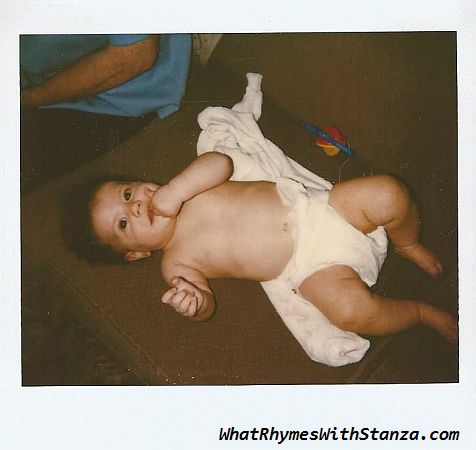
It is shared by passing it from hand to hand. It is cropped with scissors if one wishes, but that’s not likely to happen. The highlights are enhanced by tilting the photo toward the nearest window or lamp, and the image is sharpened by adjusting one’s bifocals into better focus.

I sift through my shoebox now and again — probably more often than the girls realize — and the photos always make me smile.
Truth be told, I wouldn’t trade my Polaroids for all the Photoshopping in the world.
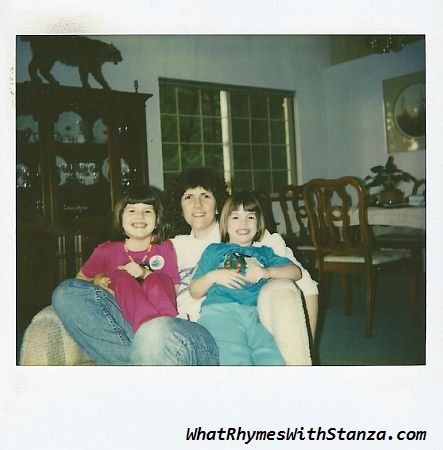
The photos above were most likely taken by a variety of relatives. Unfortunately I cannot assign individual credits.
The Daily Post Discover Challenge: Transcript

The Daily Post daily prompt: Shine
#WeekendCoffeeShare is graciously hosted by Diana at ParttimeMonsterBlog.com.
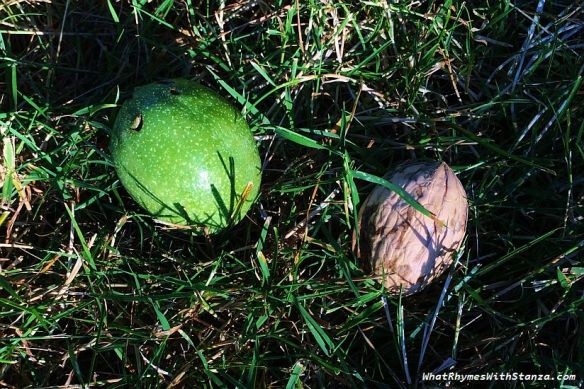
If we were having egg nog, I’d wish you a hopeful, healthy and safe New Year!
I have issues with wishing for happiness, but perhaps we can postulate that if one has hope, health and a sense of safety, there’s a good chance they can find happiness as well.
Oh, the egg nog ran out last night. No problem, I’ve got coffee brewing as we speak.
If we were having freshly brewed coffee, I’d tell you I’ve vowed to put 2016 behind me come this year. No ruminating on fears, disappointments, anger, sadness and doomsday prophesizing. I’ll try to build on the many, many positive moments of last year.
So here is a partial list of what I am wishing for and anticipating in 2017:
♦ The continued blessing of sharing my life with a loving family, companionable pets, and myriad hand tools and DIY project supplies.

♦ Opportunities to contribute to preserving and expanding the beauty and health of this planet.

♦ Tenacity to hold to an ethical, honorable and selfless ethos, such that our society can rise above the mires of that prior year I said I wouldn’t ruminate upon (hint: 2016).
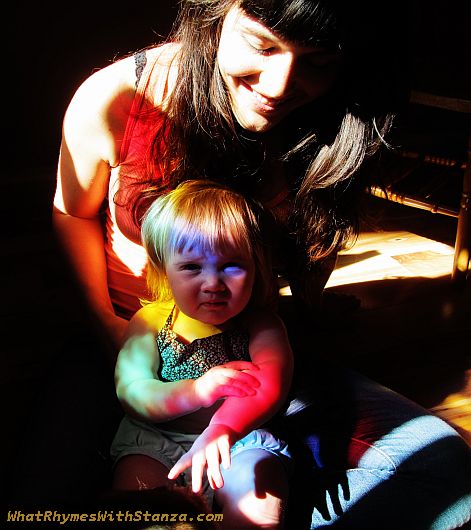
Oh, alright…
♦ ♦ ♦ I also wish for happiness for all! ♦ ♦ ♦
The Daily Post daily prompt: Year
year end reflection
long sigh of resignation
hope comes at midnight

The Daily Post daily prompt: Hopeful

“After arriving from China my dad took a year to save enough money working in San Francisco and he then walked to Astoria.” [ 718 miles ]

“My grandfather brought home salmon cheeks, a delicacy to the Chinese but a waste to the cannery owners.”
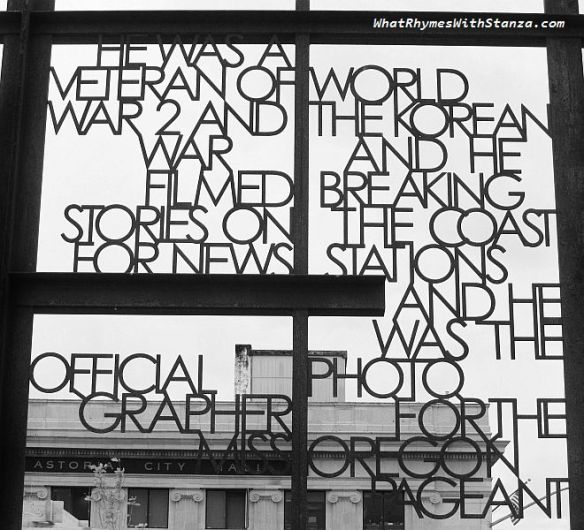
“He was a veteran of World War 2 and the Korean war and he filmed breaking stories on the coast for news stations and he was the official photographer for the Miss Oregon pageant.”

“We went to American school in the daytime and Chinese school in the evening.”
“My mother graduated with a college degree but Chinese women seldom had job opportunities so she…”
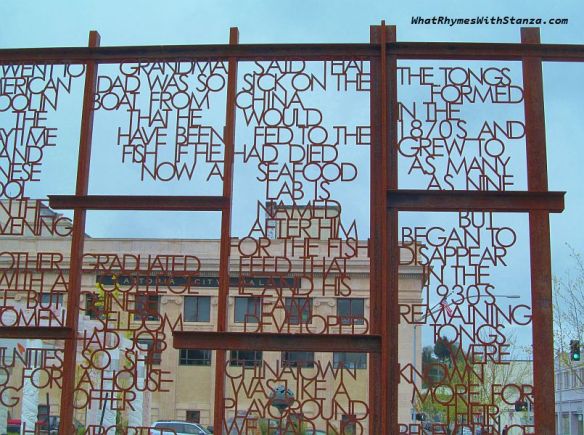
“Grandma said dad was so sick on the boat from China that he would have been fed to the fish if he had died. Now a seafood lab is named after him for the fish feed that he and his team developed.”
“The tongs formed in the 1870s and grew to as many as nine but began to disappear in the 1930s. Remaining tongs were known more for their…”
“Chinatown was like a playground. We had no…”
These photos were taken at the Garden of Surging Waves, a city park in Astoria, Oregon, which was built to honor and celebrate the Chinese heritage of that area. The Story Screen in these photos is an iron structure that includes the entry gate, and these large panels that tell about the hardships, struggles and contributions of some of the Chinese immigrants in Astoria as well as their descendants who remained in the area and who continue to be vital components in the fabric of the community.
The Daily Post weekly photo challenge: Resilient

