The Women Poets of World War One

They wrote it all down. The good (not much of that),
the bad (though with surprisingly little judgment),
and the ugly (so, so much of that).

They recalled the local boys who went from zero to hero
just by donning a uniform,
the surreal images of those same boys
heading off to war by the trainload,

the newfound responsibilities of keeping up the homefront,
the thrill of stepping out of constrictive roles:
flexing freedoms, flexing muscles, revealing capabilities;
still a wife, a sister, a nursemaid, a supportive prop,
but now also a train conductor, a delivery driver, a farmer.

They spoke of the loneliness, the longing, the yearning,
the carnal lust (“the wild cave-woman spoke”);
outgrowing the “good girl,” the “good wife” roles,
the soldiers, briefly passing by on their way to something
horrible or coming back from something horrible,
more than willing to fulfill the women's desires,
allay their fears, divest them of their virginity.

They described the ubiquitous mud of the battlefields,
how it turned uniforms brown (“the new style of clothing…
the chic of mud”),
how it disabled firearms, swallowed up artillery, drowned soldiers.

They told of the homecomings, the soldiers
no longer soldiers, the bodies no longer breathing,
the heroes who would rather not have been,

the mothers who weren’t mothers
when their men went to war,
the sainted helpmates who became whores in the
eyes of unforgiveness, of hypocritical judgment,
the fatherless children left to be raised by mothers
who could no longer hold the jobs
the men now reclaimed.

They sat opposite the empty chairs,
where their partners in life once sat.
They regretted scoffing at the the local boys in crisp new uniforms
who became soldiers, who became heroes, who became
disillusioned, haunted shells of men.

They suffered loss, but did not suffer bullet wounds,
they sacrificed all but received no medals.
They rose to the challenges but were shoehorned back
into their stifled caricatures of weakness and dependency
once deemed no longer needed in the workforce.

God bless the soldiers who fought for freedom and justice.
God bless the women who fought for stability and sanity.
God bless the female poets who lived it all
and wrote it down so that we – a century later –
might understand.

It’s National Poetry Writing Month (NaPoWriMo)!

Day Sixteen prompt from NaPoWriMo.net: write a poem in which you respond to a favorite poem by another poet. Not quite on prompt today. In looking for a poem to use (as I have no favorite), I found myself falling down a rabbit hole of female poets writing about WWI. Stark, moving poems depicting all facets of the war from a woman’s perspective.


A Sampling of Poems written by women about World War One:

War Mothers ~ Ella Wheeler Wilcox
https://www.poetryfoundation.org/poems/57317/war-mothers

August 1914 ~ Vera Mary Brittain
https://www.poetryfoundation.org/poems/57299/august-1914-56d23aac2477c

from At the Somme: The Song of the Mud ~ Mary Borden
https://www.poetryfoundation.org/poems/57329/at-the-somme-the-song-of-the-mud

After the War ~ May Wedderburn Cannan
https://www.poetryfoundation.org/poems/57365/after-the-war

August 1914 ~ May Wedderburn Cannan
https://www.poetryfoundation.org/poems/57362/august-1914-56d23ace66a9d

War Girls ~ Jessie Pope
https://www.poetryfoundation.org/poems/57296/war-girls

The Veteran ~ Margaret I. Postgate
https://www.poetryfoundation.org/poetrymagazine/browse?volume=12&issue=5&page=10

I Sit and Sew ~ Alice Moore Dunbar-Nelson
https://www.poetryfoundation.org/poems/52759/i-sit-and-sew


I Grieve

I grieve for lives lost because of others’ greed.
I grieve for dreams crushed and opportunities denied
because of prejudices and abuses of power.
I grieve for hope dying, for hope lost.

I celebrate silly memes whose sole purpose
is to express creativity and humor and joy in life;
proof of the indomitable vein of humaneness within us.
I celebrate sober acts of love, good will, humility,
generosity and bravery of everyday people
coming together to support, care for and
protect one another.

I challenge myself to not look away, to not try to
distance myself from the brutality, the
callous disregard of suffering, the shortsighted
squandering of natural resources that are the
very foundation of life on earth.
I challenge myself to right the wrongs.

I pray for wisdom.
I pray for sanity.

It’s National Poetry Writing Month (NaPoWriMo)!

Day Ten prompt from NaPoWriMo.net calls for “a meditation on grief.” I didn’t entirely meet the criteria of the prompt, but I’m still on track for a poem a day in April.

It’s time

We can’t straddle fences 
once the barbed wire goes up.

We can’t walk a fine line
when the lines have blurred into nonexistence.

We can’t look the other way
when there ceases to be any other way.

If we concede that this is the best we can hope for,
we are forsaking hope and forsaking one another.

It's time.

We are only as helpless as we allow one another to be.

Fire in the Ballot Box

Burn the ballots, ban the books, bash the ones who disagree.
When did it become the norm to forego common decency?
Ignore the truth, assert your lies loudly and repeatedly.
And God forbid you dare to challenge ye olde patri-assity.

Why do you try to stop the votes, what do you fear so mightily?
Why must you foment rage and hate, distrust and blind antipathy?
Why lurk in darkness, wearing masks to veil your true identity?
Why hide behind your guns and flags, then call it Christianity?

I am not Dem nor GOP, to none do I pledge fealty.
I aim to act with common sense, with self respect and dignity.
Far from perfect, none too wise, often lacking clarity.
Perhaps we’re more alike than not. Let’s strive for peace and harmony.

April Showers Bring…

Jules Verne. From the Earth to the Moon. London, Sampson Low, Marston, Low, and Searle, 1873 

It’s April, and we all know what that means: NaPoWriMo!

It’s National Poetry Writing Month, and the well-versed souls at NaPoWriMo.net are once again supplying us with inspiration, motivation and creative prompts to help us in the challenge of writing a poem a day for the entire month of April. I always have the best intentions of meeting the challenge, but sometimes life happens. We’ll see how it goes this year.

For April 1:

They say you can’t judge a book by its cover, but they never said you can’t try to write a poem based on a book cover — and that’s your challenge for today! 

As a resource, we were sent to The Public Domain Review’s collection “The Art of Book Covers 1820-1914.”

I chose to use a cover to Jules Verne’s book From Earth to the Moon. My endeavor:

To the Moon

When first we breached primordial ooze, 
our lungs inflating from newfound air,
we turned skyward with clouded eyes, and
there it was:

a moon!

We grew a spine (well, some of us),
strengthened lengthening limbs,
climbed mountains and – 
finding our voice – we howled 

at the moon. 

Torsos stretched, gaining balance.
Minds stretched, gaining wherewithal.
Desires stirred beyond mere survival.
Straining upright, we reached yearningly to

touch the moon.

Stripped of innocence, we clothed our bodies.
Sloughing naivete, we cloaked our intentions.
Finding pride, we adorned our personhood.
Growing listless, we set a goal: we would walk

on the moon. 

Scarred and marred from our abuse, at a distance
Earth nonetheless appears a shiny bauble; a marble
expendable in our cosmic game, because we believe
if all else fails, we will simply move 

to the moon. 

To Play or Not to Play

Bloganuary daily prompt: What was your favorite toy as a child?

Long story longer.

Art therapy for adults. Sometimes I hated it. Sometimes I loved it. Well, okay, love is a strong word, but sometimes it was insightful. A little insightful. Like if you squinted real hard from across the room at something you’d drawn, you might find a way to interpret the doodling as somehow relevant to your life. The art therapist, peering over shoulders as the patients worked on their projects, would sometimes nod or sigh or smile or give a little “hum” sound at the back of her throat as she walked around the room. All in all, it was kind of creepy.

I preferred the more structured assignments. One’s that didn’t involve jostling with the others for access to a pile of magazines for a collage project, trying to snag something that hadn’t been hacked to pieces by prior collage makers. Then trying to avoid eye contact with that person across the table who’s trying to guilt you into giving them the magazine you chose because out of the entire stack of magazines, that’s the only one that is bound to have the image they need for their masterpiece.

Just keep it simple. Hand me a piece of paper and a crayon and tell me to draw what depression looks like for me. Make sure it’s a black crayon and we’ll be set.

One day at group therapy, there was a large assortment of materials spread over the tables as we entered the art room.

“Today I just want you to play,” the therapist said.  “Use whatever you want to draw, paint, cut patterns out of colored paper, glue photos together as a collage, make something out of pipe cleaners, whatever appeals to you.”

“Play? I’m in this damned program because I’m damned depressed and I’ll be damned if I feel like playing.” That was my thought. I sat there in silence, arms folded in front of me, staring at the clock on the wall. Daring the therapist to try and make me “play.”

“Come on, it’s fun!” exclaimed one overly jubilant woman. Obviously it was time to boot her out of the program. “Just pretend you’re a kid again and play like you did back then.”

“I didn’t play when I was a kid,” I snarled, and I stood up and left the room. Didn’t play as a kid? Where did that come from? Of course, I played. Didn’t I?

I did play. Make believe, storytelling, hide and seek. Mother may I. Red light, green light. Simon says. Operator. Checkers. But none of that came to mind, specifically to my depressed mind. I didn’t remember having fun.

Group therapy ended years ago for me, and thankfully I’m in a much better mental state these days. And yet, faced with the question today as to my favorite toy as a child, my first reaction was. “I didn’t have toys.”

Of course, I had toys. Matchbox cars, bikes, skates, etch-a-sketch, spirograph sets. Balls, dolls, stuffed animals, board games. I’m sure I had lots of toys, but it’s hard to remember.

Living with depression can be like walking around wearing blinders. You don’t have the bandwidth to deal with a whole lot, so you block out a large portion of what is happening. I’m not talking about blocking out memories of traumatic experiences. I mean blocking out all sorts of things, even memories of playing and having fun. And it gets to be habit.

I still have trouble; not a poor memory per se, but I don’t focus enough to memorialize well, if that makes sense. A part of me still thinks it needs the blinders, and so the details get lost. Or the big picture is lost. I don’t know.

All of this to say, if I had a favorite toy as a child, I don’t remember it. But that’s okay. I get to play with my grandkids’ toys now. My favorite? Probably the t-ball set. I can send that plastic baseball over the fence like Hank Aaron! Remember him?
spitting on the fire

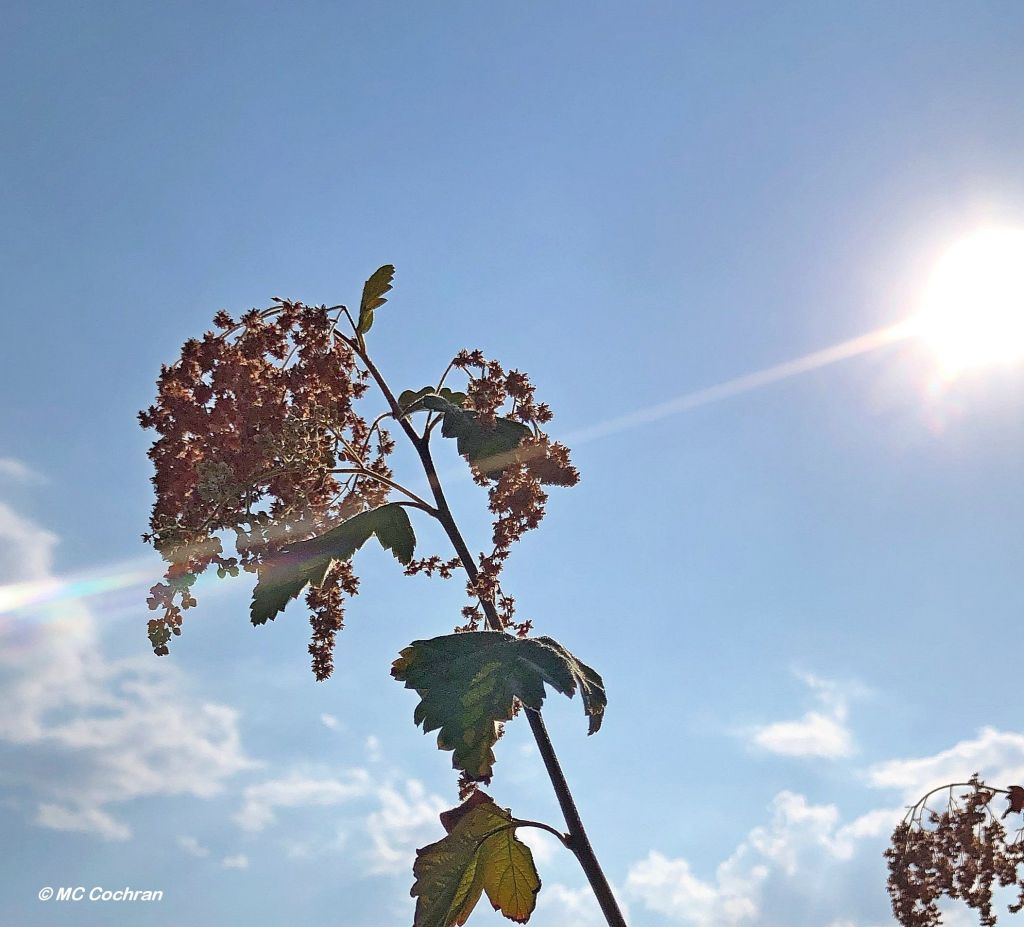
With July’s record-breaking high temperatures here, it’s been frustrating and – truth be told – rather depressing to watch flowers in my native plant garden wilt before reaching full bloom and then turn end-of-summer brown without setting seeds.

What happens, I wonder, if annuals can’t reseed themselves? What happens if birds and other critters have no seeds to tide them through the coming winter? What happens when spring pollinators show up and find but a few flowers to feed upon?

I do what I can for my small domain. I water the roots of my plants; can’t do much for the sunburned leaves. This fall I will plant more natives. In the winter I will feed the birds. Next spring, I will build a fountain of some sort to provide reliable water for thirsty creatures passing through my yard.

Sometimes my efforts feel quite satisfying, like I’m giving back to the planet. Lately, it just feels like someone trying to extinguish a forest fire with spit.


leather brown leaves curled

fists shaking at the August sun

give us a reprieve


dVerse haibun Monday: August