
 Q is for Quietude.
Q is for Quietude.

I didn’t hedge my bet
that the hedge would stay,
but the leaves left
and I was left with
a whole new view
on my view.

Sometimes privacy can be a real pane.
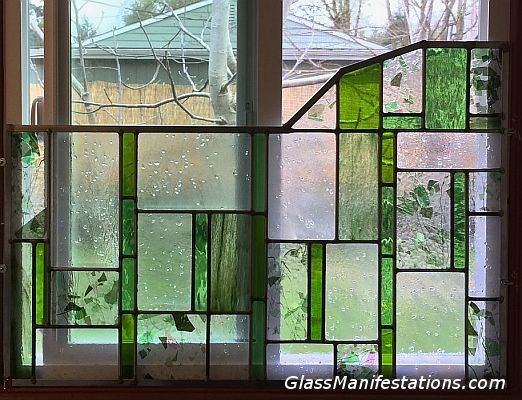
Stained glass privacy screen I recently made for my bathroom.
I raise my glass to glass.

 P is for Privacy.
Why should I care what you think?
Should I care what you think?
I care what you think.
Care what you think.
What? You think?
You, think!
Think.
 O is for opinion.
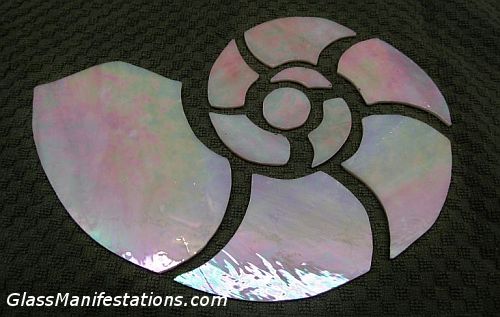
I mentioned last week that I featured a nautilus design in a stained glass panel I made for my granddaughter because of the shell’s meaning to me.
A [chambered] nautilus is a cephalopod of the genus Nautilus that has a spiral, chambered shell with pearly septa. Now doesn’t that sound totally inspiring? I mean… pearly septa! It just doesn’t get any better than that.
Okay… at my level of understanding: it’s a mollusk with a spiral shaped shell that consists of individually partitioned chambers. As the nautilus grows, it continues to enlarge its shell and create more partitions as it goes. Each chamber contains a gas that helps give the animal buoyancy.
When the nautilus inhales the gas from its chambers, its voice sounds really high, like Mickey Mouse’s. Nautiluses love to do this at parties, as it usually gets a pretty good laugh.
Okay, I made that last part up. Just the Mickey Mouse part. They really do have gas. And they don’t even eat beans.
But they are whizzes at math. See, the nautilus shell, with it’s spiral shape, is an example of the “golden ratio,” a mathematical ratio based on the number Phi. Phi (with upper case “p,” Greek letter Φ) represents the number 1.618… It’s reciprocal, phi (with lower case “p”, Greek letter φ), equals 0.618…

Approximation of the golden spiral (drawing in public domain).
Since math is all Greek to me anyway, I can’t really grasp the concept of Phi, but the ratio it represents can be seen in relationships all throughout the universe, in:
proportions of the human body, proportions of some animals, DNA, plants, music, art, geometry, the solar system, movements in the stock market, the designs of the Egyptian pyramids, raindrops on roses and whiskers on kittens (just testing to see if you’re paying attention)… and as noted, in the shape of the spiral of the nautilus shell.
Some may argue that the application of the golden ratio, in many instances, is based on arbitrary points of proportion that happen to match the equation. Kind of the idea that when all you have is a hammer, everything looks like a nail. If you set about looking for a particular pattern or ratio, you can find ways to fabricate – er, I mean discover – its appearance in almost anything.
So that’s the “golden spiral.” But, not to be outdone by the Greeks, the French (specifically French mathematician Rene Descartes) came up with the “marvelous spiral.” Something about logarithms and more math stuff.
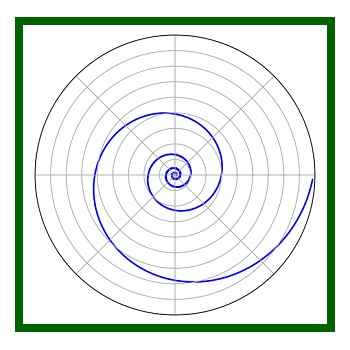
Logarithmic “marvelous” spiral (drawing in public domain).
As with the Golden ratio, the logarithmic (“marvelous”) spiral occurs in many forms in nature. Examples:
the shells of mollusks (i.e. the chambered nautilus shell); the approach of a hawk to its prey; the approach of an insect to a light source; the arms of spiral galaxies; the bands of tropical cyclones; patterns in sunflower heads; the nerves of the cornea…
I guess you could say it’s everywhere you look! (See what I did there? Cornea… everywhere you look… pretty funny, huh?)
So what is the significance of all of this?
To me it indicates that there is a strong interrelationship between virtually everything in nature (and the aesthetics of some things manmade); that there are forces bigger than we can imagine at work in the universe; and that on some level there is a grand design to everything.
A golden, marvelous design.
Note: This is a revision of a post I published on another blog I had going in a previous lifetime. Any plagiarism of myself has been done with my full knowledge and permission (to myself). I think.
 N is for Nautilus.
I know, I know. I’ve done this rant before. But obviously I didn’t rant thoroughly enough to get it out of my system. So here we go: Manifest Rant, the Sequel.
Manifest is a verb (used with object). It does not mean to attract like a magnet in a steel ball bearing factory. It is not a synonym for “magic trick,” where getting what you want is as easy as reaching into a magician’s top hat. And my favorite anti-definition – gleaned from an internet search: Manifesting is NOT “goosing the quantum field” to create a world in which “everything you desire is yours for the taking.”
Based on an internet search using the phrase “how to manifest,” I discovered that people are searching for ways to manifest…
True confession: I used to use the term “manifest” in pretty much the same fashion, although I never goosed anything, quantum or otherwise.
I do believe we can create what we truly desire in life. I do believe there are forces – both seen and unseen – that can and will assist us once we are clear on what it is we truly want, once we put that energy “out there” with confidence and trust.
But I don’t believe that whatever we desire is “ours for the taking.” Ever.
So what does the verb manifest really mean? Here you go:
Manifest – verb (used with object)
1. to make clear or evident to the eye or the understanding; show plainly:
He manifested his approval with a hearty laugh.2. to prove; put beyond doubt or question:
The evidence manifests the guilt of the defendant.
Alrighty, I feel all ranted out now. I’m going to go manifest my curiosity now, by trying to figure out just how one really goes about goosing a quantum field.
 M is for Manifest.
So I had a “light bulb moment” the other day. You know, that moment when you have a sudden realization, an enlightenment of sorts, when the metaphorical light bulb turns on in your brain and you say, “Aha!”
Oh wait… that’s an “aha moment.” But anyway, that light bulb moment when you are struck with a sudden insight or inspiration that leads you on to new discoveries?
Yeah… that’s not what I’m talking about.
I’m talking about a real light bulb. You know… bulbous, light-producing… something that you screw into a socket so that someone doesn’t come along and stick their fingers in it. That kind of light bulb.
Okay, on to my moment. I bought a light bulb that is supposed to have a 27 year life span. I can’t remember how much I paid for it. That memory is probably repressed to protect me from the trauma.
Nor can I remember what I was thinking when I decided that I needed this acme of amperage, this wonder of wattage, this lion of lumens.
Perhaps I just felt that, at some point in my dotage, I might want to switch on a lamp, and I could rest in ease knowing that my trusty light bulb would be there waiting to brighten my day. Or night.
So here I was, in possession of this almost ageless light bulb, and – as luck would have it – there was a burnt out bulb in one of my lamps. A perfect opportunity to begin my decades-long relationship with Brighton. (I figured if we were going to be together that long, the light bulb should have a name.)
I pulled Brighton out of my light bulb storage area (I seem to have quite a collection of light bulbs), and began wrestling with the packaging that was doggedly defending Brighton from harm. With a sudden shift of surrender, the packaging gave way, the bulb sprang free…
and began its unstoppable freefall to the hardwood floor.
The bulb crashed to the floor. My dog Chules came running to see what happened. I began to have visions of doggie blood spurting everywhere if Chules stepped on shards of Brighton. In one swift motion, I pushed Chules aside and bent down to assess the damage.
There lay Brighton. In one piece. On the floor. Where he landed after a four foot long plunge.
I tenderly picked Brighton up, held him to my ear, and gently shook him to see if I could hear that tinkling little noise that light bulbs make when their filament has broken. Mind you, with Brighton being the Superbulb that he is, I don’t even know if he has a filament. But I figured no sound is good sound.
I took Brighton to my bulb-less lamp and with trepidation screwed him into the socket. Holding my breath, I reached with quaking hand to flip the switch.
And then there was light!!!! Brighton’s alive! Metaphorically speaking, of course.
As I sit here basking in Brighton’s warm glow, I have every confidence that we will be together for a long, long time.
Hey, wait! Did someone turn out the lights? Brighton…?
Brighton?!?
 L is for Light bulb.
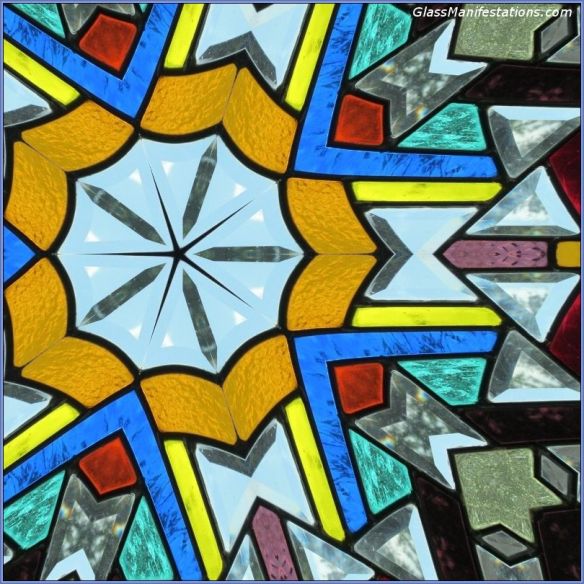
 K is for Kaleidoscope.

Flotsam, Jetsam & Lagan: sounds like a prestigious law firm, doesn’t it? Or maybe a 1960s folk rock group? But no, these terms have a more nautical theme.
I’ll let dictionary.com explain:
Flotsam — 1. the part of the wreckage of a ship and its cargo found floating on the water. 2. material or refuse floating on water. 3. useless or unimportant items; odds and ends.
Lagan — anything sunk in the sea, but attached to a buoy or the like so that it may be recovered.
Jetsam — goods cast overboard deliberately, as to lighten a vessel or improve its stability in an emergency, which sink where jettisoned or are washed ashore.
⊕⊕⊕⊕⊕
I won’t be channeling my inner pirate here; I get seasick in the bath tub if I take my eyes off the horizon. The thought of people chucking things into the ocean intentionally is also rather sickening, but I’ll save that for another post.
The point of this post is:
Wait, that doesn’t sound quite right… Anyway, I’ll wade in with my analogy:
Sometimes we go about life having taken on a lot of unnecessary “odds and ends,” and when we get hit with – “stormy weather” shall we say — we founder and end up floating about, all wet. The “useless and unimportant” baggage we were needlessly hanging onto bobs about pointlessly in the waves nearby as we frantically dog paddle and wait for rescue. That’s flotsam.

Sometimes we get the “ship” kicked out of us and lose our footing on dry land, but we manage to take stock of what happened and what’s important to us, and we can devise a plan for how to recover from our losses. That’s lagan.

And then there’s jetsam, when we rid ourselves of the unnecessary baggage that’s weighing us down, impeding our progress, or endangering our stability. And having done that – and continuing to do it – we sail through situations that might otherwise have sunk us.

I’m striving for jetsam; lightening my load of unnecessary stress, worries and material “stuff.” It’s definitely an ongoing process. Stuff seems to seek us out at every port, clinging to us like barnacles on a boat.
Okay, swabbies, I think this ship has sailed. I’m off to the galley for some chow. I suddenly have a hankering for fish and chips.
 J is for Jetsam.
 Inertia: I want to make a stained glass panel for my soon-to-be-born grandbaby. But:
Inquisitiveness: What could I make that would be fairly simple, using materials I already have on hand, while challenging my perfectionism?

Idea: I have a sample box of multi-colored rectangles of glass. I have lead came. Straight lines are simple.

Inspiration: When I lay out the sample pieces, they remind me of a patchwork quilt. I could make my new grandbaby a “quilt.” That’s a grandmotherly gift, right?

Imagination: What if I added a symbol of some sort? Something meaningful to me that would make the “quilt” more personal… like… a nautilus! [You’ll have to wait for the “N” day to find out what makes the nautilus meaningful to me.]
Implementation: Get the lead out (literally), and go for it!

Insight:

Incredible!!!! ⇒ The way that I feel for having overcome the inertia, impediments and insecurity I felt before taking on this project!

Isla: The name of my first grandbaby.
 I is for Incredible.

You know how it is when you have a thread loose on your shirt sleeve that you can see out of the corner of your eye every time you move your arm?
It’s on the sleeve of your dominant hand, so whenever you have scissors handy you try to cut it off, but with your weaker hand you can’t manage the scissors well enough to get the thread between the blades. And if you do get that far, you’re still afraid to make the cut because from your peripheral vision you can’t tell if you’d be cutting the cloth of the sleeve as well as the errant thread.
You do know how that is, right? And then when there are no scissors around, and you start noticing the thread poking up from your sleeve again, you just want to pinch it tight between your thumb and index finger and yank it out to be rid of it once and for all.
But you know you can’t. You’ve been told that if you pull on a loose thread, the entire article of clothing will come undone and fall at your feet in a ragged, unraveled heap.
What I’m getting at here is:
Not following? See, the definition of art is like that wily, unruly thread that you just can’t quite get a hold on. And so you keep coming at it from different angles, thinking the meaning of art – heck, the whole meaning of life – is right there, just visible out of the corner of your eye.
Take hostas for example. You know, those green leafy plants that don’t look like ferns. Okay, so you’ve got your hostas over here, and over there somewhere you’ve got your ferns. And the question is:
It doesn’t get any clearer than that. But you’re still scratching your head and giving me that look, so I’ll continue. No, no, I insist.
I follow the Facebook page for Dale Chihuly, world-renowned glass sculptor. Yes, he’s the magnificent artist after whom I named my dog. It’s an honor really; maybe not so much for Dale, but certainly for my dog.
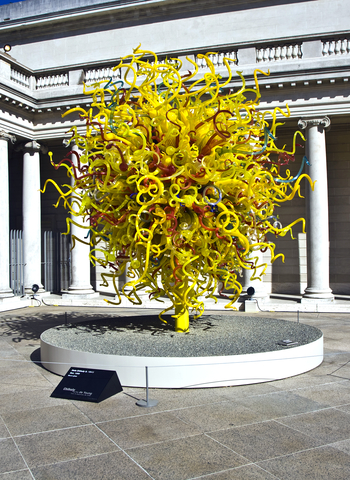
Dale Chihuly’s work.
Recently, on Dale Chihuly’s Facebook page there was a photo of a glass art installation in Oseyrarsandur, Iceland, from the year 2000. The artwork is titled “Green Ferns.” I haven’t had the chance to hop over to Oseyrarsandur to snap a photo for you, but here’s the link to the FB photo:
Okay, so the artist is sharing a photo of the artist’s work which the artist has titled “Green Ferns.” And below the FB post someone comments, “I’d say those are hostas, not ferns…. But thanks!”
So here’s the question: are they ferns, because that’s what the artist says they are? Are they hostas, because that’s what the commenter says they are? Are they both, depending on who’s looking? This is starting to sound like that twine theory stuff. String, I meant string!
Does it matter at all what anyone thinks they are? I believe it does. If you’re watching a ballet featuring dying swans, for example, and someone says, “I’d say those are ducks, not swans… But thanks!”, don’t ya kinda think they’ve missed the whole point???
I don’t suppose Dale Chihuly is losing any sleep over this. I know my dog Chihuly certainly isn’t. And maybe I’ve just turned this whole matter into a ragged, unraveled heap on the floor.

Dog Chihuly’s work.
Maybe someday I’ll see that niggling little thread out of the corner of my eye and I’ll turn my head and there they will be… all my answers to:
I apologize, Mr. Chihuly, for pulling the thread. I just couldn’t help myself.
 H is for Hostas.
Daily prompt: Green
 What Rhymes with Stanza?