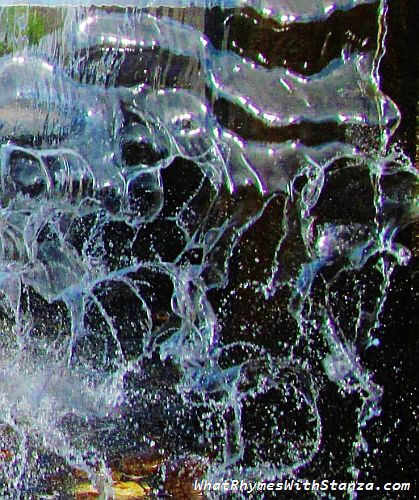
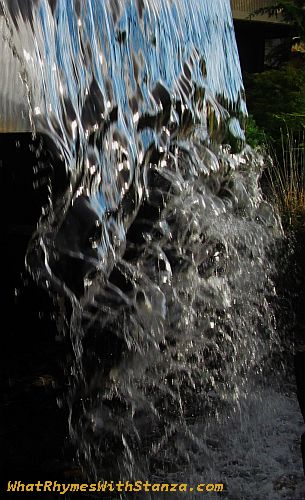
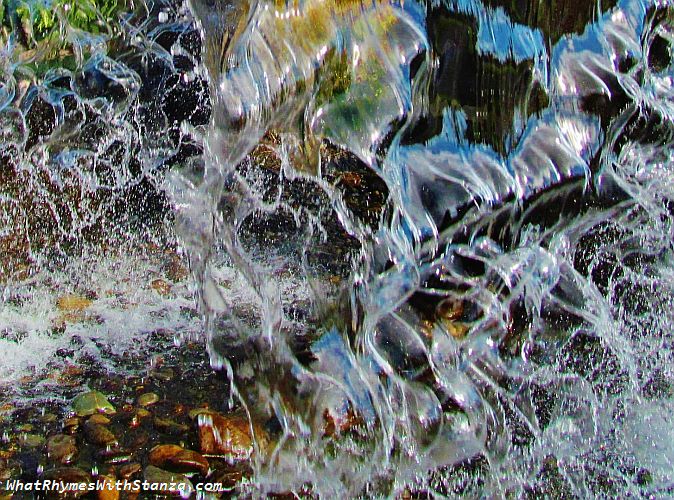
Along a street that I have driven hundreds of times in the past, my eyes were drawn this morning to a water feature in front of an office building. The early morning sunlight sparkled brilliantly off the cascading stream that cycled through a structure of concrete, rough boulders and river rock. I pulled over to check it out.

The fountain itself isn’t much to look at. With a casual glance from the street, one sees a sheet of water pouring over a concrete crossbeam and disappearing amidst some nondescript boulders.
Closer examination reveals that the water has been intentionally channeled (“choreographed,” one might say) to flow in streams that dance and glisten in the sunlight as they freefall to the rocks below.

I am reminded of the phrase “water over the dam,” which implies that something is over and done with and cannot be retracted or reconsidered. How many of us live as though the decisions and actions of our past have left us in a freefall of dire consequences over which we have no control?

Maybe water over the dam should mean that whatever happened in our past, “good” or “bad,” served to push us beyond sitting stagnant behind a wall of mediocrity, and has freed us to dance and sparkle in the sunlight on our way to something new.

We can choose to see the fountain as half empty or half full. Oh, wait, that’s an entirely different analogy. Never mind.
I’m glad I stopped to look at the fountain, and I’m going to try to be more observant of my surroundings in the future. Who knows? Maybe tomorrow I’ll find some water under the bridge.


 Photo 101 Assignment Fifteen: Landscape. This photo was taken this morning from Rocky Butte looking NE at the Willamette River in Portland, Oregon USA. Volcanic Mt. Saint Helens can be seen in the background. The early morning haze has not yet lifted.







 What Rhymes with Stanza?