Sermons and Seeds

The dVerse poetry prompt today is all about the pantoum poetry form. As explained by Gina on the dVerse Poetry blog, the pantoum is a series of interwoven quatrains and rhyming couplets. I won’t elaborate further than that (‘cuz I’d just confuse myself), but you can read Gina’s description of the form here.

Below is my attempt at such a poem.

pantoum1

When bored with a sermon of a Sunday morn,

To the graveyard next door I would go.

Among the gravestones I’d play and roam;

Decorum of death I did blithely not know.


To the graveyard next door I would go

To escape stale air and the pastor’s drone.

Decorum of death I did blithely not know;

Off I would dance over rotting bones.


To escape stale air and the pastor’s drone,

I’d blow dandelion puffballs to free the seeds.

Off they would dance over rotting bones,

Then land between tombstones and weeds.


I’d blow dandelion puffballs to free the seeds

Among the gravestones. I’d play and roam,

Then land between tombstones and weeds,

When bored with a sermon of a Sunday morn.

pantoum2

Invisible

tracks

You didn’t see me.
You watched my reflection
turn in a direction
you chose not to see.

You didn’t hear me.
You thought I was sleeping.
In fact, I was weeping.
You chose not to hear.

You didn’t touch me.
You thought I might crumble.
You thought you might stumble.
You chose not to feel.

You didn’t miss me.
You thought I had left you,
came not to my rescue.
You chose to move on.

I vow to be seen,
and heard and respected;
my path self-selected;
invisible no more.


dVerse Poetics: Invisible

Alone Time

sick chuly

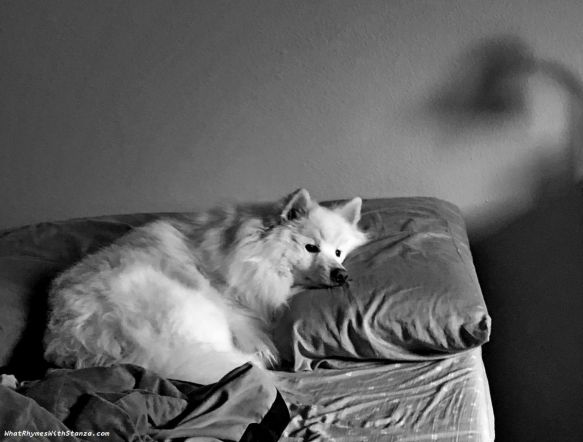
Chules is sick today. I can hear his tummy roiling from across the room. He’s been in- and outside at least a dozen times since morning. When I let him out, he beelines to the side yard fence, and tries to eat the taller grass to ease his stomach pain. Not an easy task for a canine whose teeth are not suited to grazing on plants.

Back inside, Chules disappears into my bedroom to rest in solitude. He likes alone time, even when he’s feeling well. After a couple of hours I go looking for him, and find him on the bed, resting his head on my pillow. This is atypical of him; he usually naps on the floor behind my rocking chair. I sit with him and gently pull my fingers through his soft fur. He doesn’t move, but his watery eyes close drowsily. I kiss his head and leave to let him sleep.

In the living room, I retire to the couch with a mystery book I’ve been reading. I like my alone time, too, but today I can’t relax. Soon I hear Chules padding down the hallway. He hops up on the couch and curls up next to me. I pat his backside and return to my book, feeling more at ease now. Sometimes, it’s just better to spend alone time together.

stunted winter grass
green, though growth eludes the eye
grazers are not fooled


dVerse Haibun Monday: Solitude

Weekend Wildcard: Groundhogs and Vital Bogs

1 WILDCARD

Yesterday was Groundhogs Day in the US and Canada, and megastar (among the rodent crowd) groundhog Punxsutawney Phil purportedly did not see his shadow, which is said to be a harbinger of an early spring this year.

While not the most reliable diagnostic tool of the atmospheric sciences (the groundhog has about a 39% accuracy rate), it is nonetheless a quaint tradition from simpler (climatically speaking) times.

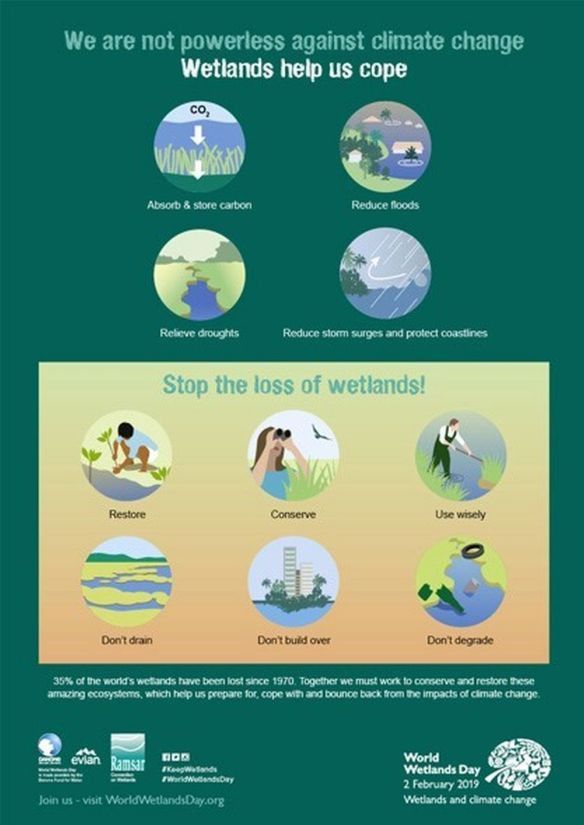
A bit lesser known in the US – okay, a LOT lesser known – observance on February 2nd is World Wetlands Day, a day designated to bring awareness to the importance of wetlands in balancing global ecosystems.

The house where I lived as a youth was situated on a sand hill that was basically surrounded by wetlands (back then designated simply as a swamp). The first signs of spring for me were the green shoots of skunk cabbage that emerged from the murky waters of the swamp. These quickly grew into wide, flat, shiny leaves and bright yellow flowers that emitted the musky odor of their namesake. I loved the cheery sight of them, and I actually found the earthy, slightly sweet smell to be somewhat pleasant (in small doses and from a distance).

Skunk Cabbage 2

The sounds of croaking frogs were prevalent on warm evenings, and every once in a while a beaver or nutria would find their way into our lower yard. Mosquitoes abounded. We pretty much stayed out of the swamp and let it do its thing of living and dying, sprouting and rotting, flooding and receding. I thought it was kind of cool to live within the wetland, but I had no appreciation of its importance as an ecosystem.

The last time I visited that area, I found that the swamp had been filled in and houses lined both sides of the low road that used to define where our yard ended and the swamp waters began. It was a sad sight. The adage “You never know what you have until it’s gone” comes to mind.

It’s too late for “my” swamp, but other wetlands can be restored, preserved and protected. Let’s do it!

wetland Infographic


Infographic taken from WorldWetlandsDay.org