If You Give a Man a Shovel: a story for Earth Day

shovel5

If you give a man a shovel, he’s going to want to dig.

He will dig holes in the ground.

He’ll want to plant something in the holes, so he’ll ask you for some seeds.

The plants growing from the seeds turn out to be edible, and lots of people will want to eat these plants.

shovel1

He will want to dig more holes and plant more plants, so he’ll ask for more land and more shovels. You will have to clear the land of all vegetation and wildlife so he can grow his crops.

He will make lots of money selling his plants, so he will keep planting the same thing season after season in his fields, and he will invent easier ways to harvest his crops.

shovel2

The soil will deteriorate from his harvesting methods and from his single crop farming. He will ask you for fertilizer to make the soil better and the plants grow faster.

The fertilizer will encourage weeds to grow in the fields, so he will ask you for an herbicide to kill the weeds.

The insects that have been eating the weeds will need a new food source, so they will start eating his crops. He will ask you to make insecticides to kill the bugs.

There are lots of bugs on the lots of plants, so he will need lots of insecticide. And more fertilizer. And more herbicide to kill the weeds that regrow in the re-fertilized soil.

shovel3

As his crops get bigger and bigger, he will glut the market, so he will ask you for money to subsidize his farming.

He will look for new ways to market his crops, and will invent high-fructose plant syrup (hfps) and people will begin putting hfps in all manner of food.

shovel4

As processed foods containing hfps become more and more unhealthy, people will begin to die prematurely from their poor eating habits.

He will need to dig holes to bury the people who die prematurely from poor eating habits, and since he needs to dig holes…

shovel6

he will probably ask you for a shovel.

The end?

“In nature, nothing exists alone.”
~ Rachel Carson, 1962


Earth Day 2019: Protect our Species

Weekend Wildcard (Flashback #2: Brushing off my Faith)

WILDCARD liftingThis is my second time of re-posting from a no longer active blog I started in 2012. The blog was my way of working through a rather severe episode of depression.

My purpose in revisiting the “old” me is — I guess — the same as it was then, to remind myself and any others who care to read, to:

claim the positive energy that is available to each of us for our own benefit and for the benefit of others.

This entry was posted on July 13, 2012:

Brushing Off My Faith

While we can control a lot of things in our lives — probably a lot more than our depressed minds allow us to believe — there are certain things that will play out for us however they will, with very little input potential from us.

So what do we do? Sit there and be the victim? Stick our heads in the sand and hope the problem goes away? Mindlessly bash away at the problem with futile “solutions” that don’t really solve anything? I don’t know about you, but those have been my top go-to responses. How’s that working for me? Not very well, thanks for asking.

Since my last mental melt down (maybe not the proper medical terminology, but you get the gist), I have been unable to return to my job. Bills are mounting up and prospects for work that I can do in the future without relapsing back into “melt down” mode seem few and far between at the moment. I don’t consider myself handicapped by depression, but I am extremely cautious about the choices I will need to make moving forward.

Buddha smallThe big question for me is: what am I going to do about these concerns? Obviously worrying about them, ignoring them, or trying to bull my way through some desperate stop-gap measure isn’t going to help. So I am choosing to turn to another resource: faith.

That doesn’t mean that I have dusted off my Sunday School shoes, or that I let someone dunk me underwater in a lake somewhere. Not that those would be bad scenarios per se, it’s just not what I am talking about at this moment. I guess I am talking about what some might consider that “mumbo jumbo” kind of faith. Putting my situation out there into the Universe and trusting that things happen for a reason. I am here for a reason. I am in the situation I am in for a reason, and there is some (Divine, if you will) plan to all of this.

I don’t know the plan. That would take all the fun out of it, I suppose. I hear the Universe has a rather quirky sense of humor that way. But I am willing to trust that there is something bigger than me and that that “something” has my back. Something’s gotta give eventually, and my part in this is to be ready, receptive and proactive when opportunity comes my way.

A tall order, to say the least. It’s all too tempting to rehash every negative thing that has ever happened in my life and say, “See? Nothing ever works out for me. Why should this situation be any different?” But what does that line of thinking get me? Nothing good, for sure.

I am fortunate that I still have some wiggle room. There is still a roof over my head. And maybe that makes this whole faith thing a lot easier to swallow. My inner naysayer is telling me to just wait and see how I feel about all this Universe stuff once my back is really to the wall. That’s my typical depressed person thought, always waiting for the other shoe to drop. And sometimes the naysayer is right. Time will tell.

In the meantime, I have a choice in how I respond to my situation, and I am choosing to trust, to put my faith in an outcome that I cannot see at this point. I will do the leg work once I figure out what that is. I don’t expect anything to be handed down to me from the clouds.

We’ll see… a great experiment. If it fails, I guess my naysayer can say it told me so. But if it succeeds… ah, there’s the faith!

All my best,
Maggie

Exhale

NaPoWriMo, Day 19.

The prompt:

Today, I’d like to challenge you to write an abecedarian poem – a poem in which the word choice follows the words/order of the alphabet. You could write a very strict abecedarian poem, in which there are twenty-six words in alphabetical order, or you could write one in which each line begins with a word that follows the order of the alphabet.

Okay, the directions seemed simple enough, but somehow I got it backwards.

Exhale

Zoey
Yearned to
eXhale.
While breathing is indeed a
Valuable asset for living, it is generally
Understood that if one goes to the
Trouble of inhaling, it’s
Simply impossible to
Refrain from exhaling. The obvious
Question, then, is what
Prompted Zoey to possess this
Oddly understated desire.

Needless to say – one would hope — the perpetual
Mishandling, neglect and abuse of an animal will
Lead to mistrust, fear and – in Zoey’s case – a
Keen sense of danger such that
Just by exhaling, she might incur the
Inability to protect herself from harm.

Her wish for safety and security was
Granted one day in the
Form of earthbound angels who
Extricated her from her dire,
Debilitating situation, and through
Care and love and patience, Zoey was
Bestowed once again with her rightful
Ability to fully, exhilaratingly exhale.

When It’s Time

NaPoWriMo, Day 18.

Our optional prompt for the day takes its cue from how poetry can help us to make concrete the wild abstraction of a feeling like grief…

Today, I’d like to challenge you to write an elegy of your own, one in which the abstraction of sadness is communicated not through abstract words, but physical detail. This may not be a “fun” prompt, but loss is one of the most universal and human experiences, and some of the world’s most moving art is an effort to understand and deal with it.

When It’s Time

I wonder how they know.
They make the call.
It’s time to come.
But how do they know?

He’s been gone for years already.
The memory, the recognition, and —
eventually — even the words.

But now he lies here, eyes closed,
erratic breathing, pale skin.
The phrase “death warmed over”
comes (irreverently) to mind.

Still, how do they know?
Mightn’t he wake up tomorrow with
that good-humored sparkle in his eye
and say something silly?
“You’ve grown so tall now;
your legs go all the way down to your feet!”

No, of course not. But still…

His skin is hot.
His breathing is ragged.
I expected clammy and shallow,
respectively.

I kiss his forehead, pat his hand.
I feel embarrassed that I don’t know what to say,
even though he can’t hear me.

I don’t say goodbye, because —
well — he’s still here. For now.
Then again, as I said before,
he’s been gone a long time already.

I wonder how they know.

Things People Say

Day Nine of NaPoWriMo.

Today’s prompt is inspired by the work of Sei Shonagon, a Japanese writer who lived more than 1000 years ago. She wrote a journal that came to be known as The Pillow Book. In it she recorded daily observations, court gossip, poems, aphorisms, and musings, including lists with titles like “Things That Have Lost Their Power,” “Adorable Things,” and “Things That Make Your Heart Beat Faster.”

The prompt:

Today, I’d like to challenge you to write your own Sei Shonagon-style list of “things.” What things? Well, that’s for you to decide!

And so:

Things People Say

“I understand.” A phrase often misunderstood.
If one truly understands,
there are many more effective ways to say so.
Better yet,
illustrate the understanding through actions.
Show, don’t tell.

“Are we there yet?”
Often responded to with a white lie:
“Almost.”
If one feels compelled to ask, the answer is
most likely “no.”

“I love you.” Best said when true.
Often withheld until one’s paramour has said it first.
Show, but also tell.

“Thank you.” Not said often enough.
Tell, and show,
at minimum seventeen times per day.

Weekend Wildcard (Flashback #1: Free Fall)

WILDCARD liftingIn 2012, I began my first of many blogs, entitled “Lifting the Weight.” Seems like eons ago. I looked this week and was surprised to see the blog still sitting out there in the ether, looking none the worse for it’s many years of neglect.

I decided to repost some of the content from that site on this one.

As described in the “About” statement from my “Lifting” blog,

July 11, 2012 —
Having suffered at the hands of my own negativity for far too long, I decided it was time to claim the positive energy that is available to each of us for our own benefit and for the benefit of others. Hence, I’ve begun the process of “lifting the weight” of depression from my soul and moving into a lighter, freer space. Please join me in finding a way to a more balanced, affirming life.

I continue that journey to this day, and I must say I see much more light than darkness these days. For that I am eternally grateful. So why revisit the “me” of seven years ago? It might provide inspiration to those still weighted down. It might provide insight to me for continuing to follow the light. If you want to skip my indulgences into the past, just forego reading my Flashbacks. Don’t worry, I’ll never know, and even if I did, I wouldn’t mind.

Here’s an entry to “Lifting the Weight,” posted on July 31, 2012:

Free Fall

“Now that my storehouse has burned down, nothing conceals the moon.”
Mizuta Masahide, poet and samurai
1657–1723

I got depressed and lost my job. In that order. And while my depression has abated, I have yet to recover from my joblessness. I am totally clueless as to what that recovery is going to look like. Yet despite my total lack of financial security, I am finding myself feeling unusually at peace; feeling, in fact, downright serene. I’ve never felt this way before.

It’s almost like I am a dissociated observer of my own life. I am watching myself with curiosity, waiting to see what’s going to happen next. I’m not judging what got me here, not dwelling on where I currently find myself, and not stressing about where I will end up. If I weren’t so mellow, I might find my attitude a bit disconcerting.

The reality is that in losing my job, I have gained the time and freedom and ability to concentrate on myself and my health, both mental and physical. I’m not working nine hours a day at a stressful job, spending seven hours trying to de-stress from my stressful job, and then going to sleep to avoid stressing about my stress. I am able to broaden my thinking, to look around and see more, to appreciate more, and to feel more. I am gaining balance in my life as I focus on healthy eating and exercise and sorting through thoughts and emotions.

I am experiencing all of these blessings while nonetheless being in a financial free fall. In the olden day cartoons, when characters fell off a cliff and started hurtling to the canyon floor, they would serendipitously get snagged mid-fall by a gnarled branch of some sort poking conveniently out of the otherwise barren cliff side.

That is, unless the character was Wile E Coyote, in which case he invariably smacked prostrate at the base of the cliff, ending up flatter than the proverbial pancake. By the next scene, though, he was re-inflated into his usual 2-dimensional self and was ready for his next adventure, something that would probably put him at the losing end of a stick of dynamite that had been purchased by Bugs Bunny from the Acme Company. Some coyotes just can’t win.

I’m not exactly banking on the notion that I will be snagged from my demise at the last minute. I’m not really banking on anything. I’m just watching. I don’t advocate this approach to life. If I fall flat on my face, there’s no saying that I will bounce back like Wile E Coyote. Time will tell.

In the meantime, I’m going to appreciate my view of the moon.
Maggie

###
If and When

Day Six of NaPoWriMo. The prompt:

Today, we’d like to challenge you to write a poem of the possible… not on what has happened, or what will happen, but on what might happen if the conditions are right. Today, write a poem that emphasizes the power of “if,” of the woulds and coulds and shoulds of the world.

If that’s what you want, I guess I could do that:

oceanside

If and When

If
you got to work in the early morning and began wondering what time I would rise from bed and what I might make for breakfast and whether I preferred my eggs scrambled or poached and did I sit at the kitchen table with the newspaper as I ate or maybe on the porch swing so I could smell the spring flowers,

would you call me and ask?

If
I wondered what you were thinking as you gazed silently out the car window on those hot summer days when we drove through the valley with the fields full of big round hay bales that remind me of cinnamon rolls,

would you tell me when I asked?

If
we walked together along the beach in the waning hours of a warm autumn day and spoke of our dreams and hopes and fears and those silly notions that pop into our minds sometimes or the songs that get stuck in our head all day or what we like most about Sunday mornings,

what might happen then?

When
winter comes, perhaps we can sit at home before a warm hearth, enjoying one another’s company, comfortable in our answers,

no questions asked.

If Only

Day Five of NaPoWriMo. Lots of choices for the prompt today. I chose to write a villanelle, which is defined as such:

The classic villanelle has five three-line stanzas followed by a final, four-line stanza. The first and third lines of the first stanza alternately repeat as the last lines of the following three-line stanzas, before being used as the last two lines of the final quatrain.

Clear as mud? I thought so, too. But I gave it a go anyway.

woods1

If Only

If we only had the time –
just imagine if you would –
all the mountains we could climb.

Wouldn’t it be fine?
Leisured strolls in shaded woods
if we only had the time?

If we let the years unwind,
wove the hard times with the good,
all the mountains we could climb.

We’d pick peaches in their prime,
dine beneath the cottonwoods
if we only had the time.

If we heard the clock bells chime,
left our worries where they stood,
all the mountains we could climb!

How might our futures be defined
if we only understood?
If we only had the time,
all the mountains we could climb.


Also posting on dVerse, where the poem form for the month is the villanelle. 

Checking In

Day Four of NaPoWriMo.

And now for today’s (optional) prompt, inspired by Teicher’s poem “Son“. One thing you might notice about this poem is that it is sad, but that it doesn’t generate that feeling through particularly emotional words. The words are very simple. Another thing you might notice is that it’s a sonnet – not in strict iambic pentameter, but fourteen rhymed, relatively short lines.

Today, we’d like to challenge you to write your own sad poem, but one that, like Teicher’s, achieves sadness through simplicity. Playing with the sonnet form may help you – its very compactness can compel you to be straightforward, using plain, small words.

My post from yesterday was sad enough, but okay. In sonnet form, here goes:

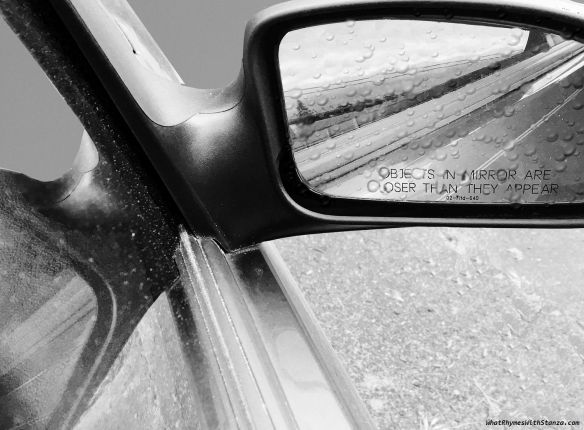
mirror 1500

Checking In

I don’t recall the last time we had dined
with just the two of us away from home.
I guess we’d never found ourselves inclined
to try relating one-on-one alone.

Conversation did not come easily,
but not for lack of words that need be said.
In short, your failing ears could not hear me.
Nonetheless you’d smile and nod your head.

A gentleman you’ve been for all your years,
your empty wallet drawn to pay the bill.
You needn’t pay, Dad, now that you live here.
I bussed the table once you’d had your fill.

A nurse came by and took you by the sleeve.
It’s best, she said, that you not see me leave.


Also posting for V.J.’s Weekly Challenge #42: farewells

In Passing

Haagen park

We met at the park, the one where a paved trail winds around an open grass field. He walked his tiny black poodle in one direction. I walked my midsize white Eskie in the other, and we would cross paths, usually beneath the tall cedar trees that provided welcome shade in the summer, and protection from rain the rest of the year.

His name was Don. The poodle was Mon Cheri, his neighbor’s dog that he borrowed for his morning walks.

Don would see us approaching on the trail, and would exclaim, “Look, Mon Cheri, it’s your friend!”

Mon Cheri would growl at my Chules and strain at her leash to gain distance. Don didn’t seem to notice, and neither did Chules.

Don would smile at Chules. “What a happy dog! Isn’t he pretty, Mon Cheri?”

At some point, Don changed direction on how he walked the loop, from clockwise to counterclockwise. I changed direction, too. Don seemed nice enough, but no matter how many times he tried to cajole Mon Cheri about her happy fluffy dog friend, Mon Cheri still rejected Chules.

Over time, our conversations expanded. I told him about stripping the old oak floors in my house. He warned me about fumes and gas pilot lights, lest they meet and blow up the house.

Don explained his reason for changing directions on the loop. It was easier to navigate a small incline in the path.

“You can’t see it, but it’s there,” he said.

He was right. I couldn’t see it.

I didn’t see Don for a while, and then one day he was back. He had shaved his beard, and maybe his head as well. He always wore a flat newsboy cap, and I had never noticed his hair length. His pace had slowed considerably.

“How are you doing?” I asked. “I’ve missed seeing you.”

“Oh,” he replied. “I’ve been coming later than I used to. I don’t get up as early in the mornings anymore. And on Sundays I go to church. It’s nice to see everyone.”

I contemplated inviting Don out for coffee. He seemed lonely. And frail. More frail each time we met. But it felt awkward, so I didn’t ask.

One day, we met on the path, and Don told me about receiving chemotherapy. He’d decided to stop treatment and resort to positive visualization and healthy eating  and “all those things they say to do.”

This was the first time Don had spoken of his health, or anything intimate or personal at all. I didn’t know what to say.

I made some throat noises that I hoped were consoling, and agreed when he said sometimes it’s best to let things take their course.

He was tired, I could tell. Tired of struggling to walk up imperceptible inclines. Tired of fighting battles he would ultimately lose. He’d even given up on trying to convince Mon Cheri that she and Chules were fast friends.

I didn’t see Don after that.

One day I crossed paths at the park with another man and his dog. I had seen them on several occasions stop and speak with Don, just as I had done.

“Have you seen Don lately?” I asked.

“Who?”

“The gentleman with the little black poodle and the newsboy cap. He used to walk here, but I haven’t seen him in a while.”

The man didn’t know who I meant.

I cried for Don. I hoped he’d had a good life. I hoped he’d been loved.

Chules and I don’t visit that park much anymore. We walk a different trail now, where we sometimes cross paths with a man and his midsize black dog named Pink.