Elegy for All

If you die tomorrow,
I will write you this elegy,
because you are loved
and you will be missed.

And if you sense no love
and no connection
and feel as though no one will even notice
when you are gone,
you may read this elegy and know that
you are loved more than you know, and —
in ways you may not even perceive —
you matter very, very much.

If I die tomorrow,
I will know I am loved
and that I had connections
of soul and heart and mind
with those whose paths touched mine.

I will be missed
by those I love and those who love me, and
even by some who don’t know me at all,
because perhaps — in ways I may not even perceive —
I mattered to them.

For today, though,
before this elegy applies,
let’s notice and celebrate –
if we are able —
our blessings of love
and connection, and of mattering.

Let’s make a difference
for those who do not feel so blessed.

Let’s open our souls and hearts and minds
to one another so we needn’t wait until
tomorrow to read this elegy and
discover just how very, very much
we all, indeed, matter.
elegy


NaPoWriMo Challenge, Day 24: “write an elegy – a poem typically written in honor or memory of someone dead. But we’d like to challenge you to write an elegy that has a hopefulness to it.”

Preacher

“Will you deliver the sermon?” he asks me.

One Sunday a year, the pastor teaches Sunday School
and asks parishioners to lead the worship service
in his stead.

Ha! Me? Preach a sermon?
I preach to my kids all the time,
mostly in the form of
“Do as I say, not as I do.”

A potential theme for a Sunday message, for sure,
but would it play well to the gray-haired majority of
this small congregation?

I think not.
It doesn’t even play well with my kids.

I hate public speaking!
And I’m none too endowed in the reverence department, either.
No way! I say to myself.
“Sure!” I say to the pastor.

On the given day, I rise to the podium.
(“It’s called a pulpit, dear” an angel whispers encouragingly.
“Shows just how qualified you are to stand behind it,”
scoffs the dude with the pointed tail.)
I look out over the sea of blue perms, bald pates, a few mullets…
and I gulp.

A voice I don’t recognize delivers anecdotes
mixed with pious postulations;
a splash of bible verse, a dash of poignant quotes
and a twist of lame joke.

Stirred, not shaken.

At one point, I tell a story about my young daughter
and I use the word “mom” a couple of times in succession.
From the rear of the sanctuary, a toddler responds.
“Mom?”
People laugh.
“From the mouths of babes,” I say.

Soon enough (or not soon enough, some may think)
the service ends.

Polite parishioners approach and tell me how well I did.
Truth be told, I thought it went pretty well myself.

A diminutive elderly woman tugs on my sleeve.
I bow slightly so I can hear her comment.
“You gave a very nice sermon,” she says, patting my arm.
“Thank you!” I beam.
“Of course, I couldn’t hear a word of it.”
She turns and slowly totters away
toward the cookie-laden tables in the fellowship hall.

At first I’m dismayed that she would complement
without having heard my sterling performance.
(“Performance?” the angel arches an eyebrow.)
But then, I think, maybe she’s on to something.

Without being put upon by someone else’s message,
she is free to rest in a pew on a Sunday morning,
surrounded by congenial peers
(“… and some noisy rugrats,” the horned heckler interjects),

and worship in her own choice of words.

Amen to that, I say.
Amen, says the angel.
Whatever, says the sulphurous cynic.

“Can we go home now?” asks my daughter.
“Let’s.”

Thus endeth my preaching career.

sg 11th partial


NaPoWriMo challenge, Day 23: write a poem based on sound. 

Driving in Reverse

NaPoWriMo Challenge, Day 18. The prompt “sounds a bit more complicated than it is, so bear with me! First, find a poem in a book or magazine (ideally one you are not familiar with)… [C]over everything but the last line. Now write a line of your own that completes the thought of that single line you can see, or otherwise responds to it. Now… uncover the second-to-last line of your source poem, and write the second line of your new poem to complete/respond to this second-to-last line. Keep going, uncovering and writing, until you get to the first line of your source poem, which you will complete/respond to as the last line of your new poem. It might not be a finished draft, but hopefully it at least contains the seeds of one.”

Well, it wasn’t hard to find a poem I’m not familiar with, as I’m not much of a literary reader. When I came across a poem written by Sheryl Luna and titled, “Neighbors Smoke on an Apartment Porch Owned by a Mental Health Agency,” I knew that would be perfect for this challenge. You can follow the link to read that poem.

Here’s my reverse response. I guess I’ll call it Mental Faculties.

Waiting their chance to bloom,
strength belied by failing light,
old habits won’t die today.

Rheumy eyes remove the hues.
Calm comes with slowing down.

Peeling bark, in rough contrast,
remember they once blossomed, too.

Come in to the sobering shade,
rise and heal thy pain.

It’s all relative, so we’re told
a tale of plums and prunes.

Wishing never leads the charge,
sinners peddling soulless fates.

Free to fly once weight-relieved,
yesterday’s work, today’s debris,

smoothed as with a butter knife,
carried high on joyful wings.

What’s left from those who sow and reap —
saying so won’t make it true —

forestalls, refusing to leave.
Stalwart nature, man-made trees,
far from home yet searching still,

if only one could hear.

They care more than one might think
of being heroes or villains.

Do-overs can set them free,
enlightened by the truth.


couch

De-Composing

NaPoWriMo Challenge, Day 19 (still catching up): An erasure poem as described by poet Dan Brady.

“First, write a paragraph of prose about anything you want. Next scan through the text and try to erase it down to a single sentence or phrase. The erased text becomes your first page and the full prose paragraph becomes your last page. Now see if you can add bit by bit to create a sequence that builds across several pages/iterations between the initial phrase to the complete text.”

erasure poem

rosemary3

All in the Timing

You don’t think we can, do you?

I know it can’t be done…

I’ll prove I’m right, I’ll prove you wrong.

… by you or anyone.


Right down that row, that’s where we’ll go.

In here, it’s called a lane.

Set up the pins, we’ll knock ‘em down.

 You’re really quite insane.


You pull Grandpa by the head

and mind his face, I know.

I’ll grab his legs and give a push.

Just take it nice and slow.


Steer clear the gutters ‘til the end.

That’s what my daddy said.

Dead center for a hole-in-one.

A “strike.” But yes, Dad’s dead.


They all fell down, we’ve won the round.

And Grandpa’s in the pit.

One problem, though, that’s only ten.

Well, just you wait a bit.


Pins swept away, news ones in play…

The gears are grinding slow.

And Grandpa clock is smashed to bits.

It’s really quite a show!


His casing’s cracked, his springs have sprung!

His hands are in the air.

He’s hit three pins in the lane next door.

I think he bowled a spare!


And there it is, just like I said!

It couldn’t be foreseen.

Grandfather clock will strike no more…

… but he did once strike thirteen.


NaPoWriMo challenge, Day 22: Take [a] statement of something impossible, and then write a poem in which the impossible thing happens. “The clock can’t strike thirteen.” 

Unpremeditated

shoe lace

I’m trying to catch up in the National Poetry Writing Month challenge. Here’s NaPoWriMo Challenge, Day 20: “Write a poem that involves rebellion in some way.” One suggested approach was to write the poem in a way that rebels against your usual writing style. I tend to want my poems to make sense, to convey a message. Even if it’s a silly poem, I want there to be a point to it. With today’s poem, I wrote with a stream-of-consciousness pace, without concerning myself with whether it was sensical.  Unedited, except for typos. 

As an experiment, it was interesting. As a poem… meh. 


cold as flame.
you said it didn’t matter, and yet
it did.

I can’t thank you enough for
the freedom you gave me.
Or at least loaned me.
Haha.

A hollow laugh. Why do we do that?
If you come for me, I won’t go.
I may follow, but
would you even lead?

These are the rules:
Always make sense.
Always second guess.
Always review and rework until perfection is attained.

Even though there is no such thing.
Even though by massaging everything,
you probably make it worse.

Overworked.
That’s what I am.
Are you?

Does this make sense?
Does anything?
Make sense, that is.

And of course, that perennial question:
does everything – or anything –
need to make sense?

Senseless.
That’s what I am.
Always wanting to be in control.
Or not. I just wish for once
I knew the rules,
so I could
break them.

Narcissus

jonquil

“I never did like Narcissus,” he says,
though I hadn’t asked for his opinion.

“Narcissus? Why not?” I ask.

“It is such a presumptuous flower,
So simple – banal really –
yet it pops up first thing in the spring
as though the world has been awaiting it
all winter.”

“All winter? Perhaps so,” I say.
“It is so beautiful and colorful
and a refreshing change from the ugly winter snow.”

“You know what I think?” he asks.
I don’t know, and I don’t ask.
He tells me anyway.

“I think these narcissus flowers bloom early
just so they can admire their reflections in the melting snow.”

“The melting snow,” I say. “I don’t care. I love them.”
I reach down to pick one of the flowers,
but it won’t come loose of the plant.
I pull harder. It still refuses to budge.

“See that?” he says.
“Narcissus won’t even let go of a bloom.
He wants to keep all the beauty for himself.”

“For himself…” I muse.
I begin to feel faint.
I feel as though I am disappearing.

“Going somewhere?” he asks.

“Going somewhere. Yes… somewhere… somewhere…”

“Say, I didn’t catch your name,” he calls after me.

“Name? Echo. Echo. Echo.”

“Nice talking with you, Echo.
My name is Nemesis.”

Nemesis. Nemesis. Nemesis.


NaPoWriMo challenge, Day 21: Write a poem that plays with the myth of Narcissus in some way. 

Mishmash

balance 4

Eat not, you’ll never want for less.
The next worst thing could be the best.
Heed not and you will find the hidden.
Spare the rod, the child has bidden.

Break some rules to mend the rest.
Let the sun rise from the west.
Speak not, others will pause to listen.
Smash the boat, champagne to christen.

If lies be told, pay heed to rumor.
I found my mind and sensed some humor.
The dead of night awoke the living,
so these sage words I’m thymely giving.


NaPoWriMo, Day 13: Write a poem in which the words or meaning of a familiar phrase get up-ended. 

moving mountains

mountain 2

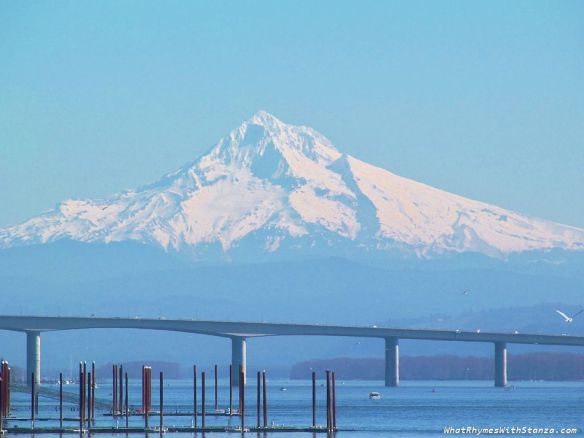
Some days the mountain sparkles in the sun with its snow-covered slopes. At other times it is invisible behind clouds and fog and – sadly – smog. But it’s always there, always a touchstone when crossing the bridge that takes me from my town in to the bigger city. Another mountain, easily distinguished by its volcanic rounded top, is more of a surprise when it appears, as I can’t seem to remember where to find it. Does it move across the landscape when I’m not looking? I have to keep my eyes on the road at least part of the time, and it would be easily missed. A third mountain is even wilier, and sometimes I mistake it for the first. Perhaps I need to concentrate more to get my bearings. Or maybe it’s just hard to see the mountains for the molehills.

branches in the wind
go to ground in my garden
dog hunts scent of birds


NaPoWriMo Challenge, Day 12: Write a haibun that takes in the natural landscape of the place you live.