Corvid

crow

You perch in silhouette on overhead power lines,
a black bird cutout from the gray-mottled clouds.
I’ve read that you recognize faces, and can
distinguish the friendly from the ill-willed.
I’ve read that you can even pass that specific discernment
down to your offspring.

And so, when you begin scolding me in raucous cawing,
I face you square on and remind you that I’m one of the good guys.
You laugh (or so it seems) and swoop down to the garden wall
where you observe (or so it seems) my every move.
When I return to the house, you will drop to the ground
and inspect the results of my comings and goings.
Perhaps I have turned up a tasty morsel from the garden.

You’ll return to your high wire and pose again,
black-on-black in silhouette against the sky.
And somehow, I take comfort in imagining
I have gained your approval and won’t fall victim
to a murder of crows.

dVerse Poetics: On Shades of Black

Invisible

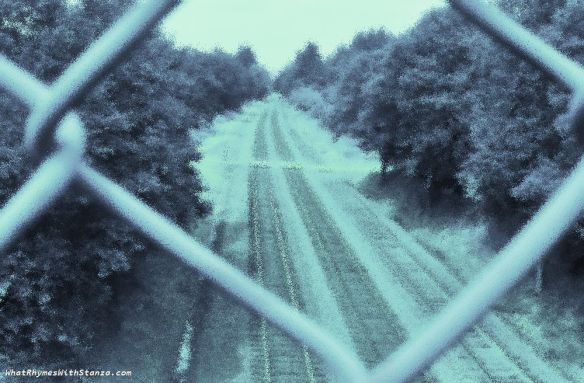
tracks

You didn’t see me.
You watched my reflection
turn in a direction
you chose not to see.

You didn’t hear me.
You thought I was sleeping.
In fact, I was weeping.
You chose not to hear.

You didn’t touch me.
You thought I might crumble.
You thought you might stumble.
You chose not to feel.

You didn’t miss me.
You thought I had left you,
came not to my rescue.
You chose to move on.

I vow to be seen,
and heard and respected;
my path self-selected;
invisible no more.


dVerse Poetics: Invisible

Overload

keyboard

“I can’t do this anymore!”
The laptop stares at me from the kitchen table
where I sit, defeated head fallen into helpless hands.
It has stalked me from my work office to my home.
Black and white pixels layer documents across its screen,
a lasagna of files dumped from an overstuffed virtual briefcase.

I can’t do this anymore.
My husband stares at me from the kitchen counter
where he sits, a lukewarm mug of coffee cupped in soft hands.
Did I say that out loud?
His disapproving frown indicates that I did.

I shove the opened laptop across the table.
It stops just shy of the edge.
I wish it would have fallen,
hit the linoleum floor and
shattered into a million pieces.
I wish I could do the same.

“Two more years,” he says.
“Stick with it for two more years, and then I can retire.
We’ll move to the valley and you won’t have to work.”

Two more years? I can’t do that.
Nor can I fathom any middle ground between
two more years and not anymore.

I can feel myself being compelled toward the edge
where I will teeter until the inevitable fall.
I wonder how many years it will take
to recover the million pieces.


In response to the dVerse Poetics prompt:

“… the Poetics challenge today is to write a confessional verse in the style of [Sylvia Plath, Robert Lowell, Anne Sexton…] … or write something which plays with the ideas expressed here — to put your regrets, your guilts, your sins, your humanity, your lived experiences, and all that you have kept within, out there through unbridled frankness or hyperbole or hidden allusions and metaphors or in any which way you want. It is all about challenging the restrictions that we impose in our written expression and to share something which is depictive of our own self.” 

On Time

time2

Who invented time?

I mean, really…
before there were calendars and watches
and birthdays and scheduling apps and
• b
• u
• l
• l
• e
• t

journals,

who decided we need to slice and dice our days and
months and years into the confines of linear numbers?

The planets and suns and moons
run circles around one another on a fairly regular basis.
They do not, however, march on like time.

Circles, cycles, ellipses, eclipses…
It is humans, not nature, who love to be linear.
We wait in lines to catch the bus, because buses must run on time.
We meet deadlines to stay timely,
read headlines to keep up with the times,
string power lines to serve the demands of modern times,
post bylines, because it’s about time we got credit for our work.

There’s no time like the present.
Time is on our side.
Time stands still for no one.

What would happen if we all became timeless?
I guess only time would tell.


dVerse Poetics: Time and What If? 

world afire

Had we only raked the forest floors
we could have stopped the fires.
If we built a higher wall,
tear gas wouldn’t cross the border.
There is no global warming;
can’t you feel the cold rain
falling on the fallen?

Anger rakes across my senses,
fire ravages my gut.
Walls can’t contain the pain
or hold back the tears.
The earth burns with desperation
as hearts grow ever colder.
And all the while, it is snowing in Russia.

stump


dverse Poetics: fire up that creativity

Let Sleepy Towns Lie

jail time

The sands of time had ground to dust.
The wheels of justice left the bus.
My day in court long overdue,
due process – it seemed – had stood me up.

This sleepy town gave me arrest
for stealing nest eggs off their nests.
When left to choose ‘twixt right and wrong,
I wrongly chose, then quickly left.

Blind justice sniffed me out that day,
threw me in jail; the key, away.
Each year, society’s ransom grew.
How long until this debt was paid?

One night I knew just what to do.
I poison-penned an IOU,
slipped through the cracks and stole away,
and vowed my life of crime was through.

I bailed from jail, but I’m still not free.
I watch my back, it watches me.
I’ll no more practice to deceive, ‘cuz
from ‘neath her blindfold, justice sees.


dVerse Poetics: Twisted Adages. “For this week’s Poetics, we will start with an adage, or several adages, but we won’t stop there.  I am asking you to craft your poetry around an adage or two that you must change in some significant way.”

I may have gotten a bit carried away with my wordplay, but you know, when it rhymes, it pours. 

I wrote a previous post that fits the bill for this challenge as well. You may find it here.