Sweet Bella

bella3

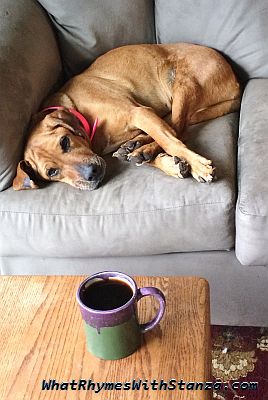
Bella went to heaven today.
Now her worry wrinkles will unfold.
She will take well-earned peaceful naps
and  wake the angels with her snoring.

Bella1

She will bow down and wiggle her butt
in the universal “let’s play” gesture,
And other dog angels will tussle with her
in fields of sweet grass and flowers.

bella7

She will live forever in our hearts,
her soulful gaze will touch our thoughts.
Her memory will always bless us,
just as she did in life.

bella5

Rest in peace, Miss Bella.

Day Six: Ekphrasis

Day Six of NaPoWriMo.*

Today’s prompt asks us to
“write a poem from the point of view of one person/animal/thing from Hieronymous Bosch’s famous (and famously bizarre) triptych The Garden of Earthly Delights.”

I used a different painting, Franz Marc’s “The Fox” for my poem, but with the same concept of using the subject’s point of view.

Here goes:

foxes

Outfoxed

As cities crumbled in disrepair,
we watched from forest shadows,
not understanding what forces cause
a species to implode.

As flora died in poisoned air,
we retreated into denser woods,
left to fathom such machinations
that place greed above survival.

With no place left to seek reprieve,
we huddled amidst brambles,
hiding from blind ignorance
that sought to take our lives.

And then the whole world shattered
into a million pieces.
We raised our heads to face our death,
and instead were met with

blue skies free from factory smoke,
waters clear as young fawns’ eyes,
fish emerging from the depths.
plants burgeoning in replenished soil.

We snuggled in comforted embrace
as nature reassembled,
as order rose from chaos
under Gaia’s healing eyes.


*National Poetry Writing Month, Day Six. Ekphrastic poetry

Corvid

crow

You perch in silhouette on overhead power lines,
a black bird cutout from the gray-mottled clouds.
I’ve read that you recognize faces, and can
distinguish the friendly from the ill-willed.
I’ve read that you can even pass that specific discernment
down to your offspring.

And so, when you begin scolding me in raucous cawing,
I face you square on and remind you that I’m one of the good guys.
You laugh (or so it seems) and swoop down to the garden wall
where you observe (or so it seems) my every move.
When I return to the house, you will drop to the ground
and inspect the results of my comings and goings.
Perhaps I have turned up a tasty morsel from the garden.

You’ll return to your high wire and pose again,
black-on-black in silhouette against the sky.
And somehow, I take comfort in imagining
I have gained your approval and won’t fall victim
to a murder of crows.


dVerse Poetics: On Shades of Black

Lost and Found

spider and bug

The spider works quickly to get the larger insect wrapped within its web. The insect doesn’t struggle; it may be dead. But the web is in tatters and shakes violently every time the spider moves. I watch the action, hoping the spider secures its hard-won meal before the web gives out.

Progress is slow, and my attention wavers. When I check back, the spider is sitting motionless in its sparse web, and the big catch-of-the-day is nowhere in sight. Has it fallen from the web? After all the spider’s hard work? I am compelled to make it right, find the bug. Maybe I can stick it back on the web somehow.

I part the plants beneath the spider’s web, and sure enough, there it is. Still wrapped in webbing. Still dead. But… moving? Two small ants have taken a hold of the hapless bug and are hauling it off as their own pre-wrapped prize. I am too late. Nature has already made it right.

nature’s web pulled taught
broken strands and gaping holes
mend on, weavers, mend


dVerse Haibun Monday — Lost and Found: Nature’s Magic

Spring Awakes

Day 25 of NaPoWriMo.

Today’s Prompt:

Taking a cue from John Keats’ poem, “To Autumn,” write a poem that (a.) is specific to a season; (b.) uses imagery that relates to all five senses; (c.) includes a rhetorical question, like Keats’ “where are the songs of spring?”

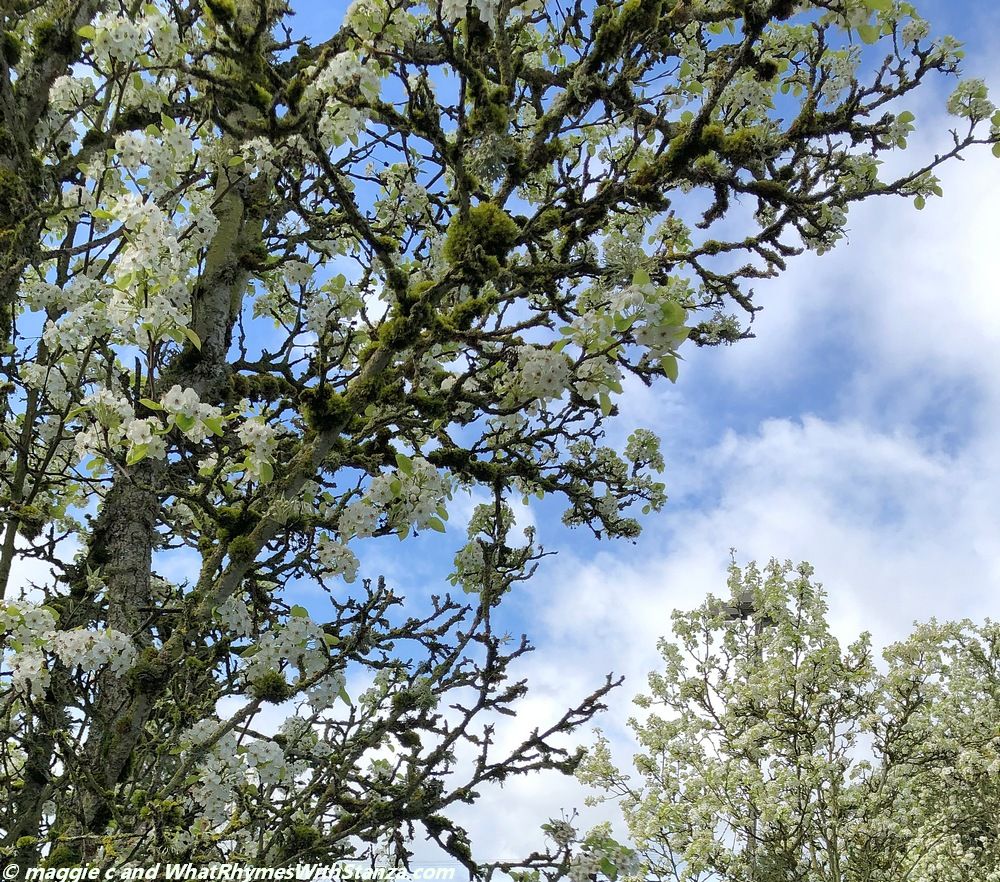
I’m so enjoying the warmer weather of late, and all the greenery, I couldn’t imagine writing about any season other than Spring.

Spring

Spring Awakes

In increments imperceptible to most,
light of day expands, hours of dark recede,
and life erupts from warming soil;
sprung from damp earth, a geyser of green,

gushing through garden and bramble and lawn,
flowing up trees, pushing sap as it surges,
splitting through soft bark of branches and twigs,
spewing leaves and blooms when at last it emerges.

While Steller’s jays gather moss for their nests,
the smaller scrub jay and a petulant crow
vie for clear title to raspiest call; and
collared doves hide in tall trees, and echo:

who Whoo who, who Whoo who.

Who planted the bulbs shooting up through the duff?
sacheted hyacinth, tulip and dainty blue bell,
bouquets laced with pungent rosemary sprigs,
and laid atop carpets of soft lemon basil;

as dandelions and dead nettle wait to serve tea.

The Way of the Whale

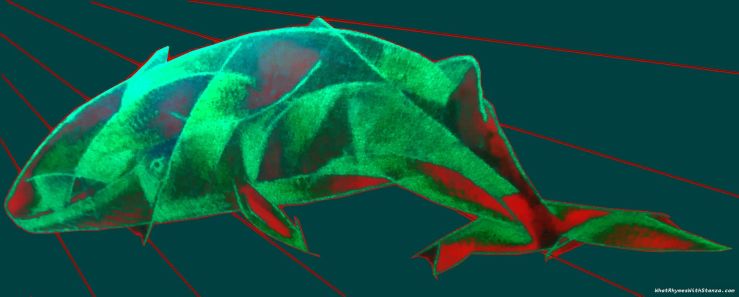
NaPoWriMo, Day 23. The prompt:

Write a poem about an animal.


whale-3

Tell me again about the whales, Great-gran; did you
ever see one?

Yes, child, I have seen them,
but only from afar.

Even at a great distance, it must have been amazing!

That it was, child. That it was. Such grand beings!

What happened to the whales, Great-gran?

Oh, child, they went the way of the dinosaur,
and the wolf, and the elephant,
and the eagle…

Oh, how sad.

Yes, yes, it is very sad.

Great-gran, have you ever seen a human?
Great-gran… Why are you crying?

I have seen them, Child. I will not speak of them,
except to say there are some things
I wish I had never seen.

Seasons in Glass

NaPoWriMo, Day 22. The prompt:

Today, I’d like to challenge you to write a poem that engages with another art form – it might be about a friend of yours who paints or sculpts, your high school struggles with learning to play the French horn, or a wonderful painting, film, or piece of music you’ve experienced – anything is in bounds here, so long as it uses the poem to express something about another form of art.

While I did struggle with French horn in high school, stained glass is much more fun. And so I give you:

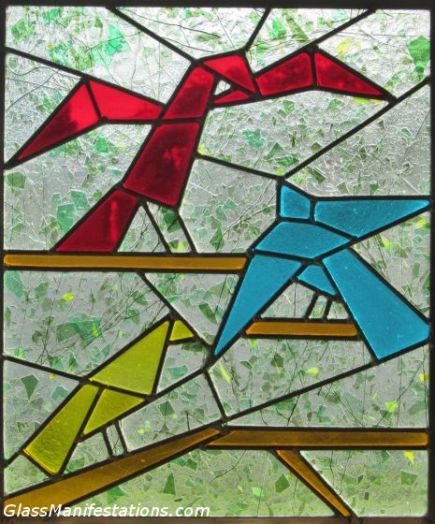
Seasons in Glass

I.

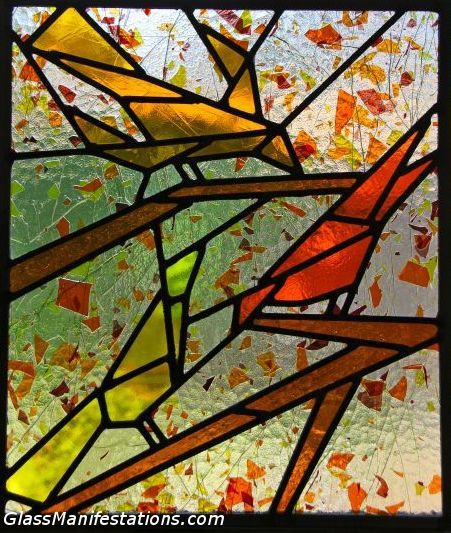
birds-summer

It is Summer.
The trees are full of leaf chips:
green and yellow with black stringer twigs.
I haven’t done glass work in ages.
I will do straight lines.
Lots of straight lines. And lead,
not copper foil. Foil is harder to do.
Birds come to mind.
I don’t really know why.
I spread my wings and begin cutting glass.

II.

birds-autumn

It is Autumn.
The leaf chips have turned gold and burnt orange,
and a deeper shade of yellow.
They are falling.
The birds chatter amongst themselves.
Is it time to head south?
It’s getting colder. They hold their wings close in
to their weightless bodies.
I turn the heater on in my studio.

III.

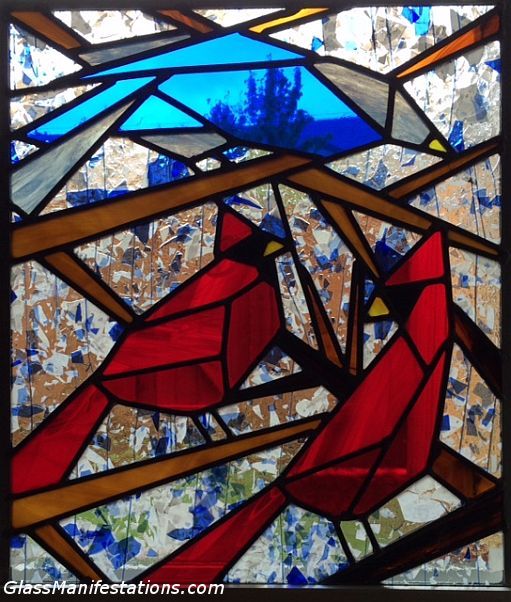
birds-winter

It is Winter.
White snow, blue ice.
This pattern is no longer in production;
the birds need to be larger.
Two fat cardinals land on bare branches and
consult with a larger bird, whose tail feathers
splay a bit to accommodate
smaller pieces of background.
I love the dark red of the cardinals;
a smooth rolled glass that cuts like butter.

IV.

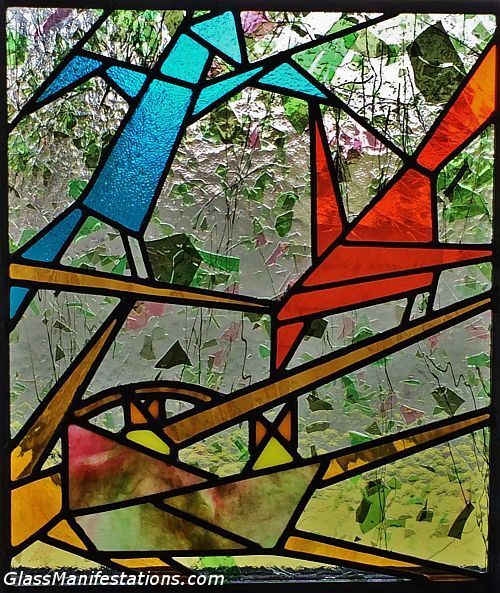
birds-spring

It is Spring.
Leaves are returning.
Delicate lavender flowers
buzz with the breeze of bee wings.
It is time for building nests,
laying eggs,
feeding hatchlings.
How does one differentiate
a worm from a slender tree branch?
I will allow curves this time.
After three seasons,
I think I’m ready.

Jackals in the Key of C-Sharp Major

Day 21 of NaPoWriMo. The prompt:

write a poem that incorporates wild, surreal images. Try to play around with writing that doesn’t make formal sense, but which engages all the senses and involves dream-logic.

I’ve been told before that I don’t make sense, but I’ve never before been asked to make less sense. Does that make any sense? Here goes:

Jackals in the Key of C-Sharp Major

When the jackals came calling, we hid
on top of a mound of field mice stacked like rows of bricks.
The jackals didn’t see us;
they were searching through the magazine racks to the east.

Turkey vultures triangled above, calling to the jackals,
pointing with their flowing pink boas,
but the jackals didn’t hear them pointing.
They were listening to us sing songs about the stupid jackals.
The field mice joined in on the chorus,
but only when it was in the key of C-sharp major.

Then the tanks rolled in, three across and ten deep,
camouflaged with tie-dyed circles the color of a midday shadow.
They rumbled through the disco,
rattling the ground with their relentless tracks,
strewing trails of Skittles in their wake
like so many teeth shaken loose from a cantaloupe skull.

Turkey vultures flapped their pink boas and chased the Skittles to ground,
trying once more to alert the jackals,
but all the hapless birds could manage to squawk out
through candy-jammed beaks were
the words “peace” and “sunshine.”

The field mice, or at least the bravest among them and
those upon whose heads we were not standing, ran
toward the turkey vultures singing “peace and sunshine.”
They wanted to join in on the chorus,
but only if it was in the key of C-sharp major.

The jackals chased the field mice down the tank tracks,
scattering Skittles, tripping over turkey vultures,
dancing through the disco, flipping through magazines,
and came to a rumbling halt at our feet, and – non-coincidentally –
at the teeny-tiny paws of such field mice as had remained behind.

Other than the pink boas circling their heads like fluffy crowns,
the jackals looked utterly ridiculous.
And stupid.

We sang them a song in the key of C-sharp major
and headed home.
All of us.
Exhale

NaPoWriMo, Day 19.

The prompt:

Today, I’d like to challenge you to write an abecedarian poem – a poem in which the word choice follows the words/order of the alphabet. You could write a very strict abecedarian poem, in which there are twenty-six words in alphabetical order, or you could write one in which each line begins with a word that follows the order of the alphabet.

Okay, the directions seemed simple enough, but somehow I got it backwards.

Exhale

Zoey
Yearned to
eXhale.
While breathing is indeed a
Valuable asset for living, it is generally
Understood that if one goes to the
Trouble of inhaling, it’s
Simply impossible to
Refrain from exhaling. The obvious
Question, then, is what
Prompted Zoey to possess this
Oddly understated desire.

Needless to say – one would hope — the perpetual
Mishandling, neglect and abuse of an animal will
Lead to mistrust, fear and – in Zoey’s case – a
Keen sense of danger such that
Just by exhaling, she might incur the
Inability to protect herself from harm.

Her wish for safety and security was
Granted one day in the
Form of earthbound angels who
Extricated her from her dire,
Debilitating situation, and through
Care and love and patience, Zoey was
Bestowed once again with her rightful
Ability to fully, exhilaratingly exhale.