Day Eighteen of National Poetry Writing Month! Today’s prompt from NaPoWriMo.net:
write an abecedarian poem – a poem in which the word choice follows the words/order of the alphabet. You could write a very strict abecedarian poem, in which there are twenty-six words in alphabetical order, or you could write one in which each line begins with a word that follows the order of the alphabet. This is a prompt that lends itself well to a certain playfulness. Need some examples? Try this poem by Jessica Greenbaum, this one by Howard Nemerov or this one by John Bosworth.
Day Fourteen of National Poetry Writing Month. The muses at NaPoWriMo.net have given us this prompt for today:
…write a parody or satire based on a famous poem… take a favorite (or unfavorite) poem of the past, and see if you can’t re-write it on humorous, mocking, or sharp-witted lines. You can use your poem to make fun of the original (in the vein of a parody), or turn the form and manner of the original into a vehicle for making points about something else (more of a satire – though the dividing lines get rather confused and thin at times).
Since I too get rather confused (though seldom thin) at times, this prompt is a perfect fit. The poem I chose to work with is Shakespeare’s Sonnet 18: Shall I compare thee to a summer’s day? For those of us who are bard-challenged, I will post Shakespeare’s version below. But first (since I control the quill), here is my rendition:
Sonnet 4: Shall I compare thee to an iced latte?
Shall I compare thee to an iced latte?
Thou sadly in cup holder dost not fit.
While coffee stains can really ruin my day,
I can control the spillage with one sip.
Sometimes you can be cold as latte’s ice,
Complexion like milk curdled in the sun.
I think it’s fairly safe if I surmise
Your pull date has already come and gone.
My latte won’t last long enough to sour
Nor lose its taste if ice begins to melt.
I tend to drink it up within an hour
The liquid sloshing gently ‘neath my belt.
   I hope this verse has not offended thee.
   So long to you and your oft bitter tea.
And Shakespeare’s sonnet:
Sonnet 18: Shall I compare thee to a summer day?
Shall I compare thee to a summer’s day?
Thou art more lovely and more temperate:
Rough winds do shake the darling buds of May,
And summer’s lease hath all too short a date;
Sometime too hot the eye of heaven shines,
And often is his gold complexion dimm'd;
And every fair from fair sometime declines,
By chance or nature’s changing course untrimm'd;
But thy eternal summer shall not fade,
Nor lose possession of that fair thou ow’st;
Nor shall death brag thou wander’st in his shade,
When in eternal lines to time thou grow’st:
   So long as men can breathe or eyes can see,
   So long lives this, and this gives life to thee.
The gray sky is low, pushing down on me
as my dog and I sidestep puddles in our path.
A sense of sadness seeps onto me, settling
like heavy mist on a wool coat.

Unexplainable loneliness rises up as though
from the rain-dampened earth and I am
enveloped in a fog of… it almost feels like despair …
that I know is not my own.

My dog, a double-coated spitz,
shakes his body in a spasm that
sprays rain water off him in all directions.
My pants leg is flecked with tiny droplets.

Arriving home, I unbuckle his leash and dry him with a towel.
He shakes again and the moisture from his
undercoat surfaces. I touch his fur; it’s as wet
as though I hadn’t wiped him down at all.

If I were to sift my fingers through his thick coat
down to the skin, it would be dry and warm.
I, conversely, am cold and shivering and wet.
An involuntary shudder courses through me,

as my psyche tries to shake the melancholy
from my soul.
It’s Day Ten of National Poetry Writing Month, and today’s challenge from NaPoWriMo.net is to write a sea shanty.
these are poems in the forms of songs, strongly rhymed and rhythmic, that sailors might sing while hauling on ropes and performing other sea-going labors. Probably the two most famous sea shanties (at least before TikTok gave us The Wellerman) are What Shall We Do With A Drunken Sailor? and Blow the Man Down. And what should your poem be about? Well, I suppose it could be about anything, although some nautical phrases tossed into the chorus would be good for keeping the sea in your shanty. Haul away, boys, haul away!
So here we go!
This shanty I’ll be singin’ you
is somewhat false but mostly true
and of no consequence to you,
I’ll tell it anyhoo.

Where ocean meets the beachy land
a ship was snared upon the sand,
a vessel maybe tall and grand,
I never really knew.

    Yo ho, she’s stuck there still,
    now barely more than rust and krill.
    Tho waves come tugging at her sill
    her sailing days are through.

The Peter Iredale she was named,
from Liverpool her owner came,
the Beatles hailed from there the same,
though none the other knew.

In nineteen oh six she came ‘round
for Portland, Oregon she was bound.
a northwest squall pushed her aground,
but didn’t harm her crew.

    Yo ho, she’s stuck there still,
    now barely more than rust and krill.
    Tho waves come tugging at her sill
    her sailing days are through.

No craggy coastline is to blame,
No pirates set the ship aflame.
A barren beach, it’s pretty lame,
still nothing they could do.

A century and more it‘s been
The masts at low tide can be seen,
The bow lists towards the waters green
Her sailing days are through.

    Yo ho, she’s stuck there still,
    now barely more than rust and krill.
    Tho waves come tugging at her sill
    her sailing days are through.
Day Nine of National Poetry Writing Month! Today’s prompt from NaPoWriMo.net:
We’re calling today Sonnet Sunday, as we’re challenging you to write in what is probably the most robust poetic form in English. A traditional sonnet is 14 lines long, with each line having ten syllables that are in iambic pentameter (where an unstressed syllable is followed by a stressed syllable). While love is a very common theme in sonnets, they’re also known for having a kind of argumentative logic, in which a problem is posed in the first eight lines or so, discussed or argued about in the next four, and then resolved in the last two lines. A very traditional sonnet will rhyme, though there are a variety of different rhyme schemes.
My attempt:
For the Love of Springtime in Colorado
Boots sinking deep in mud-browned melting snow,
sweatshirt peeled off and knotted at my waist.
Spring’s dichotomy in Colorado.
Wool socks, sun shades; my rucksack packed in haste.

Crabapples bloom, spent petals drifting down.
Snow lingers where protected by thick shade.
As winter seeps into the thawing ground,
summer will drop like curtains on a stage.

I trek on, heedless of sign and season.
Despite spring breeze or autumnal bluster,
ubiquitous blue skies transcend reason.
I suck the thinning air, my strength mustered.

Toes white with cold, face tanned by sun, I smile.
Springtime in the Rockies keeps one agile.
And click here for a throwback to a previous sonnet I wrote.
My brain is a jigsaw puzzle, with
gangly termites jigging on the pieces.
I saw it with my own ears! So puzzling.
Fred Astaire and the six jiggers.
Tap shoes on high volume,
jackhammer cane dance on my
frontal lobe.

Ginger Rogers on the sidelines,
drinking Jack Daniel’s from a
Texas-sized jigger.
“Mon Dieu,” Her voice the soft breeze of innocence.
“Tastes like circles. Gnarly, to say the least.”
“Smells like ginger,” responds the jigger.

“Looks like a talking jigger.”
Fred slides up the bannister to join them.
“Cut!” shouts the director.
“What evs,” says Fred.
He peels a banana.
Did he turn off the coffee pot this morning?

My brain is a satin pillow.
Every time I lay down, the door bell rings.
[The poet pauses. What will Mags write next?]
The sun will rise tomorrow,
wreaking havoc on my termite-jackhammered brain.
But all’s well that starts terribly!

Scene fades.
Fred in his tux; ginger in the jigger.
Not jigging termites, but some great Irish dancing.
Day Eight of National Poetry Writing Month. The writing prompt from NaPoWriMo.net is a hum dinger, and I remember it from a prior year’s NaPoWriMo.
The prompt is called the “Twenty Little Poetry Projects,” and was originally developed by Jim Simmerman. And here are the twenty little projects themselves — the challenge is to use them all in one poem:
1.  Begin the poem with a metaphor.
2. Say something specific but utterly preposterous.
3. Use at least one image for each of the five senses, either in succession or scattered randomly throughout the poem.
4. Use one example of synesthesia (mixing the senses).
5. Use the proper name of a person and the proper name of a place.
6. Contradict something you said earlier in the poem.
7. Change direction or digress from the last thing you said.
8. Use a word (slang?) you’ve never seen in a poem.
9. Use an example of false cause-effect logic.
10. Use a piece of talk you’ve actually heard (preferably in dialect and/or which you don’t understand).
11. Create a metaphor using the following construction: “The (adjective) (concrete noun) of (abstract noun) . . .”
12. Use an image in such a way as to reverse its usual associative qualities.
13. Make the persona or character in the poem do something he or she could not do in “real life.”
14. Refer to yourself by nickname and in the third person.
15. Write in the future tense, such that part of the poem seems to be a prediction.
16. Modify a noun with an unlikely adjective.
17. Make a declarative assertion that sounds convincing but that finally makes no sense.
18. Use a phrase from a language other than English.
19. Make a non-human object say or do something human (personification).
20. Close the poem with a vivid image that makes no statement, but that “echoes” an image from earlier in the poem.
To read how I responded to the prompt in 2020, click here.
Little cherub on mama’s lap,
surrounded by strangers,
crammed into narrow pews
in a room she does not know.

No color, no toys, no talking. No joy.
She squirms, but just a little.
Everyone stands in unison.

An organ plays, slow and plodding.
Grownups sing, low and droning.
She doesn’t recognize this song,
but music! Music is a familiar friend!

She listens, watching mama’s lips move.
The hymn ends. She knows what follows music.
She claps her little hands together
and gives a cheerful, “Yay!”

The congregation laughs.
Thank God for laughter amidst sorrow, and
thank God, too, for toddlers who
haven’t yet had to learn
the somber intricacies of mourning.
Day Five of National Poetry Writing Month! Our prompt today from NaPoWriMo.net talks about the “juxtaposition between grief and joy, sorrow and reprieve,” and asks us to:
write a poem in which laughter comes at what might otherwise seem an inappropriate moment – or one that the poem invites the reader to think of as inappropriate.
Day four of NaPoWriMo (National Poetry Writing Month). The muses at NaPoWriMo.net have provided this prompt for the day:
Today, let’s try writing triolets. A triolet is an eight-line poem. All the lines are in iambic tetramenter (for a total of eight syllables per line), and the first, fourth, and seventh lines are identical, as are the second and final lines. This means that the poem begins and ends with the same couplet. Beyond this, there is a tight rhyme scheme (helped along by the repetition of lines) — ABaAabAB.
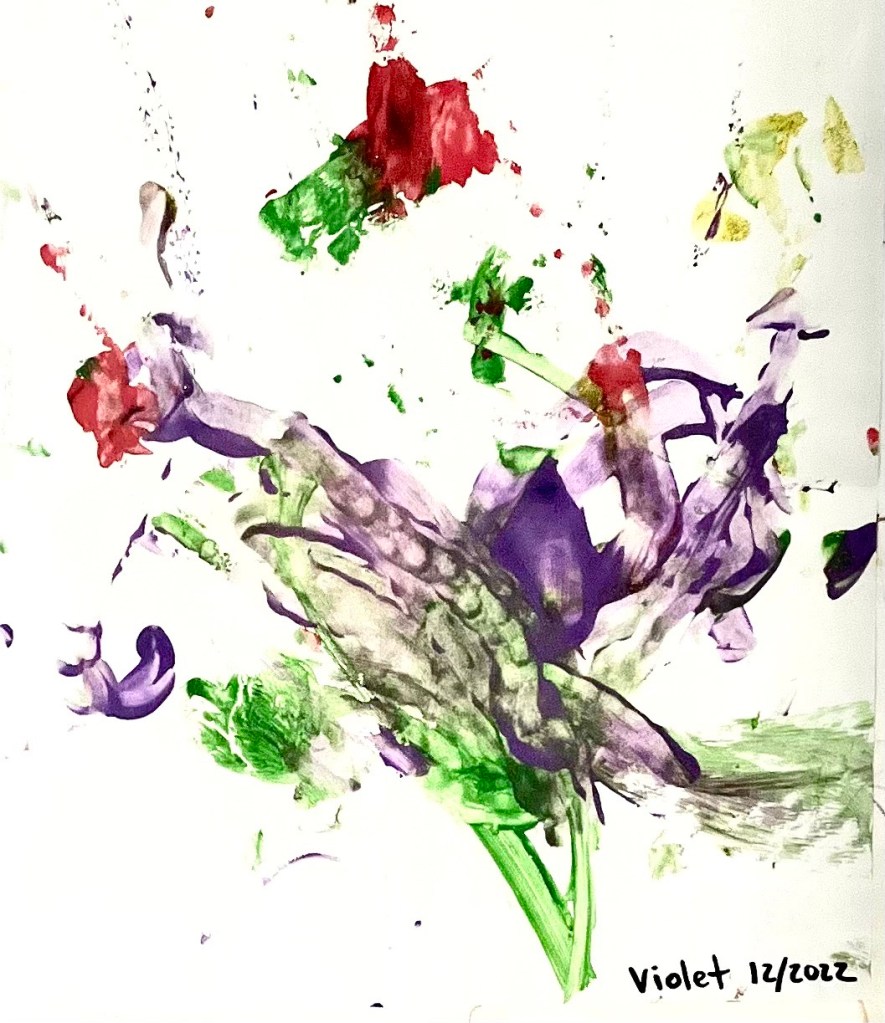
My poem today is also a celebration of my sweet granddaughter Violet’s second birthday. Happy birthday, pumpkin!










 What Rhymes with Stanza?