Sermons and Seeds

The dVerse poetry prompt today is all about the pantoum poetry form. As explained by Gina on the dVerse Poetry blog, the pantoum is a series of interwoven quatrains and rhyming couplets. I won’t elaborate further than that (‘cuz I’d just confuse myself), but you can read Gina’s description of the form here.

Below is my attempt at such a poem.

pantoum1

When bored with a sermon of a Sunday morn,

To the graveyard next door I would go.

Among the gravestones I’d play and roam;

Decorum of death I did blithely not know.


To the graveyard next door I would go

To escape stale air and the pastor’s drone.

Decorum of death I did blithely not know;

Off I would dance over rotting bones.


To escape stale air and the pastor’s drone,

I’d blow dandelion puffballs to free the seeds.

Off they would dance over rotting bones,

Then land between tombstones and weeds.


I’d blow dandelion puffballs to free the seeds

Among the gravestones. I’d play and roam,

Then land between tombstones and weeds,

When bored with a sermon of a Sunday morn.

pantoum2

Unpremeditated

shoe lace

I’m trying to catch up in the National Poetry Writing Month challenge. Here’s NaPoWriMo Challenge, Day 20: “Write a poem that involves rebellion in some way.” One suggested approach was to write the poem in a way that rebels against your usual writing style. I tend to want my poems to make sense, to convey a message. Even if it’s a silly poem, I want there to be a point to it. With today’s poem, I wrote with a stream-of-consciousness pace, without concerning myself with whether it was sensical.  Unedited, except for typos. 

As an experiment, it was interesting. As a poem… meh. 


cold as flame.
you said it didn’t matter, and yet
it did.

I can’t thank you enough for
the freedom you gave me.
Or at least loaned me.
Haha.

A hollow laugh. Why do we do that?
If you come for me, I won’t go.
I may follow, but
would you even lead?

These are the rules:
Always make sense.
Always second guess.
Always review and rework until perfection is attained.

Even though there is no such thing.
Even though by massaging everything,
you probably make it worse.

Overworked.
That’s what I am.
Are you?

Does this make sense?
Does anything?
Make sense, that is.

And of course, that perennial question:
does everything – or anything –
need to make sense?

Senseless.
That’s what I am.
Always wanting to be in control.
Or not. I just wish for once
I knew the rules,
so I could
break them.

Take Two

Here’s another take on Days Five and Six of the NaPoWriMo challenge, combined. Same photo, different poem, different experiment with line breaks. 

Mt Hood 

feel this day
with the soft touch of your gentle eyes
inhale this view; safeguard the scent in your heart
listen to the sunlight; taste its warmth on the mountaintop
tuck this day into the brightest recesses of your outermost soul
and share it as often and as loud and far and bright as you possibly can
for not everyone has the means nor  place  nor time nor the luxury nor sentience
to feel days like this


“Rued” Awakening

You wake me in the morning and it’s always too early,
as though I had only just found sleep and had just chosen
my dream and then – boom! – here you are and there’s the
light coming through the curtains and my dream rolls away
to the edge of the bed where it hesitates just long enough
to tease a glimpse of how it would have played, where it
would have taken me and what lessons I may have gleaned,
and I stretch and try to pull the dream back to me, but it’s
already gone, and so in disappointed resignation, I reach
for you instead and take what slight solace — but mostly
revenge — I can muster as I find the “off” button and
silence your wretched alarm.

curtain3


NaPoWriMo challenge, Day Six: “Write a poem that stretches your comfort zone with line breaks.”  

Chiseled Features

face2

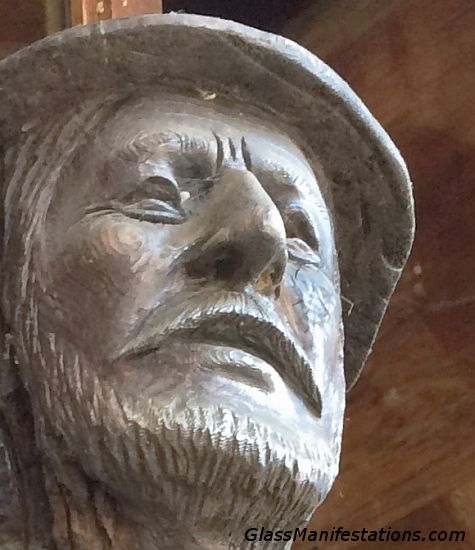
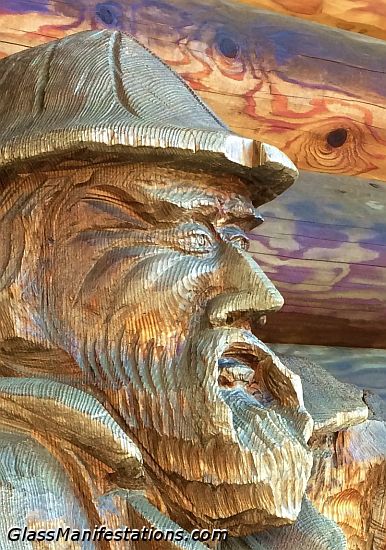
Art comes in many media and creative techniques. These three faces were carved from logs with chain saws, with final touches added by chisel.

face1

The first two represent lumberjacks. And the third is none other than Sasquatch (Big Foot) himself.

face3

These large carvings are on display at Camp 18 Logging Museum in Elsie, Oregon. Photos showing a more distant view of the lumberjacks can be seen in this post on my sister blog, “What Rhymes with Stanza?”


The Daily Post weekly photo challenge: Face

U Came, U Sawed, U Conquered!

u1

You know about Tiffany and his lamps, and how the lamps are put together with copper foil? Well, before Tiffany came along and foiled everything, there was came. Here’s a little description of came. Came 101, if you will.

Came
(noun)
1. a slender, grooved bar of lead for holding together the pieces of glass in windows of latticework or stained glass.

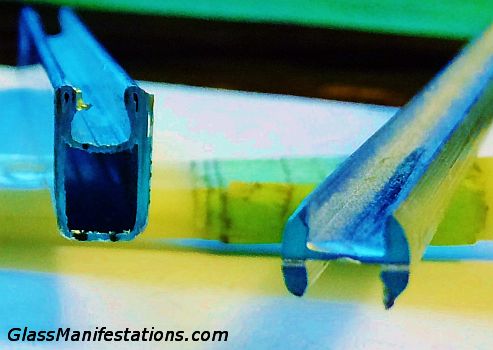
Close, Dictionary.com, but not quite. Came now comes not only in lead, but also in zinc, brass and copper. Maybe other metals, too. I’m not sure. But yes, came has grooves – or channels – that hold pieces of glass together. Or, as in the case of U-came, it can be used as a border to frame stained glass panels.

u3

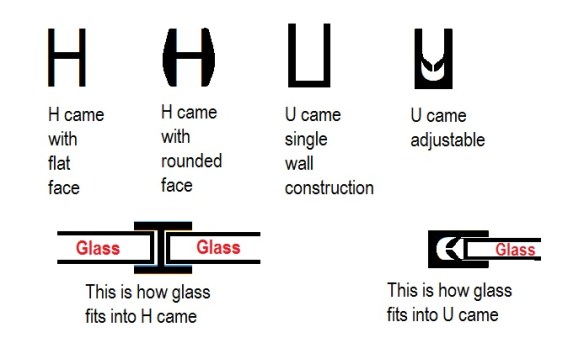
Came comes in an assortment of styles. There is H came that has two channels and thus looks like an H when viewed from the end. The exterior (face) surfaces can be either be flat or rounded.

U came has one groove and thus looks like a U when viewed from the end. Both H and U came come in varying sizes to allow for different thicknesses of glass, and for different face widths, depending on how you want your seams to appear, and on how much support your glass needs in the case of larger, heavier panels or windows.

U2

Lead came can be cut with nippers, but more rigid material, like zinc, needs something stronger to cut it. I use a hack saw. The panel is soldered together at the joints where one length of came meets another.

Okay, that’s all I came here to explain. I hope U got what U came for.


U  U is for U came.

Fids Flatten Foil

f10

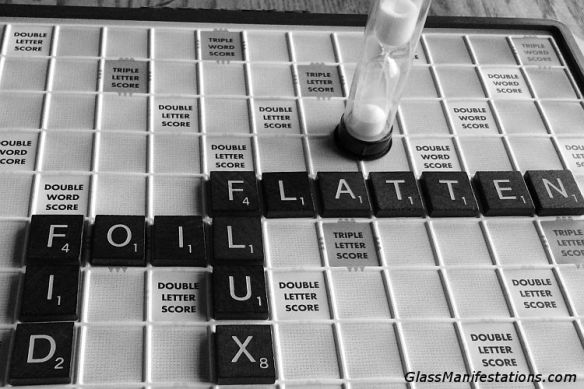
For me, one of the best things about taking up stained glass has been learning the word “fid.” Scrabble, anyone? Sure, it’s only three letters, but that little word has helped me limp along on the Scrabble board more than once.

What’s a fid? Yeah, my Scrabble competitors always ask that, too.

Here’s a photo of a fid:

f1

and another:

f2

and another:

f3

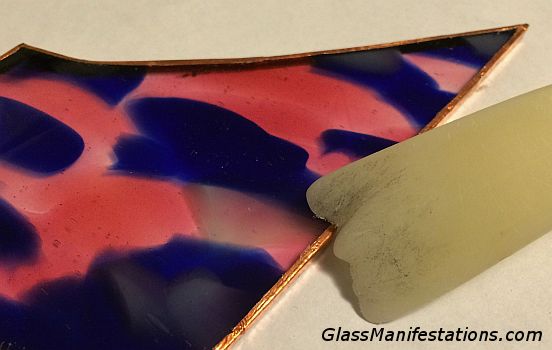
A fid has many uses in the stained glass world. When using the copper foil method of constructing stained glass projects, the individual pieces of glass are wrapped along their edges with copper foil tape.

f4

The foil has a backing that is peeled away to reveal the sticky side. The sticky side adheres to the glass.

f5

A fid is then used to press the copper foil more firmly against the glass, and to flatten the tape securely against all edges of the glass.

f6

This is my favorite fid. The end edge was straight across when I bought it. The grooves were worn in by continued use.

After all the pieces are foiled and assembled, flux is applied to the copper seams and the pieces are soldered together to create the finished project.

f7

Obviously not the same glass project as pictured above, but an example of what finished solder lines look like.

If you are using came instead of copper foil for joining the glass pieces, fids are also helpful for opening came channels to accommodate thicker pieces of glass.

f9

This is a piece of zinc U-shaped came. The glass edge fits into the channel in the came, and the came is soldered at the seams where two or more came pieces meet.

Fids are full of fantastic features for foiling fun forms! Tell that to your Scrabble companions!


F  F is for Fid

Experimenting in the 90s

experiment g

NOTE: Stained glass photos in this post are from scans of  3×5 inch prints taken a loooong time ago by a not very apt photographer (me). I apologize for the quality (or lack thereof) and small size of the detail photos.

You all remember 1998, don’t you? You could buy a dozen eggs in the USA for 88 cents. President Bill Clinton was impeached for lying about… well, everything. Quebec sought independence from Canada. The Wedding Singer was playing at movie theaters, and Spice Girls were playing everywhere else.

Okay, I don’t remember 1998 either, but I think that was around about the time that I bought my glass kiln. It was a manual model, as opposed to a programmable model. The difference being that mine had one dial that went from “1” to “10” to denote how hot you wanted the interior of your kiln to be, and a gauge that showed how hot the interior actually was. Kind of. Ballpark. Your guess was as good as the gauge’s.

Programmable kilns require a degree in computer technology (or a savvy teenager) to operate. They can be set to heat up when you want them to, stay at that temperature for however long you want, ramp up or down to whatever temp you want next… and continue doing so for however many changes your kiln allows you to preset (which is determined by how much money you shelled out for said kiln).

Needless to say, a manual kiln required a lot of experimentation, copious note-taking and additional experimentation to get the results one wants when fusing or slumping glass. Since I’m too impatient to do all of that – and since that seemed boring as all get out – I opted to just experiment to see what the kiln would produce after my wild guesses about how and when to adjust (remember that little 1 to 10 dial I mentioned?) the temperature.

Here are some of my early experiments:

In the 90s, it was really cool to melt a bottle to flatten it, drill a small, angled hole in one end, and turn it into a stick incense holder. I just stopped at the flattened bottle stage.

experiment b

Then, I had a chipped wine glass that was headed for the garbage. I “repurposed” it, chucking it into the kiln to see what would happen. I was thrilled with this result.

experiment c

This next one was quite brilliant! Unfortunately the photo doesn’t show the results well at all (we took photos with cameras back then, not our phones; my phone cord wouldn’t have extended all the way to the kiln, anyway).

I cut a circular piece of textured glass (hence the grid pattern). Then I placed little rocks in the kiln and laid the glass on top of the rocks. The notion was that the glass would melt around the rocks and form a really cool, totally random, bumpy shape.

How was I to know that the rocks I had gathered from the beach still contained moisture inside and would explode once they were heated to umpteen degrees? That session was cut short once the rock shrapnel began pummeling the inside lining of my kiln.

experiment a

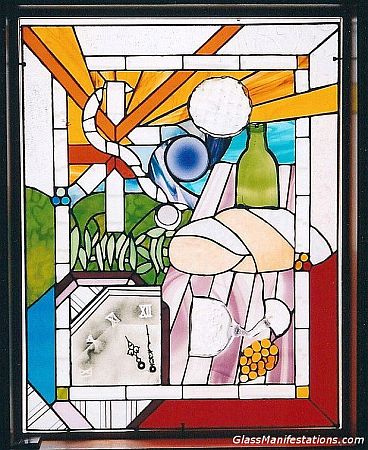
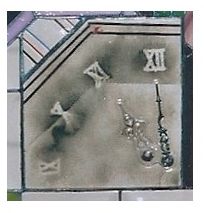
Next, I experimented with sandwiching various things between two pieces of clear glass and fusing them together. Here, I used a couple of metal clock hands. I made the Roman numeral shapes by placing the plastic pieces that came with the clock kit on the glass and sprinkling black fine frit over them. (Fine frit is colored glass that has been ground into powder.) I was smart enough to remove the plastic numbers before preparing the piece for  the kiln (rack one up for the experimenter!).

As I was moving this clock “sandwich” to the kiln, the layers slipped, thus making the shadow line in the frit that mirrors the shape of the glass corner. That “accident” just made it more interesting, so into the kiln it went! I thought this one turned out rather well. Much better than the exploding rock episode.
experiment d

I ultimately soldered my experiment “results” into this panel:
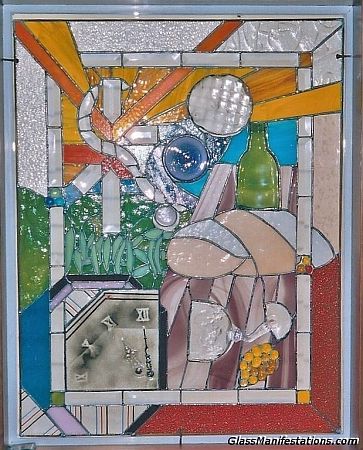
experiment e

Window with no back lighting.

experiment f

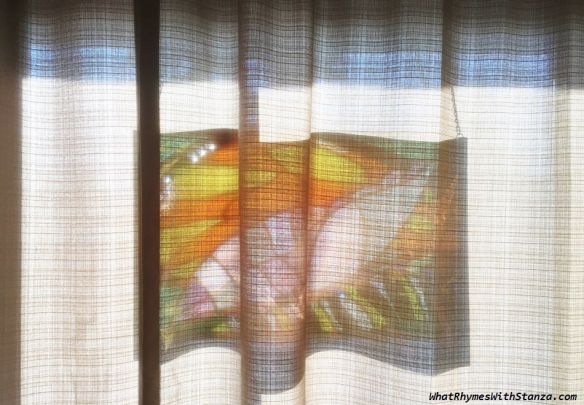
Window backlit by sunlight.

I sold my kiln when I downsized my living space. Probably just as well; who knows what I might have tried next? Will I ever buy another? I doubt it. The programming seems too daunting.

Besides, I’m still learning how to take photos with my cell phone.


E E is for Experiment