Unknown's avatar

About Maggie C

Stained glass artist, writer, respecter of life.

Sonnet Sunday

Day Nine of National Poetry Writing Month! Today’s prompt from NaPoWriMo.net:

We’re calling today Sonnet Sunday, as we’re challenging you to write in what is probably the most robust poetic form in English. A traditional sonnet is 14 lines long, with each line having ten syllables that are in iambic pentameter (where an unstressed syllable is followed by a stressed syllable). While love is a very common theme in sonnets, they’re also known for having a kind of argumentative logic, in which a problem is posed in the first eight lines or so, discussed or argued about in the next four, and then resolved in the last two lines. A very traditional sonnet will rhyme, though there are a variety of different rhyme schemes.

My attempt:

For the Love of Springtime in Colorado

Boots sinking deep in mud-browned melting snow,
sweatshirt peeled off and knotted at my waist.
Spring’s dichotomy in Colorado.
Wool socks, sun shades; my rucksack packed in haste.

Crabapples bloom, spent petals drifting down.
Snow lingers where protected by thick shade.
As winter seeps into the thawing ground,
summer will drop like curtains on a stage.

I trek on, heedless of sign and season.
Despite spring breeze or autumnal bluster,
ubiquitous blue skies transcend reason.
I suck the thinning air, my strength mustered.

Toes white with cold, face tanned by sun, I smile.
Springtime in the Rockies keeps one agile.

And click here for a throwback to a previous sonnet I wrote.

Tap Dance and Termite Jig

Image from kndpng.com
My brain is a jigsaw puzzle, with
gangly termites jigging on the pieces.
I saw it with my own ears! So puzzling.
Fred Astaire and the six jiggers.
Tap shoes on high volume,
jackhammer cane dance on my
frontal lobe.

Ginger Rogers on the sidelines, 
drinking Jack Daniel’s from a 
Texas-sized jigger.
“Mon Dieu,” Her voice the soft breeze of innocence. 
“Tastes like circles. Gnarly, to say the least.”
“Smells like ginger,” responds the jigger.

“Looks like a talking jigger.” 
Fred slides up the bannister to join them.
“Cut!” shouts the director. 
“What evs,” says Fred.
He peels a banana.
Did he turn off the coffee pot this morning?

My brain is a satin pillow.
Every time I lay down, the door bell rings. 
[The poet pauses. What will Mags write next?] 
The sun will rise tomorrow,
wreaking havoc on my termite-jackhammered brain. 
But all’s well that starts terribly! 

Scene fades.
Fred in his tux; ginger in the jigger. 
By Merian C. Cooper, Lou Brock – https://archive.org/details/flying_down_to_rio, Public Domain, https://commons.wikimedia.org/w/index.php?curid=2262169
Not jigging termites, but some great Irish dancing.

Day Eight of National Poetry Writing Month. The writing prompt from NaPoWriMo.net is a hum dinger, and I remember it from a prior year’s NaPoWriMo.

The prompt is called the “Twenty Little Poetry Projects,” and was originally developed by Jim Simmerman. And here are the twenty little projects themselves — the challenge is to use them all in one poem:

1.  Begin the poem with a metaphor.
2. Say something specific but utterly preposterous.
3. Use at least one image for each of the five senses, either in succession or scattered randomly throughout the poem.
4. Use one example of synesthesia (mixing the senses).
5. Use the proper name of a person and the proper name of a place.
6. Contradict something you said earlier in the poem.
7. Change direction or digress from the last thing you said.
8. Use a word (slang?) you’ve never seen in a poem.
9. Use an example of false cause-effect logic.
10. Use a piece of talk you’ve actually heard (preferably in dialect and/or which you don’t understand).
11. Create a metaphor using the following construction: “The (adjective) (concrete noun) of (abstract noun) . . .”
12. Use an image in such a way as to reverse its usual associative qualities.
13. Make the persona or character in the poem do something he or she could not do in “real life.”
14. Refer to yourself by nickname and in the third person.
15. Write in the future tense, such that part of the poem seems to be a prediction.
16. Modify a noun with an unlikely adjective.
17. Make a declarative assertion that sounds convincing but that finally makes no sense.
18. Use a phrase from a language other than English.
19. Make a non-human object say or do something human (personification).
20. Close the poem with a vivid image that makes no statement, but that “echoes” an image from earlier in the poem.

To read how I responded to the prompt in 2020, click here.

Funeral

Little cherub on mama’s lap, 
surrounded by strangers,
crammed into narrow pews
in a room she does not know.

No color, no toys, no talking. No joy. 
She squirms, but just a little.
Everyone stands in unison.

An organ plays, slow and plodding.
Grownups sing, low and droning.
She doesn’t recognize this song, 
but music! Music is a familiar friend!

She listens, watching mama’s lips move.
The hymn ends. She knows what follows music.
She claps her little hands together 
and gives a cheerful, “Yay!”

The congregation laughs.
Thank God for laughter amidst sorrow, and
thank God, too, for toddlers who 
haven’t yet had to learn 
the somber intricacies of mourning. 

Day Five of National Poetry Writing Month! Our prompt today from NaPoWriMo.net talks about the “juxtaposition between grief and joy, sorrow and reprieve,” and asks us to:

write a poem in which laughter comes at what might otherwise seem an inappropriate moment – or one that the poem invites the reader to think of as inappropriate.

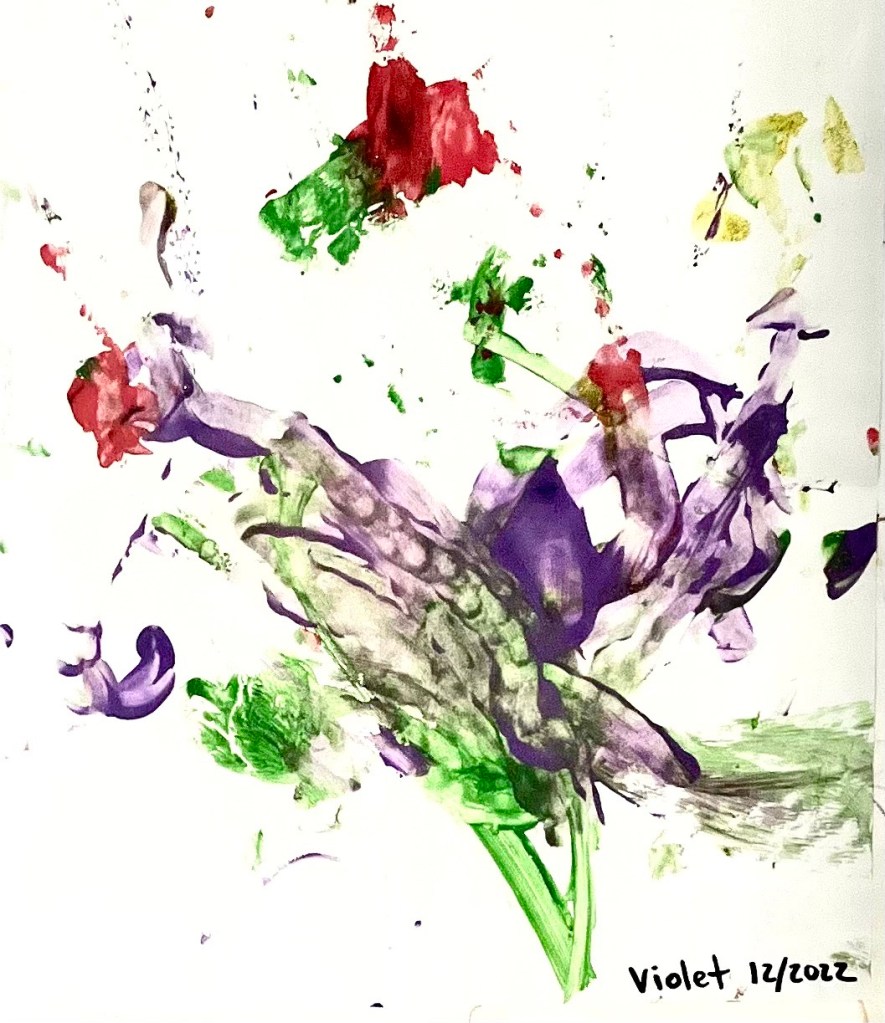
Violets (a triolet)

Sweet violets in the garden grow

in dappled shade and summer breeze.

Such vibrant beauty to behold! 

Sweet Violet’s in the garden. Grow

strong and wise and free and bold! 

May laughter always flow with ease.

Sweet! Violets in the garden grow

in dappled shade and summer breeze.


Day four of NaPoWriMo (National Poetry Writing Month). The muses at NaPoWriMo.net have provided this prompt for the day:

Today, let’s try writing triolets. A triolet is an eight-line poem. All the lines are in iambic tetramenter (for a total of eight syllables per line), and the first, fourth, and seventh lines are identical, as are the second and final lines. This means that the poem begins and ends with the same couplet. Beyond this, there is a tight rhyme scheme (helped along by the repetition of lines) — ABaAabAB.

My poem today is also a celebration of my sweet granddaughter Violet’s second birthday. Happy birthday, pumpkin!

Reverse Engineering

Passing Through the Lot on a Hot Day

Whose parking lot? I have no clue.
She probably lives in Timbuktu;
Security cams all turned on me,
She’ll see each car I’m prowling through.

Your big ‘ol mutt is onto me,
entering your car without a key.
Apart from dog drool, crushing heat; 
the brightest day you've ever seen.

Mutt jerks her leash, the collar breaks.
I know I’ve made a big mistake.
Her bark so loud, now sirens wail.
She pins me hard, there’s no escape.

The lot is filled; lights blue and red.
I alibi, cops shake their heads.
They haul me off, the jail’s close by.
I’ve made my bed, so here I’ll lie.

Day Three of National Poetry Writing Month! Today’s prompt from NaPoWriMo.net:

Find a shortish poem that you like, and rewrite each line, replacing each word (or as many words as you can) with words that mean the opposite. For example, you might turn “Shall I compare thee to a summer’s day?” to “I won’t contrast you with a winter’s night.” Your first draft of this kind of “opposite” poem will likely need a little polishing, but this is a fun way to respond to a poem you like, while also learning how that poem’s rhetorical strategies really work. (It’s sort of like taking a radio apart and putting it back together, but for poetry).

Okay, so maybe I didn’t quiiiiiiite follow the prompt, but I kinda did, in spirit at least.

The poem I chose to use is Robert Frost’s “Stopping by Woods on a Snowy Evening.” Here is Frost’s poem:

Stopping by Woods on a Snowy Evening
Robert Frost - 1874-1963

Whose woods these are I think I know.
His house is in the village though;
He will not see me stopping here
To watch his woods fill up with snow.

My little horse must think it queer
To stop without a farmhouse near
Between the woods and frozen lake
The darkest evening of the year.

He gives his harness bells a shake
To ask if there is some mistake.
The only other sound's the sweep
Of easy wind and downy flake.

The woods are lovely, dark and deep.
But I have promises to keep,
And miles to go before I sleep,
And miles to go before I sleep.

To see how others have responded to the challenge, go to NaPoWriMo.net and check out the comments section for links to other participating poets.

NaPoWriMo 2023: Day Two ~ Surreal

Day Two of NaPoWriMo

Today’s prompt is inspired by poet Paul Celan, and asks us to:

“begin by picking 5-10 words from [a specified] list. Next, write out a question for each word that you’ve selected (e.g., what is [fog]?) Now for each question, write a one-line answer. Try to make the answer an image, and don’t worry about strict logic. These are surrealist answers, after all! After you’ve written out your series of questions and answers, place all the answers, without the questions, on a new page. See if you can make a poem of just the answers. You may find that what you have is very beautifully mysterious, and somehow has its own logic. Happy writing!”

The words I chose are: fog, clove, gutter, salt , thunder, ghost, acorn, elusive, and song (not in order of use). Nothing “beautifully mysterious” came of it, but an interesting challenge nonetheless. Herewith:

What Is…

A pig, a dentist and a cup of hot spiced wine.
[Sounds like the beginning of a bar joke];
that which climbs out of empty bottles.

The smell of old sheets, the color of forgotten.
Wrinkled memories calling bs.
What the dog seeks beneath the bed.

There is…
a giant underfoot,
looking straight, but seeing crooked,
[humming] mathematical paint splatters
hung on a fence to dry.

[Don’t turn around lest they be seen,]
pillars crying at being left behind.

April Showers Bring…

Jules Verne. From the Earth to the Moon. London, Sampson Low, Marston, Low, and Searle, 1873 

It’s April, and we all know what that means: NaPoWriMo!

It’s National Poetry Writing Month, and the well-versed souls at NaPoWriMo.net are once again supplying us with inspiration, motivation and creative prompts to help us in the challenge of writing a poem a day for the entire month of April. I always have the best intentions of meeting the challenge, but sometimes life happens. We’ll see how it goes this year.

For April 1:

They say you can’t judge a book by its cover, but they never said you can’t try to write a poem based on a book cover — and that’s your challenge for today! 

As a resource, we were sent to The Public Domain Review’s collection “The Art of Book Covers 1820-1914.”

I chose to use a cover to Jules Verne’s book From Earth to the Moon. My endeavor:

To the Moon

When first we breached primordial ooze, 
our lungs inflating from newfound air,
we turned skyward with clouded eyes, and
there it was:

a moon!

We grew a spine (well, some of us),
strengthened lengthening limbs,
climbed mountains and – 
finding our voice – we howled 

at the moon. 

Torsos stretched, gaining balance.
Minds stretched, gaining wherewithal.
Desires stirred beyond mere survival.
Straining upright, we reached yearningly to

touch the moon.

Stripped of innocence, we clothed our bodies.
Sloughing naivete, we cloaked our intentions.
Finding pride, we adorned our personhood.
Growing listless, we set a goal: we would walk

on the moon. 

Scarred and marred from our abuse, at a distance
Earth nonetheless appears a shiny bauble; a marble
expendable in our cosmic game, because we believe
if all else fails, we will simply move 

to the moon.