Why should I care what you think?
Should I care what you think?
I care what you think.
Care what you think.
What? You think?
You, think!
Think.
 O is for opinion.

Why should I care what you think?
Should I care what you think?
I care what you think.
Care what you think.
What? You think?
You, think!
Think.
O is for opinion.

When I was a child
we played with sticks, rocks and mud, and
garter snakes until they escaped
into the long grass of unmown fields.
We looked for frog eggs —
and later for tadpoles — in
murky ditches of standing water
alongside gravel roads.
We went barefoot
and sometimes forgot to sidestep
the patches of barbed sand stickers that
latched onto the soles of our feet.
When I was a child
growing up in a small town,
I never realized
what a privilege it was.
CFFC: Blue and White
If we were having coffee, I’d talk about the weather. Not merely as a conversation starter, or to avoid politics, religious and financial topics. But because I’m in the process of painting the exterior of my house. By hand. With a brush. Because I want to.
So I want the weather to be dry, which is asking a lot in the Pacific Northwest in springtime. I want it to be not too hot and not too cold. Kind of like Goldilocks’ porridge.
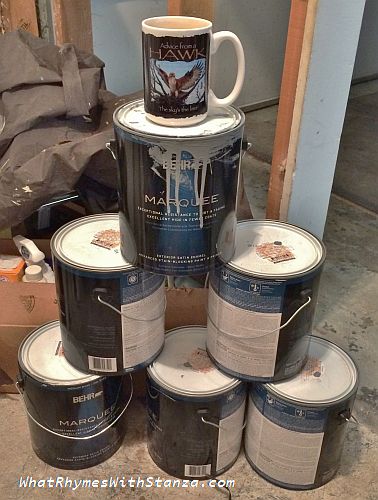
I’d tell you that, even though I used an online calculator to figure out how much paint I would need, I overshot by a huge margin. An expensive error, and one that is going to leave me with a whole lotta “dark pewter” paint on my hands. Literally and figuratively.
And so, I’d suggest that if you had anything outdoors that needed painting, you might consider the color “dark pewter,” and I could probably get you a really good deal on a few gallons.
If we were having coffee, I’d note that April seems like a good time for house painting around here because, despite having to work around rain squalls, I’m running into very few creepy crawling, buzzing, multi-legged creatures. Which suits me fine. They certainly have their place in the ecosystem and balance of life, but I’d prefer that their “place” not be overly close to me.
I’d tell you that I spent a lot of time and energy in the early hours of this morning, lying in bed and debating whether I should paint the garage door the main dark pewter color (for which I have ample paint; very ample; mega-ample). Or whether I should paint the garage door the trim color, which is “rain forest” green.
I’m toying with the idea of painting the front door a crimson red. Good feng shui, isn’t it? And maybe finding subtle ways to tie the red into other parts of the house. But I don’t want my house to look like a year round Christmas display, all red and green. Maybe crimson and rain forest wouldn’t have that effect.
Are any of you good with color? I’d rather not lose more sleep over this. Although I am thankful that garage door colors seem to be my only major concern at the moment. That, and the fact that I’ve run out of coffee.
Okay, I’m off to paint some more. Feel free to offer your color scheme ideas. And thanks for stopping by for coffee.
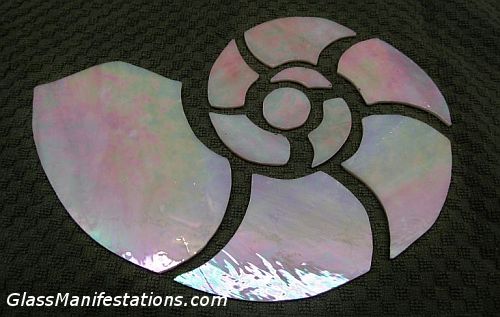
I mentioned last week that I featured a nautilus design in a stained glass panel I made for my granddaughter because of the shell’s meaning to me.
A [chambered] nautilus is a cephalopod of the genus Nautilus that has a spiral, chambered shell with pearly septa. Now doesn’t that sound totally inspiring? I mean… pearly septa! It just doesn’t get any better than that.
Okay… at my level of understanding: it’s a mollusk with a spiral shaped shell that consists of individually partitioned chambers. As the nautilus grows, it continues to enlarge its shell and create more partitions as it goes. Each chamber contains a gas that helps give the animal buoyancy.
When the nautilus inhales the gas from its chambers, its voice sounds really high, like Mickey Mouse’s. Nautiluses love to do this at parties, as it usually gets a pretty good laugh.
Okay, I made that last part up. Just the Mickey Mouse part. They really do have gas. And they don’t even eat beans.
But they are whizzes at math. See, the nautilus shell, with it’s spiral shape, is an example of the “golden ratio,” a mathematical ratio based on the number Phi. Phi (with upper case “p,” Greek letter Φ) represents the number 1.618… It’s reciprocal, phi (with lower case “p”, Greek letter φ), equals 0.618…

Approximation of the golden spiral (drawing in public domain).
Since math is all Greek to me anyway, I can’t really grasp the concept of Phi, but the ratio it represents can be seen in relationships all throughout the universe, in:
proportions of the human body, proportions of some animals, DNA, plants, music, art, geometry, the solar system, movements in the stock market, the designs of the Egyptian pyramids, raindrops on roses and whiskers on kittens (just testing to see if you’re paying attention)… and as noted, in the shape of the spiral of the nautilus shell.
Some may argue that the application of the golden ratio, in many instances, is based on arbitrary points of proportion that happen to match the equation. Kind of the idea that when all you have is a hammer, everything looks like a nail. If you set about looking for a particular pattern or ratio, you can find ways to fabricate – er, I mean discover – its appearance in almost anything.
So that’s the “golden spiral.” But, not to be outdone by the Greeks, the French (specifically French mathematician Rene Descartes) came up with the “marvelous spiral.” Something about logarithms and more math stuff.
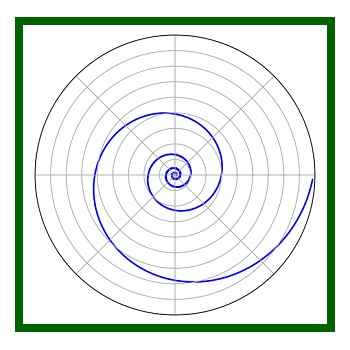
Logarithmic “marvelous” spiral (drawing in public domain).
As with the Golden ratio, the logarithmic (“marvelous”) spiral occurs in many forms in nature. Examples:
the shells of mollusks (i.e. the chambered nautilus shell); the approach of a hawk to its prey; the approach of an insect to a light source; the arms of spiral galaxies; the bands of tropical cyclones; patterns in sunflower heads; the nerves of the cornea…
I guess you could say it’s everywhere you look! (See what I did there? Cornea… everywhere you look… pretty funny, huh?)
So what is the significance of all of this?
To me it indicates that there is a strong interrelationship between virtually everything in nature (and the aesthetics of some things manmade); that there are forces bigger than we can imagine at work in the universe; and that on some level there is a grand design to everything.
A golden, marvelous design.
Note: This is a revision of a post I published on another blog I had going in a previous lifetime. Any plagiarism of myself has been done with my full knowledge and permission (to myself). I think.
 N is for Nautilus.
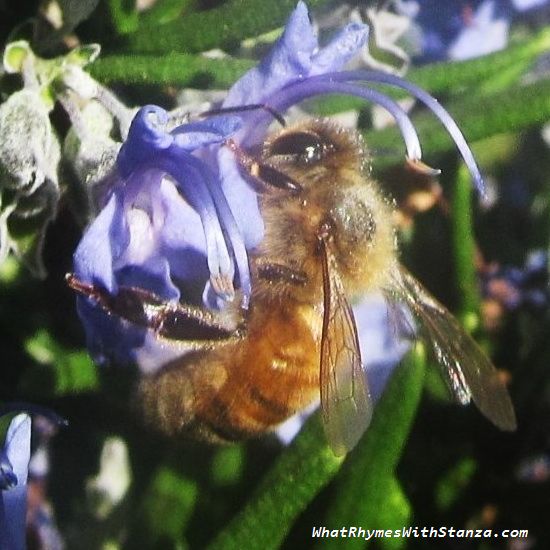
I’m not the most neighborly person in the world. And recently I seem to be gravitating toward lawn and garden projects that involve fences, privacy screens, hedges, wide moats filled with man-eating piranhas… well, I would if I could.
Last weekend I invested in a number of boxwood shrubs to create a hedge between my driveway and the driveway of the house next door. Once I got the shrubs planted, I gathered up the containers they had come in, the tags I had cut off of them, and the little stick things that get shoved into the containers to identify the plants and tell you how to water them.

Stick Thing
I never really read the stick things. I let nature decide when to water the plants, intervening only when I hear the plants hallucinating that the mailbox is a shimmering waterfall.
I happened to glance down at one of the stick things in my hand, and my eye caught a word that began with “neon.” Idly wondering if my hedge was going to glow in the dark or light up with beer signs, I took a closer look. The stick thing read:
This plant is protected from problematic
- aphids
- white flies
- beetles
- mealy bugs
and other unwanted pests by Neonicotinoids.
These pesticides are approved by the EPA.
Since I try to avoid pesticides in my yard, I was not impressed that someone had taken it upon themselves to determine which pests were wanted or unwanted in my hedge. But I’d already planted the boxwoods, so I made a pledge to read the stick things more carefully in the future, and went inside the house to clean up.
After scrubbing the dirt (and pesticides, apparently) off my hands, I opened my laptop and checked my Facebook feed. The first post to grab my eye was one by The Mother Nature Network. A photo of bees crawling over a honeycomb was accompanied by the heading:
Very cool! And about time. The declining bee population is a major problem for the environment.
Then I read the first line of the click-through article:
“Ortho’s decision to nix neonicotinoids is an important one.”
Neonicotinoids… hmmm… where had I seen that word? Neon—
OMG!!! My glow-in-the-dark boxwood hedge was going to turn me into a bee killer!
I started researching.
⇒ Maybe I could just rinse the pesticide off. (No, you can’t).
⇒ Maybe the effects of the pesticide are short-lived. (Wrong again.)
⇒ Maybe boxwoods don’t have flowers that will attract bees to them. (Yes, they do. In fact, bees love boxwood flowers.)
The only “solution” I could find: pluck off all the blossoms in the first blooming season so the bees don’t get to them. In subsequent seasons, the poison won’t be so harmful. So they say.
You know what a boxwood flower looks like? Yeah, neither does anyone else. They are described as “inconspicuous.” Small and yellow-green in color, they pretty much just blend in with the leaves.
I’m at a moral crossroad here. Do I:
The hedge runs along my dandelion/clover-infested yard where it abuts the neighbor’s always green, utterly weed-free lawn. Maybe his weed killer sprays or granules (or whatever form of poison he uses) will leach over and kill my bee-killer pesticide-drenched boxwoods. One could hope.
I have a feeling I will be ripping out my hedge this weekend. Maybe it will bring good bee karma. Maybe the bees will pay me back by asking their wasp buddies to leave me alone this year. I could recommend a nice relocation site nearby. One with a very, very green lawn.
Yeah, as I said at the start, I’m just not very neighborly.
The Daily Post weekly photo challenge: Dinnertime
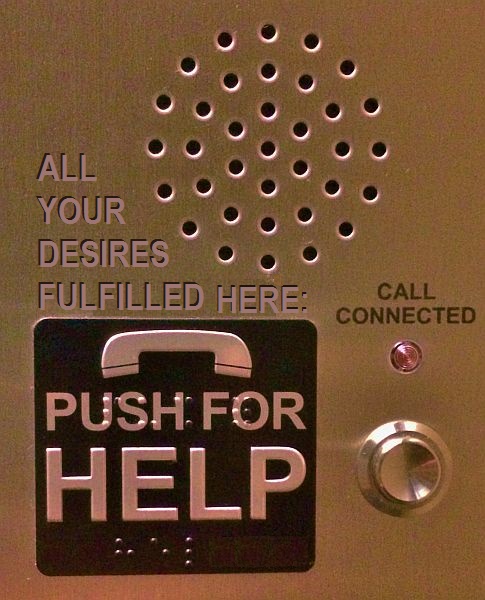
I know, I know. I’ve done this rant before. But obviously I didn’t rant thoroughly enough to get it out of my system. So here we go: Manifest Rant, the Sequel.
Manifest is a verb (used with object). It does not mean to attract like a magnet in a steel ball bearing factory. It is not a synonym for “magic trick,” where getting what you want is as easy as reaching into a magician’s top hat. And my favorite anti-definition – gleaned from an internet search: Manifesting is NOT “goosing the quantum field” to create a world in which “everything you desire is yours for the taking.”
Based on an internet search using the phrase “how to manifest,” I discovered that people are searching for ways to manifest…
True confession: I used to use the term “manifest” in pretty much the same fashion, although I never goosed anything, quantum or otherwise.
I do believe we can create what we truly desire in life. I do believe there are forces – both seen and unseen – that can and will assist us once we are clear on what it is we truly want, once we put that energy “out there” with confidence and trust.
But I don’t believe that whatever we desire is “ours for the taking.” Ever.
So what does the verb manifest really mean? Here you go:
Manifest – verb (used with object)
1. to make clear or evident to the eye or the understanding; show plainly:
He manifested his approval with a hearty laugh.2. to prove; put beyond doubt or question:
The evidence manifests the guilt of the defendant.
Alrighty, I feel all ranted out now. I’m going to go manifest my curiosity now, by trying to figure out just how one really goes about goosing a quantum field.
 M is for Manifest.
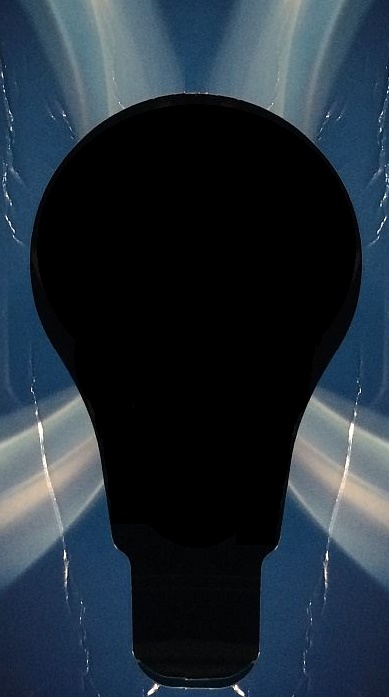
So I had a “light bulb moment” the other day. You know, that moment when you have a sudden realization, an enlightenment of sorts, when the metaphorical light bulb turns on in your brain and you say, “Aha!”
Oh wait… that’s an “aha moment.” But anyway, that light bulb moment when you are struck with a sudden insight or inspiration that leads you on to new discoveries?
Yeah… that’s not what I’m talking about.
I’m talking about a real light bulb. You know… bulbous, light-producing… something that you screw into a socket so that someone doesn’t come along and stick their fingers in it. That kind of light bulb.
Okay, on to my moment. I bought a light bulb that is supposed to have a 27 year life span. I can’t remember how much I paid for it. That memory is probably repressed to protect me from the trauma.
Nor can I remember what I was thinking when I decided that I needed this acme of amperage, this wonder of wattage, this lion of lumens.
Perhaps I just felt that, at some point in my dotage, I might want to switch on a lamp, and I could rest in ease knowing that my trusty light bulb would be there waiting to brighten my day. Or night.
So here I was, in possession of this almost ageless light bulb, and – as luck would have it – there was a burnt out bulb in one of my lamps. A perfect opportunity to begin my decades-long relationship with Brighton. (I figured if we were going to be together that long, the light bulb should have a name.)
I pulled Brighton out of my light bulb storage area (I seem to have quite a collection of light bulbs), and began wrestling with the packaging that was doggedly defending Brighton from harm. With a sudden shift of surrender, the packaging gave way, the bulb sprang free…
and began its unstoppable freefall to the hardwood floor.
The bulb crashed to the floor. My dog Chules came running to see what happened. I began to have visions of doggie blood spurting everywhere if Chules stepped on shards of Brighton. In one swift motion, I pushed Chules aside and bent down to assess the damage.
There lay Brighton. In one piece. On the floor. Where he landed after a four foot long plunge.
I tenderly picked Brighton up, held him to my ear, and gently shook him to see if I could hear that tinkling little noise that light bulbs make when their filament has broken. Mind you, with Brighton being the Superbulb that he is, I don’t even know if he has a filament. But I figured no sound is good sound.
I took Brighton to my bulb-less lamp and with trepidation screwed him into the socket. Holding my breath, I reached with quaking hand to flip the switch.
And then there was light!!!! Brighton’s alive! Metaphorically speaking, of course.
As I sit here basking in Brighton’s warm glow, I have every confidence that we will be together for a long, long time.
Hey, wait! Did someone turn out the lights? Brighton…?
Brighton?!?
 L is for Light bulb.
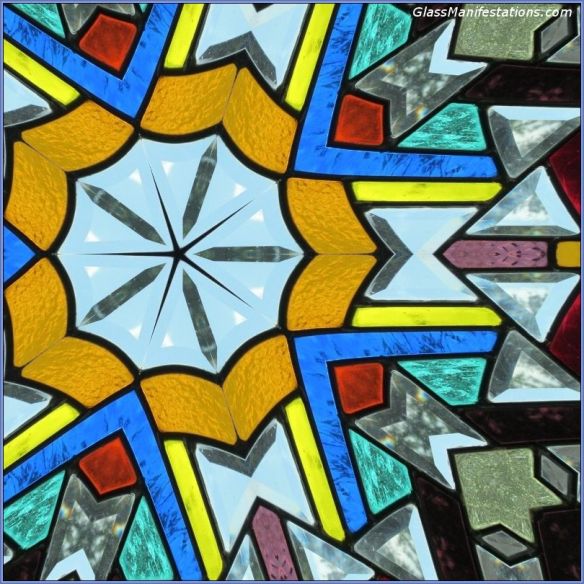
 K is for Kaleidoscope.


 What Rhymes with Stanza?