Jackals in the Key of C-Sharp Major

Day 21 of NaPoWriMo. The prompt:

write a poem that incorporates wild, surreal images. Try to play around with writing that doesn’t make formal sense, but which engages all the senses and involves dream-logic.

I’ve been told before that I don’t make sense, but I’ve never before been asked to make less sense. Does that make any sense? Here goes:

Jackals in the Key of C-Sharp Major

When the jackals came calling, we hid
on top of a mound of field mice stacked like rows of bricks.
The jackals didn’t see us;
they were searching through the magazine racks to the east.

Turkey vultures triangled above, calling to the jackals,
pointing with their flowing pink boas,
but the jackals didn’t hear them pointing.
They were listening to us sing songs about the stupid jackals.
The field mice joined in on the chorus,
but only when it was in the key of C-sharp major.

Then the tanks rolled in, three across and ten deep,
camouflaged with tie-dyed circles the color of a midday shadow.
They rumbled through the disco,
rattling the ground with their relentless tracks,
strewing trails of Skittles in their wake
like so many teeth shaken loose from a cantaloupe skull.

Turkey vultures flapped their pink boas and chased the Skittles to ground,
trying once more to alert the jackals,
but all the hapless birds could manage to squawk out
through candy-jammed beaks were
the words “peace” and “sunshine.”

The field mice, or at least the bravest among them and
those upon whose heads we were not standing, ran
toward the turkey vultures singing “peace and sunshine.”
They wanted to join in on the chorus,
but only if it was in the key of C-sharp major.

The jackals chased the field mice down the tank tracks,
scattering Skittles, tripping over turkey vultures,
dancing through the disco, flipping through magazines,
and came to a rumbling halt at our feet, and – non-coincidentally –
at the teeny-tiny paws of such field mice as had remained behind.

Other than the pink boas circling their heads like fluffy crowns,
the jackals looked utterly ridiculous.
And stupid.

We sang them a song in the key of C-sharp major
and headed home.
All of us.

The Big Reveal

It is weeks in the making. First the design is conceived, drawn and copied for a pattern to attach to the worktable. Glass is selected by color, texture, opacity… or sometimes simply availability and affordability. The glass is cut, ground and sized until each piece fits perfectly into the pattern. Individual pieces are wrapped with leading, lead joints soldered together, then putty is worked under the lead for stability and waterproofing. Cleaning is done in place with a bristle brush and whiting powder. Then, the wait.

The putty takes three days to set. Twice daily the artisan cleans off any putty that seeps  from beneath the lead. She notices where she applied too much solder. Or too little. She guiltily surveys a piece she had cut too small but used anyway, knowing she could fudge with lead or putty to hide the gap. She second-guesses her glass choices. Will the colors compliment or contrast as she intended? Will the nuances of the design come across as planned?

When the putty is set, it’s time. The artisan lifts the stained glass panel, wipes it clean and rests it gently on a windowsill. She backs away and for the first time gazes upon the completed work. The critical eye judges workmanship, mercilessly and exacting. The artistic eye must wait ‘til the critic quiets. And lastly, the cautious heart will weigh in on the worthiness of the piece. The verdict? We’ll have to wait and see.

patience takes patience
minutes take sixty seconds
waiting takes its time

IMG_0059r

“Hammer Shattering Glass Shattering Hammer” stained glass panel by Maggie C.


dVerse Haibun Monday: Waiting

Cruel Moon

moon

“The moon is merciless,” she writes.
Cruel and scathing, she tells us.

Is this the same moon under which
lovers swoon?

The same moon toward which
canids tilt sharp-muzzled heads and
sing ballads torn from the depths of
ancient heritage?

Seer of harvests, bountiful and ripe.
Sometimes new,
sometimes blue,
sometimes erased by crumbling clouds,
sometimes agleam like a new gold tooth.

How can it be merciless, suspended
beyond mortal hands? Out of reach,
out of touch,
timelessly same as the day it was born.

“I know the bottom,” she writes.
“I do not fear it; I have been there.”
Moon-stricken poet, no longer a pawn
to the beacon of night,
where is this bottom you speak of, and
where are you now?


NaPoWriMo Challenge, Day 29: pick a poem written by Sylvia Plath, and then write a poem that responds or engages with your chosen Plath poem in some way.

I chose the poem “Elm,” written on April 19, 1962.

Driving in Reverse

NaPoWriMo Challenge, Day 18. The prompt “sounds a bit more complicated than it is, so bear with me! First, find a poem in a book or magazine (ideally one you are not familiar with)… [C]over everything but the last line. Now write a line of your own that completes the thought of that single line you can see, or otherwise responds to it. Now… uncover the second-to-last line of your source poem, and write the second line of your new poem to complete/respond to this second-to-last line. Keep going, uncovering and writing, until you get to the first line of your source poem, which you will complete/respond to as the last line of your new poem. It might not be a finished draft, but hopefully it at least contains the seeds of one.”

Well, it wasn’t hard to find a poem I’m not familiar with, as I’m not much of a literary reader. When I came across a poem written by Sheryl Luna and titled, “Neighbors Smoke on an Apartment Porch Owned by a Mental Health Agency,” I knew that would be perfect for this challenge. You can follow the link to read that poem.

Here’s my reverse response. I guess I’ll call it Mental Faculties.

Waiting their chance to bloom,
strength belied by failing light,
old habits won’t die today.

Rheumy eyes remove the hues.
Calm comes with slowing down.

Peeling bark, in rough contrast,
remember they once blossomed, too.

Come in to the sobering shade,
rise and heal thy pain.

It’s all relative, so we’re told
a tale of plums and prunes.

Wishing never leads the charge,
sinners peddling soulless fates.

Free to fly once weight-relieved,
yesterday’s work, today’s debris,

smoothed as with a butter knife,
carried high on joyful wings.

What’s left from those who sow and reap —
saying so won’t make it true —

forestalls, refusing to leave.
Stalwart nature, man-made trees,
far from home yet searching still,

if only one could hear.

They care more than one might think
of being heroes or villains.

Do-overs can set them free,
enlightened by the truth.


couch

De-Composing

NaPoWriMo Challenge, Day 19 (still catching up): An erasure poem as described by poet Dan Brady.

“First, write a paragraph of prose about anything you want. Next scan through the text and try to erase it down to a single sentence or phrase. The erased text becomes your first page and the full prose paragraph becomes your last page. Now see if you can add bit by bit to create a sequence that builds across several pages/iterations between the initial phrase to the complete text.”

erasure poem

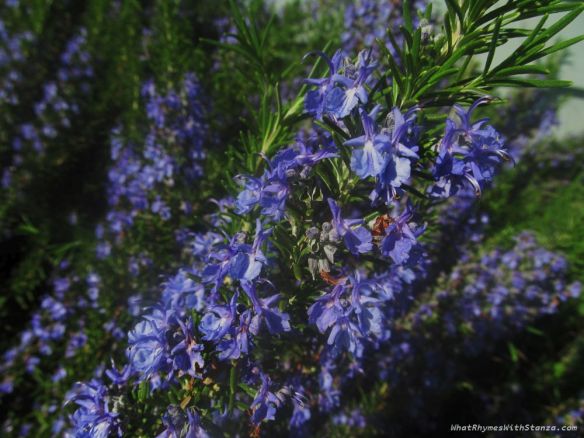
rosemary3

Unpremeditated

shoe lace

I’m trying to catch up in the National Poetry Writing Month challenge. Here’s NaPoWriMo Challenge, Day 20: “Write a poem that involves rebellion in some way.” One suggested approach was to write the poem in a way that rebels against your usual writing style. I tend to want my poems to make sense, to convey a message. Even if it’s a silly poem, I want there to be a point to it. With today’s poem, I wrote with a stream-of-consciousness pace, without concerning myself with whether it was sensical.  Unedited, except for typos. 

As an experiment, it was interesting. As a poem… meh. 


cold as flame.
you said it didn’t matter, and yet
it did.

I can’t thank you enough for
the freedom you gave me.
Or at least loaned me.
Haha.

A hollow laugh. Why do we do that?
If you come for me, I won’t go.
I may follow, but
would you even lead?

These are the rules:
Always make sense.
Always second guess.
Always review and rework until perfection is attained.

Even though there is no such thing.
Even though by massaging everything,
you probably make it worse.

Overworked.
That’s what I am.
Are you?

Does this make sense?
Does anything?
Make sense, that is.

And of course, that perennial question:
does everything – or anything –
need to make sense?

Senseless.
That’s what I am.
Always wanting to be in control.
Or not. I just wish for once
I knew the rules,
so I could
break them.

Narcissus

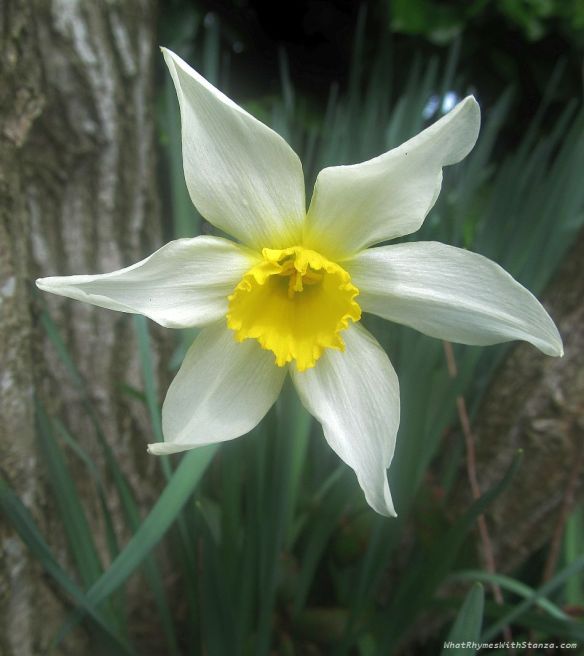
jonquil

“I never did like Narcissus,” he says,
though I hadn’t asked for his opinion.

“Narcissus? Why not?” I ask.

“It is such a presumptuous flower,
So simple – banal really –
yet it pops up first thing in the spring
as though the world has been awaiting it
all winter.”

“All winter? Perhaps so,” I say.
“It is so beautiful and colorful
and a refreshing change from the ugly winter snow.”

“You know what I think?” he asks.
I don’t know, and I don’t ask.
He tells me anyway.

“I think these narcissus flowers bloom early
just so they can admire their reflections in the melting snow.”

“The melting snow,” I say. “I don’t care. I love them.”
I reach down to pick one of the flowers,
but it won’t come loose of the plant.
I pull harder. It still refuses to budge.

“See that?” he says.
“Narcissus won’t even let go of a bloom.
He wants to keep all the beauty for himself.”

“For himself…” I muse.
I begin to feel faint.
I feel as though I am disappearing.

“Going somewhere?” he asks.

“Going somewhere. Yes… somewhere… somewhere…”

“Say, I didn’t catch your name,” he calls after me.

“Name? Echo. Echo. Echo.”

“Nice talking with you, Echo.
My name is Nemesis.”

Nemesis. Nemesis. Nemesis.


NaPoWriMo challenge, Day 21: Write a poem that plays with the myth of Narcissus in some way. 

Mishmash

balance 4

Eat not, you’ll never want for less.
The next worst thing could be the best.
Heed not and you will find the hidden.
Spare the rod, the child has bidden.

Break some rules to mend the rest.
Let the sun rise from the west.
Speak not, others will pause to listen.
Smash the boat, champagne to christen.

If lies be told, pay heed to rumor.
I found my mind and sensed some humor.
The dead of night awoke the living,
so these sage words I’m thymely giving.


NaPoWriMo, Day 13: Write a poem in which the words or meaning of a familiar phrase get up-ended. 

To be, or never was…

I don’t get it, I say aloud
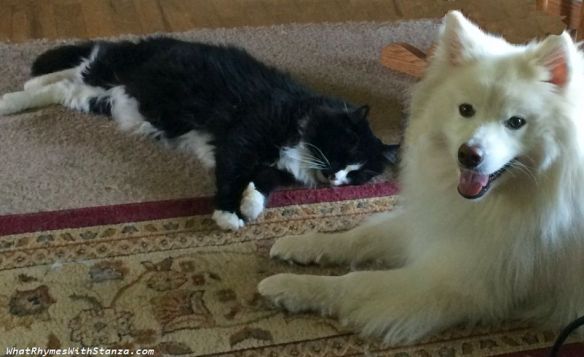
though no one’s in the room save the dog.
He tilts his head and gives me
that quizzical look that could mean so many things.
Or nothing at all.

Today I am impatient and so his sweet face doesn’t work its magic.

Go chase the cat, I tell the dog.
His ears perk up. Although he understands but a few commands —
and of those known obeys even fewer —
he jumps to his feet and scampers off, ostensibly in search of the cat.

I feel sorry for the cat and a bit mean for having made the suggestion,
but who really thought the dog would follow through?

I still don’t get it, I say aloud,
and this time there’s no one in the room at all,
unless…

the cat’s tail flicks out from behind the drapes.

Green eyes peer around a fold of cloth and lock me in a stare.
I heard what you just did, the cat seems to say.
I’m sorry, I mouth silently so as not to give his presence away.

I hear the dog sigh as he squeezes beneath my bed in the back room.
His favorite napping place. He has given up the game.
Cat is safe for now, but by his look I can tell I am far from forgiven.

I continue my soliloquy.
You know what I don’t get? This!
I point in the general direction of the glowing laptop screen.
Lines of text — some
short,
some longer — parade down the edge of the screen.

Sometimes a line or two

skips toward the center screen
as though it were the end dancer of a cancan line and missed a turn.

No rhyme nor reason.
Well, sometimes a rhyme. After all, it’s poetry, right?

Or so it self-proclaims. This is what I don’t get.
I don’t understand poetry. What makes something a poem,
and not just some random words stitched together
in seeming sincerity?

I’m too shallow, I tell the cat. He has come out of hiding
and jumps on the couch in hopes of securing a warm spot near the laptop.
Poetry in motion, that’s what they say about cats. Sometimes.

The cat meows in response and I press my finger to his lips to shush him.
Too late. The dog scrambles from beneath the bed and pads out to be with us.
No poetry in this dog’s gangly moves. Maybe he’s just a limerick.

Am I too shallow? I ask the dog and cat. They fail to reach a consensus.
Never mind, I say.

I return my attention to the keyboard.
I’ve gotta hurry up and bang out this poem
before I go to bed.

poet


NaPoWriMo challenge, Day Ten: write a poem of simultaneity – in which multiple things are happening at once.

Story Time

golden path 2

Rain splatters in puddles, and rivulets of water snake down window panes.
Snot spatters on child-sized sweatshirts, and rivulets of same puddle above little pink lips.

“Tell us a story, Oma.” Oma has already told half a dozen just since nap time, but how does one refuse such a rapt audience?

“Once upon a time there was a little girl and her little brother.”
“No, not about us! A princess with three fairies!”

“Okay. Once upon a time there was a princess with three heads.”
“No, Oma! Three fairies!”
“Oh, right. A princess with one head, and three fairies with three heads.”

Little girl sits back, satisfied with the new head count.

Little boy chews on the round, magnifier lid of a “bug catcher” container he has pried open. The bug catcher holds a big black spider — correction: used to hold a big black spider before little boy pried the lid off.

Oma gently pulls the lid from little boy’s mouth.
“A magic mirror!” Little girl reaches for the snot-laden lid and holds it up to her eye. “The princess has a magic mirror!”

Oma hands little girl a magic tissue with which to clean the “mirror.” Little girl misses the point. (Just as well. The tissue later becomes a magical horse blanket.)

Future pretend magical horse rolls onto his side and lazily licks his paw.

“What does the princess see in the mirror?” Little girl looks wide-eyed into the magnifier lid.

Probably not much in its current condition, Oma thinks.
“The future!” Oma says.

♦♦♦

The princess learns that an evil horse prince is going to turn her little brother into a horse on her brother’s fourth birthday, unless the princess can stop him.

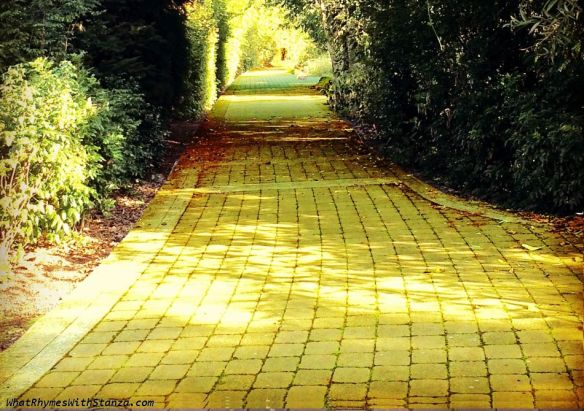
With the help of the three fairies (one head apiece) and her magical mucous-filled mirror, the princess sets off down the golden path to the dark forest where the evil horse prince with glowing red eyes lives in a dark, dark cave.

♦♦♦

The story progresses — with minor plot changes at little girl’s request — and at last the princess prevails.

Little boy has long since lost interest in the princess story and instead pretends to be drinking water from the insect catcher container which, he informs Oma, has spider poop in it.

Oma assumes that announcement is primarily based on two-year-old little boy’s fondness for saying the word “poop.” After all, the big black spider that formerly occupied the container is a plastic toy.

Oma would, however, like to know the whereabouts of the big black spider. She half-wonders if it’s going to come flying out of little boy’s nose the next time little boy sneezes.

Just then, the beautiful, wise and brave queen comes riding up the hill to the castle in her magical Subaru, and little boy and little girl greet the queen with coughing, sneezing, snot-flinging hugs and kisses.

Oma takes her leave and climbs aboard her handsome Nissan steed to head home to her palace. As Oma checks the magical rearview mirror, she gets a vision of her own future.

In the not-so-distant future, Oma foresees that she will be coughing, sneezing and snorting into her own magical tissues.

And they all live happily ever after.

Achoo!


Based on NaPoWriMo day eight prompt: Write poems in which mysterious and magical things occur. (I don’t know that this qualifies as poetry, but it is mysterious and magical.)