
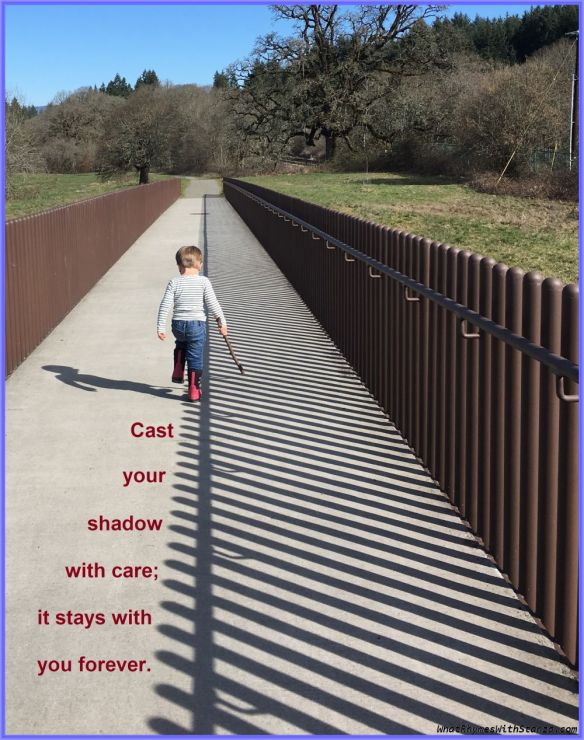
We met at the park, the one where a paved trail winds around an open grass field. He walked his tiny black poodle in one direction. I walked my midsize white Eskie in the other, and we would cross paths, usually beneath the tall cedar trees that provided welcome shade in the summer, and protection from rain the rest of the year.
His name was Don. The poodle was Mon Cheri, his neighbor’s dog that he borrowed for his morning walks.
Don would see us approaching on the trail, and would exclaim, “Look, Mon Cheri, it’s your friend!”
Mon Cheri would growl at my Chules and strain at her leash to gain distance. Don didn’t seem to notice, and neither did Chules.
Don would smile at Chules. “What a happy dog! Isn’t he pretty, Mon Cheri?”
At some point, Don changed direction on how he walked the loop, from clockwise to counterclockwise. I changed direction, too. Don seemed nice enough, but no matter how many times he tried to cajole Mon Cheri about her happy fluffy dog friend, Mon Cheri still rejected Chules.
Over time, our conversations expanded. I told him about stripping the old oak floors in my house. He warned me about fumes and gas pilot lights, lest they meet and blow up the house.
Don explained his reason for changing directions on the loop. It was easier to navigate a small incline in the path.
“You can’t see it, but it’s there,” he said.
He was right. I couldn’t see it.
I didn’t see Don for a while, and then one day he was back. He had shaved his beard, and maybe his head as well. He always wore a flat newsboy cap, and I had never noticed his hair length. His pace had slowed considerably.
“How are you doing?” I asked. “I’ve missed seeing you.”
“Oh,” he replied. “I’ve been coming later than I used to. I don’t get up as early in the mornings anymore. And on Sundays I go to church. It’s nice to see everyone.”
I contemplated inviting Don out for coffee. He seemed lonely. And frail. More frail each time we met. But it felt awkward, so I didn’t ask.
One day, we met on the path, and Don told me about receiving chemotherapy. He’d decided to stop treatment and resort to positive visualization and healthy eating and “all those things they say to do.”
This was the first time Don had spoken of his health, or anything intimate or personal at all. I didn’t know what to say.
I made some throat noises that I hoped were consoling, and agreed when he said sometimes it’s best to let things take their course.
He was tired, I could tell. Tired of struggling to walk up imperceptible inclines. Tired of fighting battles he would ultimately lose. He’d even given up on trying to convince Mon Cheri that she and Chules were fast friends.
I didn’t see Don after that.
One day I crossed paths at the park with another man and his dog. I had seen them on several occasions stop and speak with Don, just as I had done.
“Have you seen Don lately?” I asked.
“Who?”
“The gentleman with the little black poodle and the newsboy cap. He used to walk here, but I haven’t seen him in a while.”
The man didn’t know who I meant.
I cried for Don. I hoped he’d had a good life. I hoped he’d been loved.
Chules and I don’t visit that park much anymore. We walk a different trail now, where we sometimes cross paths with a man and his midsize black dog named Pink.




 What Rhymes with Stanza?