If You Give a Man a Shovel: a story for Earth Day

shovel5

If you give a man a shovel, he’s going to want to dig.

He will dig holes in the ground.

He’ll want to plant something in the holes, so he’ll ask you for some seeds.

The plants growing from the seeds turn out to be edible, and lots of people will want to eat these plants.

shovel1

He will want to dig more holes and plant more plants, so he’ll ask for more land and more shovels. You will have to clear the land of all vegetation and wildlife so he can grow his crops.

He will make lots of money selling his plants, so he will keep planting the same thing season after season in his fields, and he will invent easier ways to harvest his crops.

shovel2

The soil will deteriorate from his harvesting methods and from his single crop farming. He will ask you for fertilizer to make the soil better and the plants grow faster.

The fertilizer will encourage weeds to grow in the fields, so he will ask you for an herbicide to kill the weeds.

The insects that have been eating the weeds will need a new food source, so they will start eating his crops. He will ask you to make insecticides to kill the bugs.

There are lots of bugs on the lots of plants, so he will need lots of insecticide. And more fertilizer. And more herbicide to kill the weeds that regrow in the re-fertilized soil.

shovel3

As his crops get bigger and bigger, he will glut the market, so he will ask you for money to subsidize his farming.

He will look for new ways to market his crops, and will invent high-fructose plant syrup (hfps) and people will begin putting hfps in all manner of food.

shovel4

As processed foods containing hfps become more and more unhealthy, people will begin to die prematurely from their poor eating habits.

He will need to dig holes to bury the people who die prematurely from poor eating habits, and since he needs to dig holes…

shovel6

he will probably ask you for a shovel.

The end?

“In nature, nothing exists alone.”
~ Rachel Carson, 1962

Earth Day 2019: Protect our Species

Seasons in Glass

NaPoWriMo, Day 22. The prompt:

Today, I’d like to challenge you to write a poem that engages with another art form – it might be about a friend of yours who paints or sculpts, your high school struggles with learning to play the French horn, or a wonderful painting, film, or piece of music you’ve experienced – anything is in bounds here, so long as it uses the poem to express something about another form of art.

While I did struggle with French horn in high school, stained glass is much more fun. And so I give you:

Seasons in Glass

I.

birds-summer

It is Summer.
The trees are full of leaf chips:
green and yellow with black stringer twigs.
I haven’t done glass work in ages.
I will do straight lines.
Lots of straight lines. And lead,
not copper foil. Foil is harder to do.
Birds come to mind.
I don’t really know why.
I spread my wings and begin cutting glass.

II.

birds-autumn

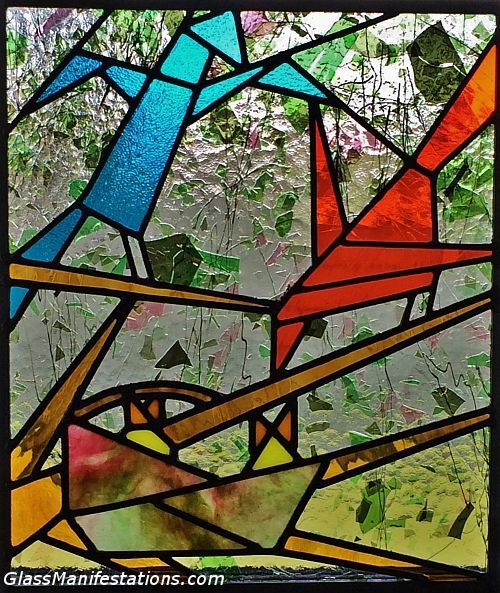
It is Autumn.
The leaf chips have turned gold and burnt orange,
and a deeper shade of yellow.
They are falling.
The birds chatter amongst themselves.
Is it time to head south?
It’s getting colder. They hold their wings close in
to their weightless bodies.
I turn the heater on in my studio.

III.

birds-winter

It is Winter.
White snow, blue ice.
This pattern is no longer in production;
the birds need to be larger.
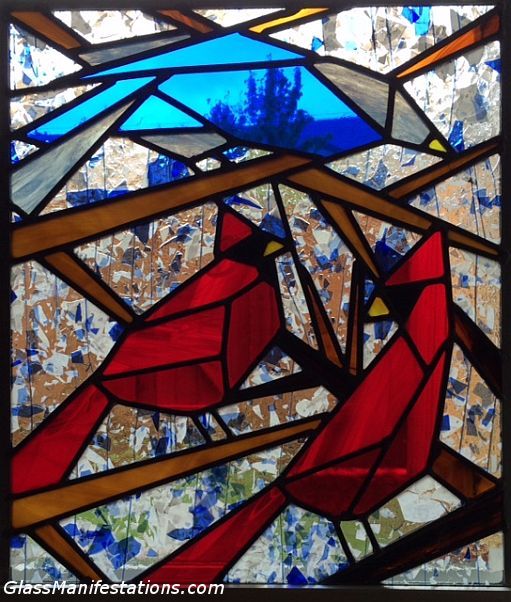
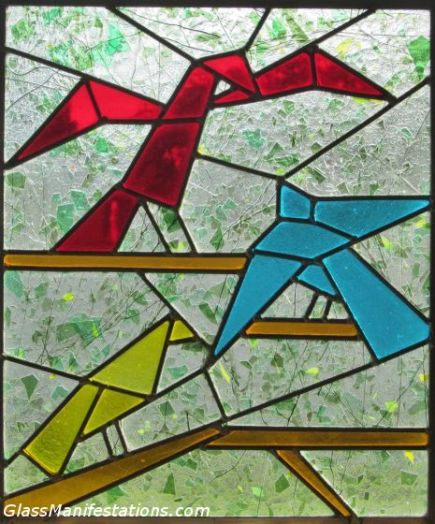
Two fat cardinals land on bare branches and
consult with a larger bird, whose tail feathers
splay a bit to accommodate
smaller pieces of background.
I love the dark red of the cardinals;
a smooth rolled glass that cuts like butter.

IV.

birds-spring

It is Spring.
Leaves are returning.
Delicate lavender flowers
buzz with the breeze of bee wings.
It is time for building nests,
laying eggs,
feeding hatchlings.
How does one differentiate
a worm from a slender tree branch?
I will allow curves this time.
After three seasons,
I think I’m ready.

Jackals in the Key of C-Sharp Major

Day 21 of NaPoWriMo. The prompt:

write a poem that incorporates wild, surreal images. Try to play around with writing that doesn’t make formal sense, but which engages all the senses and involves dream-logic.

I’ve been told before that I don’t make sense, but I’ve never before been asked to make less sense. Does that make any sense? Here goes:

Jackals in the Key of C-Sharp Major

When the jackals came calling, we hid
on top of a mound of field mice stacked like rows of bricks.
The jackals didn’t see us;
they were searching through the magazine racks to the east.

Turkey vultures triangled above, calling to the jackals,
pointing with their flowing pink boas,
but the jackals didn’t hear them pointing.
They were listening to us sing songs about the stupid jackals.
The field mice joined in on the chorus,
but only when it was in the key of C-sharp major.

Then the tanks rolled in, three across and ten deep,
camouflaged with tie-dyed circles the color of a midday shadow.
They rumbled through the disco,
rattling the ground with their relentless tracks,
strewing trails of Skittles in their wake
like so many teeth shaken loose from a cantaloupe skull.

Turkey vultures flapped their pink boas and chased the Skittles to ground,
trying once more to alert the jackals,
but all the hapless birds could manage to squawk out
through candy-jammed beaks were
the words “peace” and “sunshine.”

The field mice, or at least the bravest among them and
those upon whose heads we were not standing, ran
toward the turkey vultures singing “peace and sunshine.”
They wanted to join in on the chorus,
but only if it was in the key of C-sharp major.

The jackals chased the field mice down the tank tracks,
scattering Skittles, tripping over turkey vultures,
dancing through the disco, flipping through magazines,
and came to a rumbling halt at our feet, and – non-coincidentally –
at the teeny-tiny paws of such field mice as had remained behind.

Other than the pink boas circling their heads like fluffy crowns,
the jackals looked utterly ridiculous.
And stupid.

We sang them a song in the key of C-sharp major
and headed home.
All of us.

Exhale

NaPoWriMo, Day 19.

The prompt:

Today, I’d like to challenge you to write an abecedarian poem – a poem in which the word choice follows the words/order of the alphabet. You could write a very strict abecedarian poem, in which there are twenty-six words in alphabetical order, or you could write one in which each line begins with a word that follows the order of the alphabet.

Okay, the directions seemed simple enough, but somehow I got it backwards.

Exhale

Zoey
Yearned to
eXhale.
While breathing is indeed a
Valuable asset for living, it is generally
Understood that if one goes to the
Trouble of inhaling, it’s
Simply impossible to
Refrain from exhaling. The obvious
Question, then, is what
Prompted Zoey to possess this
Oddly understated desire.

Needless to say – one would hope — the perpetual
Mishandling, neglect and abuse of an animal will
Lead to mistrust, fear and – in Zoey’s case – a
Keen sense of danger such that
Just by exhaling, she might incur the
Inability to protect herself from harm.

Her wish for safety and security was
Granted one day in the
Form of earthbound angels who
Extricated her from her dire,
Debilitating situation, and through
Care and love and patience, Zoey was
Bestowed once again with her rightful
Ability to fully, exhilaratingly exhale.

When It’s Time

NaPoWriMo, Day 18.

Our optional prompt for the day takes its cue from how poetry can help us to make concrete the wild abstraction of a feeling like grief…

Today, I’d like to challenge you to write an elegy of your own, one in which the abstraction of sadness is communicated not through abstract words, but physical detail. This may not be a “fun” prompt, but loss is one of the most universal and human experiences, and some of the world’s most moving art is an effort to understand and deal with it.

When It’s Time

I wonder how they know.
They make the call.
It’s time to come.
But how do they know?

He’s been gone for years already.
The memory, the recognition, and —
eventually — even the words.

But now he lies here, eyes closed,
erratic breathing, pale skin.
The phrase “death warmed over”
comes (irreverently) to mind.

Still, how do they know?
Mightn’t he wake up tomorrow with
that good-humored sparkle in his eye
and say something silly?
“You’ve grown so tall now;
your legs go all the way down to your feet!”

No, of course not. But still…

His skin is hot.
His breathing is ragged.
I expected clammy and shallow,
respectively.

I kiss his forehead, pat his hand.
I feel embarrassed that I don’t know what to say,
even though he can’t hear me.

I don’t say goodbye, because —
well — he’s still here. For now.
Then again, as I said before,
he’s been gone a long time already.

I wonder how they know.

Matchless

NaPoWriMo, Day 17. Due to the demise of my computer, my muse has been forced to sit silent for this past week. But we’re back!

Today’s prompt:

Write a poem that presents a scene from an unusual point of view.

flame

Matchless

Rrrrtch tssss whooos.
Match strikes to life.
Sulfurous head turns black,
then glows orange-red.
Blue flame encircles the head,
turning yellow as it reaches upward.

Match touches wick.
Wick resists, but then
accepts the flame with a
complaining sizzle and pop.

Flame dances brightly to the
rhythm of an invisible breeze.
Wispy white smoke coils up and away.

There’s warmth in the watching,
shadows chiseled by the light,
danger cloaked in tenuousness.

And then, Pifft!
Match is extinguished, and all that is left
is that copycat flame perched ridiculously
atop a flimsy wick and weaving like a drunk parakeet.


NaPoWriMo, Day 17

Things People Say

Day Nine of NaPoWriMo.

Today’s prompt is inspired by the work of Sei Shonagon, a Japanese writer who lived more than 1000 years ago. She wrote a journal that came to be known as The Pillow Book. In it she recorded daily observations, court gossip, poems, aphorisms, and musings, including lists with titles like “Things That Have Lost Their Power,” “Adorable Things,” and “Things That Make Your Heart Beat Faster.”

The prompt:

Today, I’d like to challenge you to write your own Sei Shonagon-style list of “things.” What things? Well, that’s for you to decide!

And so:

Things People Say

“I understand.” A phrase often misunderstood.
If one truly understands,
there are many more effective ways to say so.
Better yet,
illustrate the understanding through actions.
Show, don’t tell.

“Are we there yet?”
Often responded to with a white lie:
“Almost.”
If one feels compelled to ask, the answer is
most likely “no.”

“I love you.” Best said when true.
Often withheld until one’s paramour has said it first.
Show, but also tell.

“Thank you.” Not said often enough.
Tell, and show,
at minimum seventeen times per day.

Crash for Cash

Day Eight of NaPoWriMo. The prompt:

Today, I’d like to challenge you to think about the argot of a particular job or profession, and see how you can incorporate it into a metaphor that governs or drives your poem.

I’ll let the phrase “crash for cash” drive my poem.

traffic 2

Crash for Cash

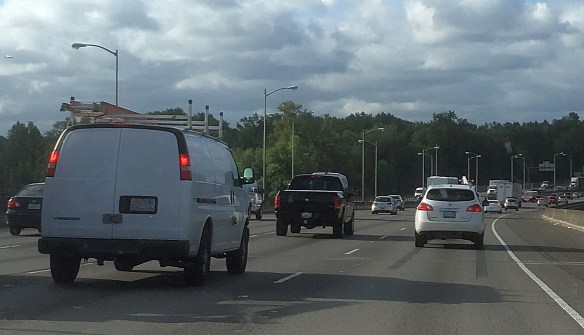
Put pedal to the metal,
don’t let them get away.
Faster than fast, hit the gas
if you’re gonna play.

Gotta get ahead now,
catch them in their own lane.
They won’t even know you’ve
beat them at the game.

Don’t give them time to guess;
road rage or reckless chase.
They’ll let you lead the way,
they’ll settle for second place.

Not here to win the race,
you’re here to get the prize.
Slam on the brakes, let them
hit you in the backside.

**> ~ ~ <**

They’ll say it’s your fault.
You’ll say it’s whiplash.
They say they’ll sue you.
You say you’ll take cash.

It’s how the race is run,
not about who wins the race.
Wanna know what I think?
It’s all about who sets the pace.