cyclical seasons
geometric life patterns
spurn linear time

Daily Post weekly photo challenge: Circle
cyclical seasons geometric life patterns spurn linear time
Daily Post weekly photo challenge: Circle
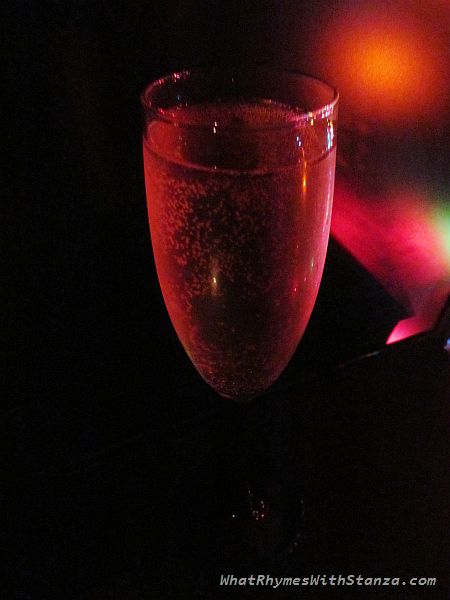
life effervescent
moments surface and explode
tickling my senses
Daily Post’s weekly photo challenge: Now

A herd of elk gathers in a pasture. Beautiful animals, aren’t they?
Daily Press weekly photo challenge: Gathering
birds gather on wires
dark clouds gather in the sky
I gather my belongings and
seek shelter from the storm

Daily Post weekly photo challenge: Gathering
So there I was, sitting in my living room staring once again at that little bulging hole in the wall underneath the window. It was about the size of a thumbnail, with a couple of cracks running about three inches out from it.

Its location under the window made me concerned that the window might be leaking water and causing the damage. But aside from my water concerns, that little hole just irritated the heck out of me every time I looked at it.
For some reason this year I got it into my head that I was going to be some kind of do-it-yourself super warrior. So even though I’d never done any type of wall repair before, I set out to fix that annoying anomaly.
First I took my handy dandy utility knife (I absolutely LOVE my utility knife; it’s just so… utile), and cut out some of the wall sheetrock to see what I was dealing with.

Then I accidentally cut into a prior mesh patch (oops!) and ended up removing it. So I had a bigger hole to fix.

This was more than I had bargained for. I paused to consider my options. While pausing, I made a temporary patch using a pizza box and duct tape (I absolutely LOVE duct tape. It’s just so… ducky).

At least I didn’t have to look at that little hole in the wall anymore.
As the saying goes, “In for a penny, in for a pound.” I forged ahead, replacing the pizza box with sheetrock, and taping and mudding and sanding the new repair. The offending little hole spot now looked like this:

A little texture spray and new paint, and the wall under the window looks as good as new, except for the missing baseboard that I tore off. But that’s a totally different do-it-myself super warrior story.

Daily Post weekly photo challenge: Oops!

When working with stained glass, it’s always wise to factor in the likelihood of breakage during the construction of a panel. That’s what glass does. It breaks. It cracks. It shatters.
And when it does, you say, “Oops!” or some other four letter words, sweep away the shards, pull out the extra glass that you purchased for just such an occasion, and go on with the project.
But sometimes you have only a limited supply of a particular type of glass, and you have to plan carefully to get the best use out of it. And so it was with my Spring Birds panel.
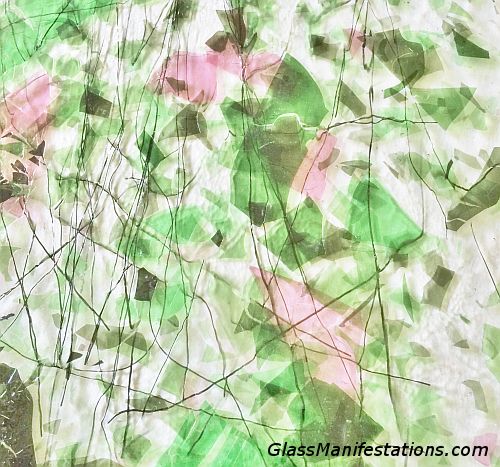
The background glass was rather spendy, and so I bought just the amount that I thought would be needed for the project.
When it came to cutting and fitting the largest background piece into the panel, I was ever so careful to get it just right. There would be no second chances, because I had no other piece of that kind large enough to replace this one.
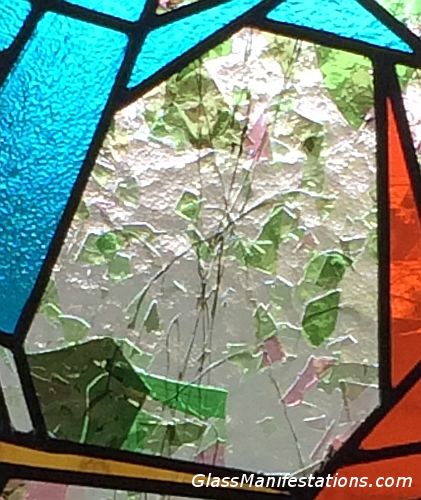
I got the piece in, sighing with relief as I tapped the horseshoe nail into place to keep it from shifting and, as I turned away to get the next piece to put in place, I mindlessly gave the nail just one. more. tap.
And I heard it. That heartbreaking, glass breaking, shard making sound. I looked back and saw this:

Oops, indeed!
Long story short, after a trip to the Uroboros glass factory and many dollars later, I was able to replace the broken piece and finish the panel.
I guess when you work with glass, them’s the breaks.
Daily Post weekly photo challenge: Oops!

Sometimes,
facing life’s challenges
makes you feel as though
you’re trying to fit
through the eye of a needle.
The way to make it through is
one thread at a time.
Daily Post weekly photo challenge: Eye Spy
“To see the moon that cannot be seen,
turn your eyes inward & look at yourself, in silence…”~ Rumi
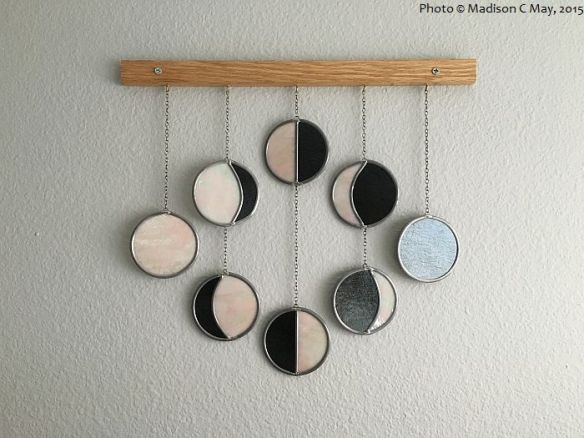
Moon Phases (artist Maggie C)
You might say I’m in the eye business. According to Dictionary.com, one of the definitions of eye is:
the power of seeing; appreciative or discriminating visual perception: [as in] the eye of an artist.
Okay, so this particular definition is sixth in line of the listed meanings, but it is there.
I think for most visual artists, what you see (literally, with your eyes) when you look at their work is inconsequential compared to what you feel. Or how it makes you think. Or what memories it evokes.
Or any number of other responses. But a response that comes from your inner eye.
I always find it interesting to hear how my stained glass pieces affect a viewer. What it says to them, if anything. It’s especially interesting with my abstract designs.
Someone saw one of my panels once and said, “That looks like hope!” Someone else might see it and say it looks like despair. There’s no right or wrong.
I may have my own interpretations of the pieces, and my interpretation is also neither right nor wrong, even though it’s my creation. It can evoke myriad responses from me, too. Different responses at different times.
Different things that my inner eye chooses to perceive. That’s what makes art – and life – interesting.
“Close both eyes to see with the other eye.”
~ Rumi

It’s fun to make series of panels on a theme. I have one in progress that I’ll share more about later.
The topic of The Daily Post’s weekly photo challenge this week is Transition.
Here I have used some fun background glass to help depict the four seasons. Hope you enjoy.
Click on photo below for larger images of each panel.



 What Rhymes with Stanza?