Matchless

NaPoWriMo, Day 17. Due to the demise of my computer, my muse has been forced to sit silent for this past week. But we’re back!

Today’s prompt:

Write a poem that presents a scene from an unusual point of view.

flame

Matchless

Rrrrtch tssss whooos.
Match strikes to life.
Sulfurous head turns black,
then glows orange-red.
Blue flame encircles the head,
turning yellow as it reaches upward.

Match touches wick.
Wick resists, but then
accepts the flame with a
complaining sizzle and pop.

Flame dances brightly to the
rhythm of an invisible breeze.
Wispy white smoke coils up and away.

There’s warmth in the watching,
shadows chiseled by the light,
danger cloaked in tenuousness.

And then, Pifft!
Match is extinguished, and all that is left
is that copycat flame perched ridiculously
atop a flimsy wick and weaving like a drunk parakeet.


NaPoWriMo, Day 17

Things People Say

Day Nine of NaPoWriMo.

Today’s prompt is inspired by the work of Sei Shonagon, a Japanese writer who lived more than 1000 years ago. She wrote a journal that came to be known as The Pillow Book. In it she recorded daily observations, court gossip, poems, aphorisms, and musings, including lists with titles like “Things That Have Lost Their Power,” “Adorable Things,” and “Things That Make Your Heart Beat Faster.”

The prompt:

Today, I’d like to challenge you to write your own Sei Shonagon-style list of “things.” What things? Well, that’s for you to decide!

And so:

Things People Say

“I understand.” A phrase often misunderstood.
If one truly understands,
there are many more effective ways to say so.
Better yet,
illustrate the understanding through actions.
Show, don’t tell.

“Are we there yet?”
Often responded to with a white lie:
“Almost.”
If one feels compelled to ask, the answer is
most likely “no.”

“I love you.” Best said when true.
Often withheld until one’s paramour has said it first.
Show, but also tell.

“Thank you.” Not said often enough.
Tell, and show,
at minimum seventeen times per day.

Crash for Cash

Day Eight of NaPoWriMo. The prompt:

Today, I’d like to challenge you to think about the argot of a particular job or profession, and see how you can incorporate it into a metaphor that governs or drives your poem.

I’ll let the phrase “crash for cash” drive my poem.

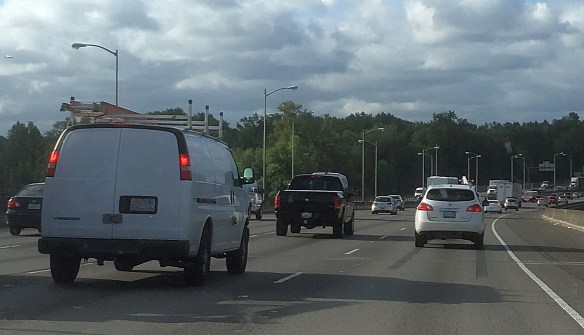
traffic 2

Crash for Cash

Put pedal to the metal,
don’t let them get away.
Faster than fast, hit the gas
if you’re gonna play.

Gotta get ahead now,
catch them in their own lane.
They won’t even know you’ve
beat them at the game.

Don’t give them time to guess;
road rage or reckless chase.
They’ll let you lead the way,
they’ll settle for second place.

Not here to win the race,
you’re here to get the prize.
Slam on the brakes, let them
hit you in the backside.

**> ~ ~ <**

They’ll say it’s your fault.
You’ll say it’s whiplash.
They say they’ll sue you.
You say you’ll take cash.

It’s how the race is run,
not about who wins the race.
Wanna know what I think?
It’s all about who sets the pace.

If and When

Day Six of NaPoWriMo. The prompt:

Today, we’d like to challenge you to write a poem of the possible… not on what has happened, or what will happen, but on what might happen if the conditions are right. Today, write a poem that emphasizes the power of “if,” of the woulds and coulds and shoulds of the world.

If that’s what you want, I guess I could do that:

oceanside

If and When

If
you got to work in the early morning and began wondering what time I would rise from bed and what I might make for breakfast and whether I preferred my eggs scrambled or poached and did I sit at the kitchen table with the newspaper as I ate or maybe on the porch swing so I could smell the spring flowers,

would you call me and ask?

If
I wondered what you were thinking as you gazed silently out the car window on those hot summer days when we drove through the valley with the fields full of big round hay bales that remind me of cinnamon rolls,

would you tell me when I asked?

If
we walked together along the beach in the waning hours of a warm autumn day and spoke of our dreams and hopes and fears and those silly notions that pop into our minds sometimes or the songs that get stuck in our head all day or what we like most about Sunday mornings,

what might happen then?

When
winter comes, perhaps we can sit at home before a warm hearth, enjoying one another’s company, comfortable in our answers,

no questions asked.

If Only

Day Five of NaPoWriMo. Lots of choices for the prompt today. I chose to write a villanelle, which is defined as such:

The classic villanelle has five three-line stanzas followed by a final, four-line stanza. The first and third lines of the first stanza alternately repeat as the last lines of the following three-line stanzas, before being used as the last two lines of the final quatrain.

Clear as mud? I thought so, too. But I gave it a go anyway.

woods1

If Only

If we only had the time –
just imagine if you would –
all the mountains we could climb.

Wouldn’t it be fine?
Leisured strolls in shaded woods
if we only had the time?

If we let the years unwind,
wove the hard times with the good,
all the mountains we could climb.

We’d pick peaches in their prime,
dine beneath the cottonwoods
if we only had the time.

If we heard the clock bells chime,
left our worries where they stood,
all the mountains we could climb!

How might our futures be defined
if we only understood?
If we only had the time,
all the mountains we could climb.


Also posting on dVerse, where the poem form for the month is the villanelle. 

Checking In

Day Four of NaPoWriMo.

And now for today’s (optional) prompt, inspired by Teicher’s poem “Son“. One thing you might notice about this poem is that it is sad, but that it doesn’t generate that feeling through particularly emotional words. The words are very simple. Another thing you might notice is that it’s a sonnet – not in strict iambic pentameter, but fourteen rhymed, relatively short lines.

Today, we’d like to challenge you to write your own sad poem, but one that, like Teicher’s, achieves sadness through simplicity. Playing with the sonnet form may help you – its very compactness can compel you to be straightforward, using plain, small words.

My post from yesterday was sad enough, but okay. In sonnet form, here goes:

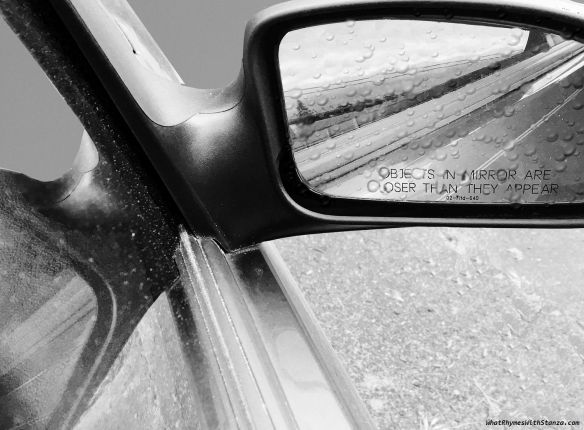
mirror 1500

Checking In

I don’t recall the last time we had dined
with just the two of us away from home.
I guess we’d never found ourselves inclined
to try relating one-on-one alone.

Conversation did not come easily,
but not for lack of words that need be said.
In short, your failing ears could not hear me.
Nonetheless you’d smile and nod your head.

A gentleman you’ve been for all your years,
your empty wallet drawn to pay the bill.
You needn’t pay, Dad, now that you live here.
I bussed the table once you’d had your fill.

A nurse came by and took you by the sleeve.
It’s best, she said, that you not see me leave.


Also posting for V.J.’s Weekly Challenge #42: farewells

In Passing

Haagen park

We met at the park, the one where a paved trail winds around an open grass field. He walked his tiny black poodle in one direction. I walked my midsize white Eskie in the other, and we would cross paths, usually beneath the tall cedar trees that provided welcome shade in the summer, and protection from rain the rest of the year.

His name was Don. The poodle was Mon Cheri, his neighbor’s dog that he borrowed for his morning walks.

Don would see us approaching on the trail, and would exclaim, “Look, Mon Cheri, it’s your friend!”

Mon Cheri would growl at my Chules and strain at her leash to gain distance. Don didn’t seem to notice, and neither did Chules.

Don would smile at Chules. “What a happy dog! Isn’t he pretty, Mon Cheri?”

At some point, Don changed direction on how he walked the loop, from clockwise to counterclockwise. I changed direction, too. Don seemed nice enough, but no matter how many times he tried to cajole Mon Cheri about her happy fluffy dog friend, Mon Cheri still rejected Chules.

Over time, our conversations expanded. I told him about stripping the old oak floors in my house. He warned me about fumes and gas pilot lights, lest they meet and blow up the house.

Don explained his reason for changing directions on the loop. It was easier to navigate a small incline in the path.

“You can’t see it, but it’s there,” he said.

He was right. I couldn’t see it.

I didn’t see Don for a while, and then one day he was back. He had shaved his beard, and maybe his head as well. He always wore a flat newsboy cap, and I had never noticed his hair length. His pace had slowed considerably.

“How are you doing?” I asked. “I’ve missed seeing you.”

“Oh,” he replied. “I’ve been coming later than I used to. I don’t get up as early in the mornings anymore. And on Sundays I go to church. It’s nice to see everyone.”

I contemplated inviting Don out for coffee. He seemed lonely. And frail. More frail each time we met. But it felt awkward, so I didn’t ask.

One day, we met on the path, and Don told me about receiving chemotherapy. He’d decided to stop treatment and resort to positive visualization and healthy eating  and “all those things they say to do.”

This was the first time Don had spoken of his health, or anything intimate or personal at all. I didn’t know what to say.

I made some throat noises that I hoped were consoling, and agreed when he said sometimes it’s best to let things take their course.

He was tired, I could tell. Tired of struggling to walk up imperceptible inclines. Tired of fighting battles he would ultimately lose. He’d even given up on trying to convince Mon Cheri that she and Chules were fast friends.

I didn’t see Don after that.

One day I crossed paths at the park with another man and his dog. I had seen them on several occasions stop and speak with Don, just as I had done.

“Have you seen Don lately?” I asked.

“Who?”

“The gentleman with the little black poodle and the newsboy cap. He used to walk here, but I haven’t seen him in a while.”

The man didn’t know who I meant.

I cried for Don. I hoped he’d had a good life. I hoped he’d been loved.

Chules and I don’t visit that park much anymore. We walk a different trail now, where we sometimes cross paths with a man and his midsize black dog named Pink.
What Just Happened?

Day Two of NaPoWriMo. Today’s prompt:

Write a poem that resists closure by ending on a question, inviting the reader to continue the process of reading (and, in some ways, writing) the poem even after the poem ends.

End with a question? Are you sure?

whats happening

What Just Happened?

Say, did you hear that noise just now?
No? Neither did I.
What do you suppose it was?
Or wasn’t.

Could have been most anything,
but you know what I think?
I think it was nothing; a very quiet nothing.
Came out of nowhere, and went…
nowhere.

You think I hear things that aren’t really there?
Where did you hear that?
Never mind, that’s neither here nor there.

Fact is, I’m not hearing things that aren’t really there.
Nothing wrong with that, is there?
Who am I to judge a sound by its absence?

Speaking of sound judgment…
are you thinking what I’m thinking?
No? Me neither.

What do you suppose it was?

How to

Day One of NaPoWriMo. The prompt:

[W]rite poems that provide the reader with instructions on how to do something.

Herewith,

how to

How To

There’s so many things I’ve yet to learn,
like where and why and what and who.
So who said what, why is it where
most try to teach “how to?”

How to fall in love;
how to win it back.
How to lose the oaf
when his façade cracks.

How to earn big bucks
quick and easily,
how to file the forms
for your bankruptcy.

How to win respect from
those you disdain,
how to show concern
with sympathy feigned.

I won’t tell you how
to live your life.
It takes patience, care
and sometimes strife.

But I’ll gladly show how
to change your and my luck
with just four installments
of twenty bucks.