
Read the Signs

Day 26 of National Poetry Writing Month (NaPoWriMo) .

Today’s NaPoWriMo prompt is to write a sonnet. The strict rules of sonnets:

  • 14 lines
  • 10 syllables per line
  • Those syllables are divided into five iambic feet. (An iamb is an unstressed syllable followed by a stressed syllable).
  • Rhyme schemes vary, but the Shakespearian sonnet is abab cdcd efef gg (three quatrains followed by a concluding couplet).
  • Sonnets are often thought of as not just little songs, but little essays, with the first six-to-eight or so lines building up a problem, the next four-to-six discussing it, and the last two-to-four coming to a conclusion.

The “rules” are somewhat bendable, but I tried stay relatively true to the strict format. Herewith:

Sales Pitch (Read the Signs)

The sign says No Solicitors. You knock.
Beware the Dog that lunges at my door.
“The rats and piss ants this year run amok.”
You’ll slay them all. They’ll bother me no more.

A spider egg sac hangs upon the wall.
“A hundred spiderlings your home will fill.”
More likely to my garden they will crawl
to feast upon the bugs you wish to kill.

No rodents, bugs or crawlies bother me.
The poison’s “safe for pets,” you persevere.
My Wildlife Habitat sign plain to see;
No chemicals have touched my yard in years.

Your sales pitch failed, now please just go away.
My “pests” will live to see another day.

Beyond Compare

Day Fourteen of National Poetry Writing Month. The muses at NaPoWriMo.net have given us this prompt for today:

…write a parody or satire based on a famous poem… take a favorite (or unfavorite) poem of the past, and see if you can’t re-write it on humorous, mocking, or sharp-witted lines. You can use your poem to make fun of the original (in the vein of a parody), or turn the form and manner of the original into a vehicle for making points about something else (more of a satire – though the dividing lines get rather confused and thin at times).

Since I too get rather confused (though seldom thin) at times, this prompt is a perfect fit. The poem I chose to work with is Shakespeare’s Sonnet 18: Shall I compare thee to a summer’s day? For those of us who are bard-challenged, I will post Shakespeare’s version below. But first (since I control the quill), here is my rendition:

Sonnet 4: Shall I compare thee to an iced latte?

Shall I compare thee to an iced latte?
Thou sadly in cup holder dost not fit.
While coffee stains can really ruin my day,
I can control the spillage with one sip.
Sometimes you can be cold as latte’s ice,
Complexion like milk curdled in the sun.
I think it’s fairly safe if I surmise
Your pull date has already come and gone.
My latte won’t last long enough to sour
Nor lose its taste if ice begins to melt.
I tend to drink it up within an hour
The liquid sloshing gently ‘neath my belt. 
   I hope this verse has not offended thee.
   So long to you and your oft bitter tea.

And Shakespeare’s sonnet:

Sonnet 18: Shall I compare thee to a summer day?

Shall I compare thee to a summer’s day?
Thou art more lovely and more temperate:
Rough winds do shake the darling buds of May,
And summer’s lease hath all too short a date;
Sometime too hot the eye of heaven shines,
And often is his gold complexion dimm'd;
And every fair from fair sometime declines,
By chance or nature’s changing course untrimm'd;
But thy eternal summer shall not fade,
Nor lose possession of that fair thou ow’st;
Nor shall death brag thou wander’st in his shade,
When in eternal lines to time thou grow’st:
   So long as men can breathe or eyes can see,
   So long lives this, and this gives life to thee.

Sonnet Sunday

Day Nine of National Poetry Writing Month! Today’s prompt from NaPoWriMo.net:

We’re calling today Sonnet Sunday, as we’re challenging you to write in what is probably the most robust poetic form in English. A traditional sonnet is 14 lines long, with each line having ten syllables that are in iambic pentameter (where an unstressed syllable is followed by a stressed syllable). While love is a very common theme in sonnets, they’re also known for having a kind of argumentative logic, in which a problem is posed in the first eight lines or so, discussed or argued about in the next four, and then resolved in the last two lines. A very traditional sonnet will rhyme, though there are a variety of different rhyme schemes.

My attempt:

For the Love of Springtime in Colorado

Boots sinking deep in mud-browned melting snow,
sweatshirt peeled off and knotted at my waist.
Spring’s dichotomy in Colorado.
Wool socks, sun shades; my rucksack packed in haste.

Crabapples bloom, spent petals drifting down.
Snow lingers where protected by thick shade.
As winter seeps into the thawing ground,
summer will drop like curtains on a stage.

I trek on, heedless of sign and season.
Despite spring breeze or autumnal bluster,
ubiquitous blue skies transcend reason.
I suck the thinning air, my strength mustered.

Toes white with cold, face tanned by sun, I smile.
Springtime in the Rockies keeps one agile.

And click here for a throwback to a previous sonnet I wrote.

Checking In

Day Four of NaPoWriMo.

And now for today’s (optional) prompt, inspired by Teicher’s poem “Son“. One thing you might notice about this poem is that it is sad, but that it doesn’t generate that feeling through particularly emotional words. The words are very simple. Another thing you might notice is that it’s a sonnet – not in strict iambic pentameter, but fourteen rhymed, relatively short lines.

Today, we’d like to challenge you to write your own sad poem, but one that, like Teicher’s, achieves sadness through simplicity. Playing with the sonnet form may help you – its very compactness can compel you to be straightforward, using plain, small words.

My post from yesterday was sad enough, but okay. In sonnet form, here goes:

mirror 1500

Checking In

I don’t recall the last time we had dined
with just the two of us away from home.
I guess we’d never found ourselves inclined
to try relating one-on-one alone.

Conversation did not come easily,
but not for lack of words that need be said.
In short, your failing ears could not hear me.
Nonetheless you’d smile and nod your head.

A gentleman you’ve been for all your years,
your empty wallet drawn to pay the bill.
You needn’t pay, Dad, now that you live here.
I bussed the table once you’d had your fill.

A nurse came by and took you by the sleeve.
It’s best, she said, that you not see me leave.


Also posting for V.J.’s Weekly Challenge #42: farewells

It’s a Sonnet, Doggone it!

NOTE: January 3, 2019 ~ It’s been over three years since I wrote this sonnet, and it’s still the only one I’ve managed. The dVerse prompt today is the sonnet. The form still confounds me, but I will stretch my comfort zone and practice writing another one. Maybe two. In the meantime, I am sharing this poem, and am most welcoming of feedback. Thank you. 


October 19, 2015:

The final assignment in the WordPress Writing 201 course is to write a sonnet. Not my style at all, although I have to admit I’ve never tried to write one before.

At any rate, I hiked up my Shakespeare shorts and dove in, and as you can see below, my muse Chules chipped in by demonstrating his poetry quothe-ing and theatrical emoting skills.

sonnet

But, bark! What lights softly through yawnder broken window?

Herewith, I giveth thee my sonnet:

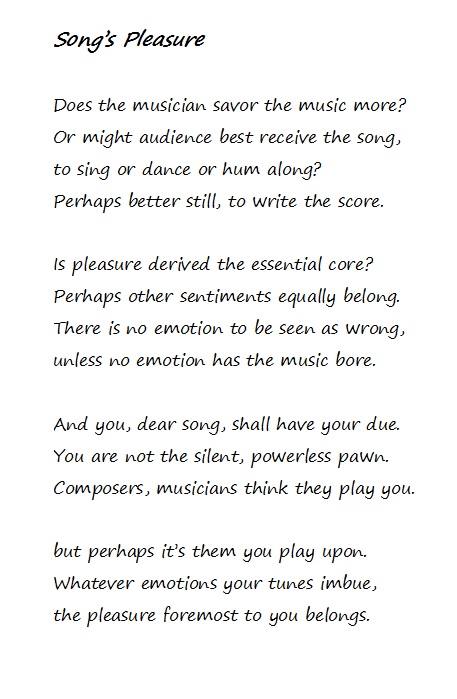
songs pleasure


WordPress Writing 201, Assignment Ten. Prompt: pleasure. Form: sonnet . Device: apostrophe.