The Glass is Always Greener…

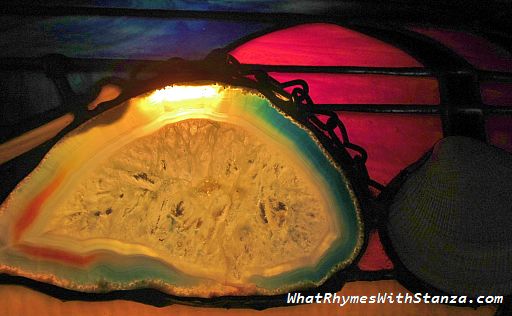
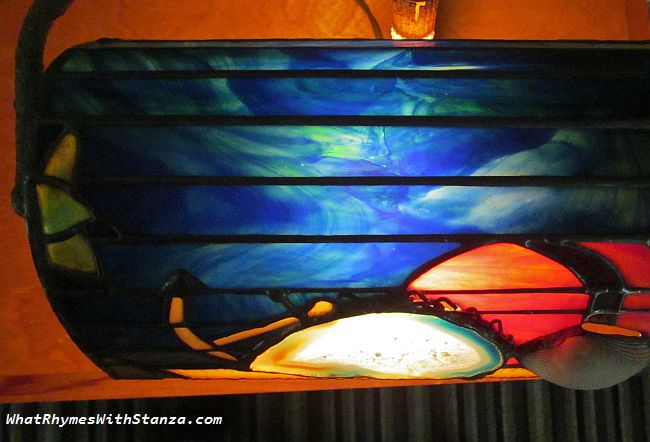
green2Citrine, known as the “Success Stone,” is believed to aid in attracting success and prosperity. The color green is considered to represent prosperity and abundance.

A winning combination, I’d say. Stay tuned! I’ll let you know.

Weekly Photo Challenge: Monochromatic

Inside a Kaleidoscope

I was speaking with “T” the other day about the importance of making our surroundings pleasing to our senses. T is familiar with my stained glass work and she commented on how wonderful it would be if I hung my glass art in every window of my house.

“It would be like living inside a kaleidoscope!” she told me.

What a vivid image! A home where every room dances with color and light! I might not go for it if I lived in a setting where Nature’s own designs graced my view from each window.

But as I sit in my living room gazing out my picture window at the Walgreens Pharmacy across the street, I’m thinking this just might be the perfect spot for a kaleidoscope. Or at least a stained glass panel.

kaleidoscope

In response to Cee’s Fun Foto Challenge: Sight. “This week’s topic is the colors of the sense of seeing…  [P]ost anything that stimulates or delights you visually.”

Sorting Glass — A Poem

I’ve turned my energies to poetry for a while, as I take a two-week challenge from The Daily Post. I didn’t write this poem for the challenge, but was reminded of it, so I thought I’d share it here:

Sorting Glass

Sorting stained glass into bins,
careful lest I cut myself.
How does one parse the spectrum of light
into specific and separate boxes?

Blue or green?
Translucent or opaque?
Flashed? Rolled? Blown? 
It even defies the line 
between solid and liquid.

Can’t mold it into endless shapes,
like a potter fondling clay on a wheel.
Can’t sand it smooth like a choice piece of wood,
and wipe the fine dust away with gentle strokes.

No. It’s cold and rigid and sharp and brittle.

But when the light finds it,
it warms and dances and morphs 
into myriad shapes and textures and nuances
that no other medium can rival. 
It comes alive. 

It brings me to life.
And as I sort it into bins,
being careful not to cut myself,
I feel its pulse in time with mine. 

m3

According to Scale

Weekly Photo Challenge: Scale

Weekly Photo Challenge: Scale

Stained glass is not a medium that lends itself easily to realism. I mean, I can make a panel that depicts something specific – a rose, for example – but even if I attempt to make it look realistic, you aren’t likely to view it and be led to believe that you are seeing an actual rose.

Even from a distance. In the dark. With one eye closed.

I really like that, because it lets me off the hook. I don’t feel compelled to portray images in perfect proportion or according to scale. Which is good, because I don’t think I could do it if I tried.

A lot of artistic people are blessed with multiple creative talents. They can paint and draw and sculpt, or whatever. Their artistic abilities just splash all over the place, like an overfilled cup of coffee. Me, not so much.

I can design a stained glass panel to my liking, but if you ask me to make a drawing of the same subject, the outcome would be pretty dismal. That’s why God invented abstract art… for people like me. And Picasso.

Window installation at UCC church, Tillamook, Oregon

Window installation at UCC church, Tillamook, Oregon

The only time I attempted realism in a panel was with a commissioned piece for a church. The window had to “match” or compliment the already existing windows in the structure, which were of a realistic nature.

And so I took on Jesus. Of course, we don’t really know what Jesus looked like, so I pretty much took my cue from the drawings I’d seen throughout my stint in Sunday school. And in those pictures, Jesus is a pretty proportionate fellow.

I will never be satisfied with the results (which you can see pictured here). Does it look like his left forearm is raised higher than the right (hint: it’s supposed to), or does it look like his left arm is shorter than the right (hint: that would be bad)? There are other areas that do not seem made to scale (depending on how you interpret body placement), but I’ll give myself (and Jesus) a break and not pick him totally apart.

So here’s my life analogy: things don’t always have to be according to scale. People talk about wanting to live “balanced” lives, and that’s great. But sometimes it’s okay to let one arm hang a little lower than the other.

Yeah, well, analogies aren’t my strong suit, either.


The Daily Post weekly photo challenge: Scale

Depth Finder


Close up of light reflection on stained glass panel.

Close up of light reflection on stained glass panel.

In my little corner of the world, it seems that interest in glass work is swinging greatly towards the direction of “warm glass,” or kiln-formed glass. Which is very understandable. There is so much potential for creativity in the three-dimensional forms that melting glass allows.

Even the vocabulary of fused glass is fun: slumping, frit, draping, stringers, confetti…

And the vocabulary of my work with flat stained glass panels? How about “fid?” It’s just not a sexy word, although it works well in Scrabble when you’re really stuck. Or “lead,” which elicits sayings like: get the lead out… lead-footed… lead poisoning. Also not sexy.

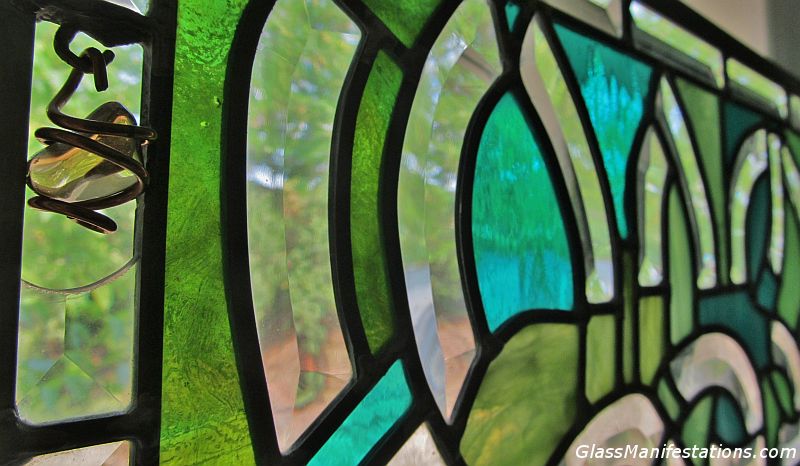
Of course, there is some dimensionality in panels – in glass bevels, for example. Or in textured glass. And a flat panel doesn’t exclude the incorporation of three-dimensional objects.

Just because a panel is flat, however, does not mean it lacks depth.

“Depth” has so many meanings beyond the concept of a dimension. From Dictionary.com:

  1. a dimension taken through an object or body of material… [the extent, measurement, or distance downwards, backwards, or inwards]
  2. the quality of being deep; deepness.
  3. complexity or obscurity, as of a subject: a question of great depth.
  4. gravity; seriousness.
  5. emotional profundity: the depth of someone’s feelings.
  6. intensity, as of silence, color, etc.
  7. lowness of tonal pitch: the depth of a voice.

So a flat stained glass panel can be complex – either in design or in abstract meaning, can emote or evoke a sense of seriousness or profound feeling, and can incorporate intense colors. And if it could talk, who knows? It might just sound like Morgan Freeman.

Not bad for only two dimensions.


Weekly Photo Challenge:  Depth

Express Yourself (Weekly Photo Challenge)

hammer

“Hammer Shattering Glass Shattering Hammer” What does it mean?

I’ve been pondering the question of “What is Art?” and consequently, what makes an artist?

and what is the purpose of art?

and who decides all of these things?

and what is the meaning of life?

Oh, wait. Nix that last one. I quit pondering that a long time ago.

I’ll be exploring these questions in future posts. Probably…

But today, the Daily Post weekly photo challenge is based on the theme “Express Yourself,” which has led me to musing about art as a means of expressing oneself.

Maybe that’s a basic parameter of art: the artist is creating/performing/producing art as a means of self-expression.

But if an artist creates something in order to express him- or herself, does it matter whether the viewer understands what it is that the artist is trying to express? Or is it the act of expressing oneself all that really matters?

I share photos of my newly completed stained glass panels on FaceBook, a practice which is primarily undertaken because I like to get positive feedback on my work. And since they’re all my “friends” on FB, I can be fairly confident that I won’t get flamed. I’m kind of a coward that way.

I got a FB comment once that did rankle me for a while, though. In response to a photo of one of my pieces, someone wrote, “Cool. But what is it?” It didn’t bother me that this woman couldn’t recognize what I was trying to portray. My intent was more to convey an emotion – or a mood – than to depict a literal object.

What bugged me was that she felt the need to ask. My response to her was along the lines of, “It’s whatever you want it to be.” I know what it means to me, and it’s irrelevant to me as to what it meant to her. Not that I don’t care; it’s always interesting to know what others see in your work. And someone else’s interpretation might give me new insight as well. But whatever her interpretation is, it’s neither good nor bad, neither right nor wrong.

So another thought… does it matter whether the artist him- or herself knows what they are trying to convey? Does art have to have any meaning at all?

Jackson Pollock’s paintings are about as abstract as art can get. A Wikipedia article about him states that, “[In] continuing to evade the viewer’s search for figurative elements in his paintings, Pollock abandoned titles and started numbering his works.”

Pollock’s wife, Lee Krasner, is quoted as explaining the numbering of his works thusly: “Numbers are neutral. They make people look at a picture for what it is—pure painting.”

Pure painting… Does that mean that it is not meant to be interpreted at all? Did Pollock have his own interpretations for the pieces, or was he simply practicing “pure painting?”

And if there is meant to be no interpretation on the part of the artist or the viewer, is it in fact art?

So many questions…

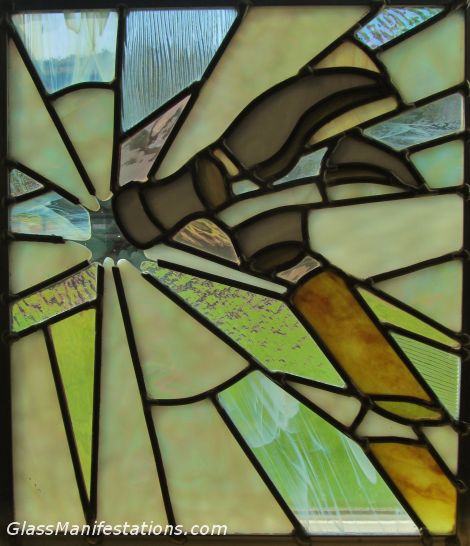
My title for the panel pictured above is “Hammer Shattering Glass Shattering Hammer.” (Or No. 11, if you prefer.) I’d be curious to know how others interpret the piece.

Any comments?
Express Yourself
Piece.by.Piece.

Monday, January 2015 – Dear Diary:  I’ve had my pattern laid out for this stained glass panel for a while now, but for some reason I can’t get myself to go into the studio and start cutting glass.

  • Maybe it’s the dog. Every time I head to the studio he starts running amok all over the house.
  • Maybe it’s just getting over the inertia of starting a new project.

I’ll start cutting glass tomorrow. 


huly in trouble

Tuesday – Dear Diary:  The studio just doesn’t feel right. I got in there and cut one piece of glass, but something’s off.

  • It could be the new layout of the studio. I just moved and so the setup isn’t quite the same. I just need time to get used to it.

I’ll do better tomorrow.

one piece


 Wednesday – Dear Diary:  I went into the studio today and cut another piece of glass. Just one. This time I began to feel dizzy and ill.

  • Maybe it’s the mats on the floor. They’re squishier on this floor than at my previous studio.

I just need to get my “sea legs.” Or would that be my studio legs?

mat2


 Thursday – Dear Diary:   The more I think about it, there could be a number of reasons for feeling ill yesterday.

  • Perhaps I drank too much coffee and overdosed on caffeine.
  • I probably need to improve my diet. I could have felt dizzy because of all the crappy food I’ve been eating.

I’ll eat better tomorrow.

starbucks

 Friday – Dear Diary:  I think the studio just needs airing out. There was some nasty stuff on the walls when I moved in, and the fumes from the bleach-based cleaner I used were strong enough to fell a horse. Had there been a horse in my studio.

I’ll open a window and get some fresh air in here.

pokey

 Saturday – Dear Diary:  The open window thing didn’t work. I forgot that there are storm windows on this side of the house, and I didn’t open the storm window when I opened the inner one, so no fresh air got in. Oops! Today I’ll open BOTH windows.

window

 Sunday – Dear Diary:  Wow! It’s been a week already, and I’ve only gotten two pieces cut. Let’s see… It’s January. There are 91 pieces to this panel. At this rate, I’ll be ready to solder it together in roughly 44 more weeks. Right around Thanksgiving. But then we’ll be into the holiday season and it’s hard to get much of anything done during the holidays.

christmas

 New Year’s Resolution for 2016:

Get this stained glass panel finished!!!


Note: No horses were harmed during the photographing of this post. The dog, however, was chastised. But just a little.

Visual Fodder

brick wall

Coming up with ideas for stained glass panel designs is perhaps the most fun part of the whole creative process. Someone asked me once about how I get my ideas. I told him that they just kind of evolve. I just wait, and they show up.

That’s not entirely true. I don’t just sit around waiting for an epiphany. I’d be waiting a very long time if that were the case. What I really do is feed my imagination.

I take walks in nature. I take walks in urbania. (I know, urbania’s not a real word, but it should be, don’t you think? Like, inclusive of cities, suburbs, towns, strip malls… Maybe there’s already a word for that. I’ll give Merriam Webster a call someday to find out.)

I take photographs everywhere I go. Well, not everywhere. That would just be creepy. But by consciously looking for photo subjects, I am training myself to notice things that might otherwise be overlooked.  Basically I’m gathering images to study and play with and ruminate over.

And then all that visual fodder begins to shift and sift and coalesce into an image that can be translated into glass. Not to make this sound all ethereal and pretentious (or like a cow chewing its cud… “ruminate?” “fodder?”)

Sometimes the “image” is as simple as a brick-like pattern.

path

path pattern

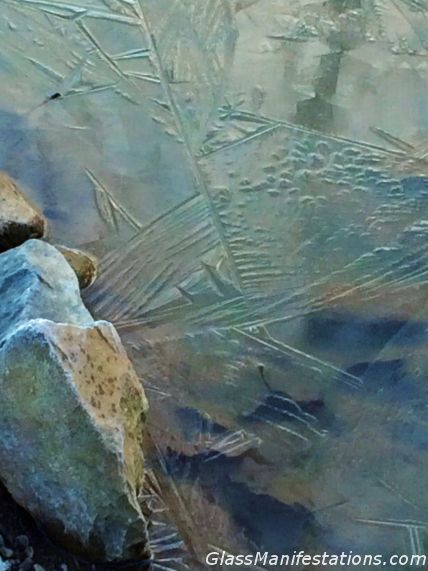
Sometimes it’s as silly as “Three Penguins on Ice.”

ice

penguins

Maybe someday I will experience an epiphany. But until that day arrives, I will continue to feed my imagination. There’s not much worse than a starving imagination.

Where do you find your ideas?

Manifesting through Stained Glass

NOTE: This post was the first written for my now defunct blog Glass Manifestations. I have since folded many of the Glass posts into my What Rhymes with Stanza blog.

Manifest —

3. verb (transitive) to show plainly; reveal or display

  1. to prove; put beyond doubt or question

Creating stained glass panels is a very personal process for me. From the inspiration, to the design, selection of colors and textures, and then to the actual crafting of the piece. Sure, I like to sell my work and keep my cupboard stocked with food and my studio stocked with glass.

But what mostly matters to me is the process. The quest for ideas and inspiration and the way they “manifest” out of the seemingly mundane fabric of my simple life. The challenge of translating those ideas into a dynamic two-dimensional design. The sensory pleasure of looking at material options, feeling the heft of the sheets of glass, holding them up to the window to study the interplay of color and light, tracing my fingers (carefully!) across the surface to gauge how the texture will contribute to the overall design. And then the careful application of age old techniques to craft the materials into a final cohesive piece of art.

And finally, the moment of truth, when I lift the completed panel off the work table, move it to a window to let the sunlight filter through, step back and experience how my original inspiration has morphed into a tangible representation constructed with glass and lead.

I gain a lot of insight during the process of creating a panel, and again whenever I contemplate the finished piece.

Glass Manifestations [My original blog site was] about glass (sort of) because working with glass is how I do a lot of my processing (thoughts, feelings, ideas, inspirations…), and hence a lot of my thoughts, feelings and ideas are made manifest in my art. But it’s also about insight and growth, in the hope that what I manifest tomorrow, or next week or next year – in life as well as in glass – will continue to improve. In quality, in meaningfulness, and in pure, simple pleasure.