on wings

chicken

Scissors in one hand, hen in the other, a couple of quick snips and the wing tips swirl to the ground. Keeps ‘em from ‘flying the coop’, the farmer says. He releases the hen. She takes a moment to regain her balance, then runs to the opposite side of the pen where she flaps and clucks her objections. Isn’t it rather cruel to clip their wings, I wonder? Nah, the farmer says. It doesn’t hurt them, and ‘sides, if they don’t like it, they can leave. The farmer chuckles at the irony of his own joke and reaches for another hen.

boundless sky beckons
anticipation takes flight
gravity prevails


dVerse Haibun Monday — Complexity of Freedom

Street Names

From the dVerse blog for Tuesday Poetics: May 29, 2018: “Here’s what I want you to use tonight as inspiration for your poem. I’ve listed some street names for you, and I want you to imagine what the street is like…or who might live there…or how the name came about.”

The street name I selected from the list is Buttgarden Street.


garden

We pass this way most every day,
my faithful dog and I,
and on this street a man we meet,
his mutt heeled at his side.

We greet as neighbors tend to do
a nod and friendly hi.
Our dogs sniff at their private parts;
we turn a modest eye.

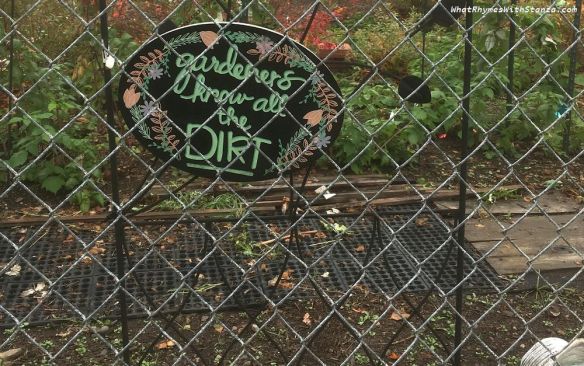
A garden for the neighborhood
some volunteers commenced,
fronts this street for several feet
behind a cyclone fence.

“I wish they’d put this somewhere else,”
my neighbor groused aloud.
“This used to be a quiet street.
Now every day’s a crowd.”

True, many gardeners come each day
to tend their tidy beds.
With backs bent low, they weed and sow,
as blood runs to their heads.

Perhaps someday we’ll see green stalks
of veggies grown with care.
But until then there’s just a crop
of butts up in the air.

Rush Hour

traffic1

I should have taken the I-5 freeway, I tell myself even as I commit to the onramp of I-84 East. Traffic is at a crawl as drivers jockey to merge into the three eastbound lanes. I choose the center lane. A red Volvo in front of me switches to the left lane even though it, too, is at a near standstill. My line begins to move and I pull past the Volvo. I bet they’re sorry they changed lanes. I smile smugly. A mile later, my lane slows, and cars are passing on both sides. The Volvo, now in the right lane, zooms past me. That’s okay. It’s not a race. I stay in the middle lane. Dance with the one that brung ya, right?

drivers on their marks
finish lines are self-described
bring your own trophy

For the next six miles, traffic ebbs and flows. Compulsively, I check my progress against cars on either side of me. No, it’s not a race, but there’s that nagging need to prove that I chose the best lane. I reach my exit and check my rear view mirror as I ease over to the off ramp. The red Volvo is right behind me. Ha! For all its lane changing, I still came out in front. Had it been a race – which of course it wasn’t – I would have won. Yep… dance with the one that brung ya. Fidelity always pays off. Until it doesn’t.

crows raise strident voice
choruses of morning birds
solos every one


Haibun Monday: Silent Sounds

with you — unseen (a contrapuntal)

Sometimes I see that you are
sad, upset…
					In pain
I don’t know what to say,
other than, “I’m sorry.” 
					you retreat,
You say, “It’s okay.
It’s not your fault.” 
					lick your wounds
We both know that it’s not.
Not my fault – at least not this time –
and not okay.

What is it that keeps us		unseen.
from being okay with life
not being okay? 

What is it that keeps us		Unseen,
from allowing one another to
be with us in our sorrows?
					
I am with you when you are down.	I bear your pain
I am with you when it’s not okay.
I am with you when it’s not my fault… 	and remain
even when it is my fault. 

If you do not wish to be with me,
or just aren’t ready right now,
that’s okay. 

Or maybe it’s not. 
But I will be with you in my heart,	in silence.
even if not in yours. 

In response to dVerse Meeting the Bar, May 24, 2018, where it is explained that, “Contrapuntal music is composed of multiple melodies that are relatively independent that are sounded together. In the poetic world, contrapuntal poems are poems that intertwine two (or more) separate poems into a single composition.”

Dog Weather

rain cabin

Come outside, it’s raining!

Damp tree scents tickle our noses;
delicious, earthy chills.

Raindrops splash in puddles.
Watch them dance; taste the freshness.

Hear the rain trickle through
moss-furred branches overhead.
Feel the wet soaking in.

Then back inside to shake it all off.


dVerse Quadrille: Don’t rain on my parade! 
The Daily Post weekly photo challenge: Liquid

Tall Order

heroes

HEROES WANTED
Must have crisp capes and masks with
just the right balance of intrigue and
mystery.

Must have superpowers of seeing through
rumors, lies and half-truths; and
leaping over small thoughts,
imposed barriers and festering hatred.

Must be unflinching in the face of
introspection, and have the wisdom to
acknowledge that there are no difficult answers,
just difficult questions.

Must be of such mettle that –
perchance the mask slips –
revelation of the hero’s true character
can withstand close scrutiny in the
oh-so-harsh light of day.

Most importantly,
beneath the crisp cape and behind the mysterious mask,
must be a human with foibles,
vulnerabilities, and the willingness to risk
love and forgiveness.

White horse optional.

Bookends (Slaking the Muse)

I began April’s National Poetry Writing Month (NaPoWriMo) with a poem about “Waking the Muse.” Now thirty days later (and 30 poems, though not all were posted), I will bookend the month with a sequel to the first poem. Hence:

Slaking the Muse

“Good morning!” I called as I came through the door.
“It’s time to learn what our next poem has in store.”
My muse gave a snort. “I’ve got ideas galore.
But haven’t you heard? I don’t work here no more.”

“What gives?” I inquired, with mounting distress.
“Your pen is not inked and your grammar’s a mess.”
“It’s over,” muse sighed, “perhaps all for the best.”
“But we’ve only just started!” I rushed to protest.

“No more NaPoWriMo, since April is gone.
No challenge, no prompt, so it’s time to move on.
To the bookcase I’ll go, with my Greek lexicon.
‘Midst these two huge thesauri you’ll find me anon.”

“Please don’t leave me now,” I implored with a cry.
“There will be no more poems without you at my side.”
“Indeed,” said my muse, looking ever so sly.
“Under better conditions, I’d perhaps longer bide.”

“What is it you want?” I knew I’d been had,
having first felt so glum, and now equally mad.
“I will double your pay, if you think it’s so bad.”
“Twice nothing is nothing.” Muse knows how to add.

“You can take some days off to relax and repose.”
“That serves as a start,” muse begrudgingly supposed.
“These dealings between us are still far from closed.
But we’d best start composing while I’m yet rhyme-disposed.”

Her thoughts so profound that in awe I must gasp,
at times muse’s musings I struggle to grasp.
My pen moves as fast as the strike of an asp,
and the rest will be history (once time has elapsed).

bookend 1

Off the Wall

Forty scientists and engineers and
computer programmers toil each year,
a million bucks per annum spent,
a decade now, with price so dear.

Another study of fifty years,
such value held in answers sought,
in labs where winged subjects die,
though scientists claim it’s not for aught.

The topic: vast data processed in flight,
motion and movement sensitivity;
the interconnections of brain nerve cells
that exceed computer capabilities.

Complex, for sure, but fifty years?
Such lengthy studies in part explained;
the task of handling small electrodes
when attaching them to house fly brains.

Now, I may not a scientist be,
but the question I would like explored
is why flies crash into window panes
instead of flying out open doors.


NaPoWriMo Challenge, Day 30 (final day): write a poem that engages with a strange and fascinating fact.


Cruel Moon

moon

“The moon is merciless,” she writes.
Cruel and scathing, she tells us.

Is this the same moon under which
lovers swoon?

The same moon toward which
canids tilt sharp-muzzled heads and
sing ballads torn from the depths of
ancient heritage?

Seer of harvests, bountiful and ripe.
Sometimes new,
sometimes blue,
sometimes erased by crumbling clouds,
sometimes agleam like a new gold tooth.

How can it be merciless, suspended
beyond mortal hands? Out of reach,
out of touch,
timelessly same as the day it was born.

“I know the bottom,” she writes.
“I do not fear it; I have been there.”
Moon-stricken poet, no longer a pawn
to the beacon of night,
where is this bottom you speak of, and
where are you now?


NaPoWriMo Challenge, Day 29: pick a poem written by Sylvia Plath, and then write a poem that responds or engages with your chosen Plath poem in some way.

I chose the poem “Elm,” written on April 19, 1962.