Words and Paint

NaPoWriMo, Day 28

The prompt today deals with:

“the concept of meta-poems – which are poems about poems! In this video, the poets Al Fireis, Lily Applebaum, Dave Poplar, and Camara Brown discuss Emily Dickinson’s ‘We learned the Whole of Love.’ …

And now for our daily (optional) prompt. As you may have guessed, today I’d like to challenge you to try your hand at a meta-poem of your own.

So this is maybe not a proper meta-poem, but after watching about half of the video provided as a resource, this is the impression I was left with:

journal

Words and Paint

Large canvas yawns on studio floor
Cigarette ash lengthens with neglect
Eye sizes up canvas and looks for inspiration
Brushes, paints, splatters, spills
Colors, contrasts, movement, perspective

Figure steps back, surveys result
Artist, art? Crafts-person, handiwork?
Custodian, drop cloth?

♦ ♦ ♦

Blank page of crisp, white paper
Pen taps desk, ink smears
Hand looms over paper and waits for direction
Verbs, nouns, phrases, thoughts
Colors, contrasts, movement, perspective

Figure lifts page, reads and reworks
Poet, poetry? Wordsmith, story?
Shopper, grocery list?

♦ ♦ ♦

Canvas is framed, hung on wall in gallery
Viewers study the painting
Discuss what the artist intended
with each brush stroke or nuanced hue.

Writing is published in journal
Readers study the piece
Discuss word choice and tenor
Delve into the poet’s mindset and meaning.

♦ ♦ ♦

Custodian goes in search of missing drop cloth.
Shopper wonders where they misplaced their list.

A Host of Hostas or a Flock of Ferns?

h1

You know how it is when you have a thread loose on your shirt sleeve that you can see out of the corner of your eye every time you move your arm?

It’s on the sleeve of your dominant hand, so whenever you have scissors handy you try to cut it off, but with your weaker hand you can’t manage the scissors well enough to get the thread between the blades. And if you do get that far, you’re still afraid to make the cut because from your peripheral vision you can’t tell if you’d be cutting the cloth of the sleeve as well as the errant thread.

You do know how that is, right? And then when there are no scissors around, and you start noticing the thread poking up from your sleeve again, you just want to pinch it tight between your thumb and index finger and yank it out to be rid of it once and for all.

But you know you can’t. You’ve been told that if you pull on a loose thread, the entire article of clothing will come undone and fall at your feet in a ragged, unraveled heap.

What I’m getting at here is:

What is the meaning of art?

Not following? See, the definition of art is like that wily, unruly thread that you just can’t quite get a hold on. And so you keep coming at it from different angles, thinking the meaning of art – heck, the whole meaning of life – is right there, just visible out of the corner of your eye.

Take hostas for example. You know, those green leafy plants that don’t look like ferns. Okay, so you’ve got your hostas over here, and over there somewhere you’ve got your ferns. And the question is:

When is a fern a hosta and when is a fern a fern, and who gets to decide?

It doesn’t get any clearer than that. But you’re still scratching your head and giving me that look, so I’ll continue. No, no, I insist.

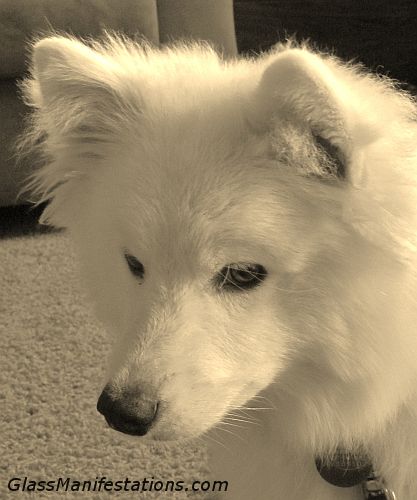
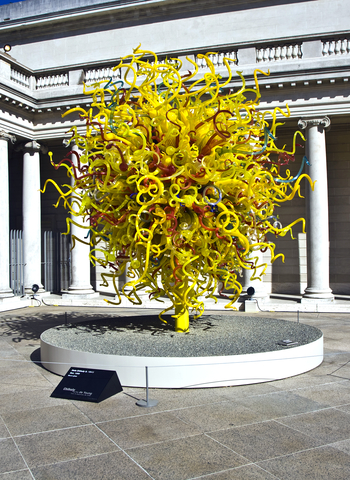
I follow the Facebook page for Dale Chihuly, world-renowned glass sculptor. Yes, he’s the magnificent artist after whom I named my dog. It’s an honor really; maybe not so much for Dale, but certainly for my dog.
h3

Dale Chihuly’s work.


Recently, on Dale Chihuly’s Facebook page there was a photo of a glass art installation in Oseyrarsandur, Iceland, from the year 2000. The artwork is titled “Green Ferns.” I haven’t had the chance to hop over to Oseyrarsandur to snap a photo for you, but here’s the link to the FB photo:

Okay, so the artist is sharing a photo of the artist’s work which the artist has titled “Green Ferns.” And below the FB post someone comments, “I’d say those are hostas, not ferns…. But thanks!”

So here’s the question: are they ferns, because that’s what the artist says they are? Are they hostas, because that’s what the commenter says they are? Are they both, depending on who’s looking? This is starting to sound like that twine theory stuff. String, I meant string!

Does it matter at all what anyone thinks they are? I believe it does. If you’re watching a ballet featuring dying swans, for example, and someone says, “I’d say those are ducks, not swans… But thanks!”, don’t ya kinda think they’ve missed the whole point???

I don’t suppose Dale Chihuly is losing any sleep over this. I know my dog Chihuly certainly isn’t. And maybe I’ve just turned this whole matter into a ragged, unraveled heap on the floor.

h2

Dog Chihuly’s work.


Maybe someday I’ll see that niggling little thread out of the corner of my eye and I’ll turn my head and there they will be… all my answers to:

  • who gets to say what is art?
  • who gets to say what art is? (yes, those are two separate questions);
  • what the heck is string theory, anyway? and
  • why are so many loose threads in life just barely out of reach of one’s scissors?

I apologize, Mr. Chihuly, for pulling the thread. I just couldn’t help myself.


H  H is for Hostas.


Daily prompt: Green
Clusters: All Together, Now

cluster example 5
In yesterday’s post, the definition of bevels included the mention of “geometric configurations (called ‘clusters’) for incorporation into leaded glass work.”

Ah, clusters…

The fun thing about clusters is that you have ready-made pieces that you simply fit together (with copper foil or some type of came, i.e. lead), and then fill in the rest of your pattern with pieces to accomplish the desired panel shape (rectangle, square, circle…).

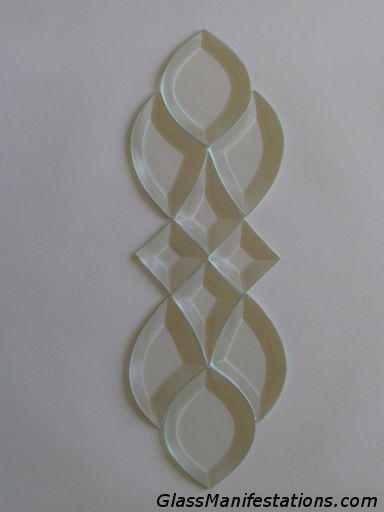
For example, I purchased a bevel cluster with ten bevels that – when pieced together – would look like this ornate design:

cluster example 1

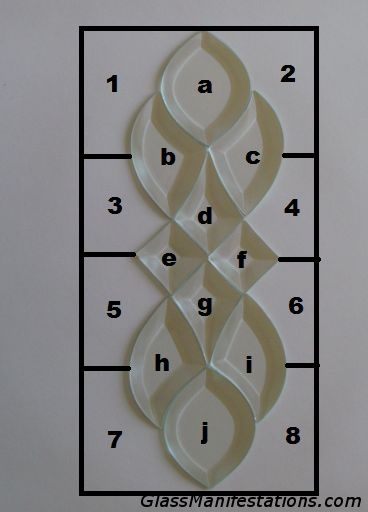
By cutting glass in the shapes of “1” through “8,” as pictured below, one could turn the design into a rectangular panel with the bevel cluster pieces (“a” through “j” in the diagram) centered within the rectangle. A simple example:

cluster example 2

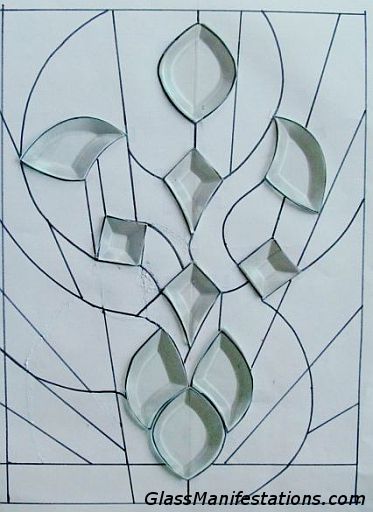
Something I like to do for fun is use the bevel pieces in a more unconventional way and incorporate them into panels to create entirely different patterns. In the example below I kind of “exploded” the bevel cluster and came up with this design:

cluster example 3

And here is the completed panel:

cluster example 4

I need to work on my window photography.

I titled the panel “Ascending.”

The bevels used in the “Manifest” design that appears on the header of this blog is another example of using a cluster in an unconventional way. Can you guess what the design was originally intended to be?


C  C is for Cluster.

The Bevel You Say!

Bevel
One way to easily dress up a stained glass panel is to incorporate bevels into the design. While frequently used as borders, individual bevels can also be employed as standalone elements in the overall design of a window or panel.

A bevel, as defined at Glass Patterns Quarterly, is:

“cold glass (usually clear, thick plate) with edges that have been ground and polished to an angle other than 90 degrees. Transmitted light is refracted and a prism-like effect results. Bevels are available in a variety of sizes, shapes and geometric configurations (called ‘clusters’) for incorporation into leaded glass work.”

There was a time when I was downsizing from my three-bedroom home (with garage studio), and moving into a one-bedroom apartment (no garage). I couldn’t see any way that I could find room for a stained glass work area. So I started selling/giving away/using up many of my supplies.

I had a box of triangle-shaped clear bevels that I had purchased with no particular project in mind. I probably got them in some kind of deal, like the “spend just $100 more and get free shipping on your order” offers. Who can pass those up, right?

I decided to make a window based simply around triangle bevels. This is what I came up with:

bevel2

I’m back in a three-bedroom home (two bedrooms and one studio, actually), and glass supplies seem to be slowly accumulating again. I now have a box of ¾ inch by 4 inch rectangular bevels that I bought for no particular purpose (going-out-of-business sale… Hello!). They will no doubt start trickling into future designs.

In the meantime, I can always hang them in my windows and, just like Pollyanna, use them as prisms to create rainbows.

“Just as if anybody’d care when they were living all the time in a rainbow!”
~ Pollyanna, by Eleanor H. Porter


B  B is for Bevel.

Dog Imitates Art

The theme for this week’s Daily Post photo challenge is “Life Imitates Art.”

When I created the “Canid” panel (pictured below), I had a fox in mind. Some folks commented that it looked like my American Eskimo dog, except for the coloring of course.

I’ve been thinking about tweaking the design to make a similar panel to represent my Eskie. Might have to add that to the queue of projects.

In the meantime, enjoy my entry for the “life imitates art” challenge:

art1

Chules, my America Eskimo dog

art2

“Canid” stained glass panel by Maggie C.